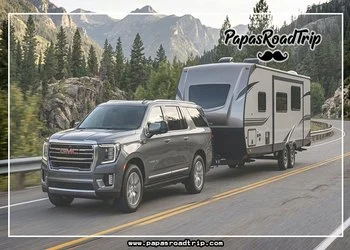
The gmc yukon xl towing capacity reaches up to 8,200 pounds on properly equipped two-wheel-drive models, and up to 7,900 pounds with four-wheel drive. The exact figure depends on your model year, trim, axle ratio and how many people and how much cargo you carry. That’s a big spread, and the sticker on your door jamb is the only number that counts for your truck. This guide breaks down the figures by year, engine and drivetrain, and shows you how to read your own rating.
What the Yukon XL rating really measures
The Yukon XL is the long-wheelbase version of GMC’s full-size SUV. It shares its body and frame with the Chevrolet Suburban. Its longer wheelbase and heavier curb weight are why it tows more than the standard Yukon and carries more cargo at the same time.
Towing capacity isn’t one fixed number. It’s the maximum weight of a loaded trailer that the vehicle can pull, brake and control safely. GMC sets it per configuration, then prints it on the certification label inside the driver’s door jamb.
That label also gives you the gross vehicle weight rating (GVWR) and the gross combined weight rating (GCWR). The GCWR is the total of the truck, everything in it, and the trailer. Your real towing limit is whatever keeps you under that combined figure.
The misconception is simple. People see “8,200 lbs” in an ad or a brochure and treat it as the truck’s permanent ability. It isn’t. That number assumes the max trailering package, one driver, no cargo and the right axle ratio. Add three adults, a full tank and a bed of gear, and your usable trailer weight drops.
The Yukon XL suits families who tow a boat, a camper or a utility trailer a few times a year. It’s not a substitute for a heavy-duty pickup when you pull a large travel trailer every weekend.
How to find your Yukon XL towing capacity
You don’t need a dealer to get your rating. You need your door jamb label and a trip to a public scale. Work through these decisions in order, because each one changes the next.
- Read the certification label. Open the driver’s door and find the sticker with the tire and loading information. Write down the GVWR and the GCWR. These are your hard ceilings, and they never change.
- Confirm your drivetrain and axle ratio. Two-wheel drive tows more than four-wheel drive. The axle ratio (often printed on a build sheet or given by a dealer from your VIN) decides how much of the engine’s pull reaches the ground.
- Weigh the truck loaded. Fill the tank, add your passengers and gear, then drive onto a public scale. Most truck stops and some recycling centers have one. Subtract that weight from the GCWR. What’s left is your real trailer allowance.
- Add the trailer’s loaded weight, not its dry weight. A camper’s dry weight leaves out water, propane, batteries and your belongings. Use the trailer’s gross vehicle weight rating as a safe planning figure.
- Check the tongue weight. Aim for roughly 10 to 15 percent of the loaded trailer weight on the hitch. Too little causes sway; too much eats your payload.
- Match the hitch and ball. Confirm the hitch’s own rating meets or beats your trailer weight, and that the ball size matches the coupler.
- Add a weight-distribution hitch for heavy trailers. Most SUV makers, GMC included, require one above a certain trailer weight. Check your owner’s manual for the exact threshold on your model year.
The judgement call that matters most is step 3. People estimate their cargo and get it wrong by hundreds of pounds. A scale ticket costs little and settles it.
Weighing a loaded vehicle and setting up a weight-distribution hitch are jobs a careful owner can do. Repairs to the hitch receiver or the truck’s frame are not — those go to a qualified shop.
Yukon XL towing figures by setup
Use this table to see how the rating moves with the configuration. Figures below reflect recent-generation Yukon XL models; older years differ, so confirm yours on the door label or in the owner’s manual for that model year.
| Your setup | What to do | Figure that matters | What to watch for |
|---|---|---|---|
| 2WD, base engine, max trailering package | Use the full rating | Up to 8,200 lbs | Assumes one driver, no cargo, correct axle ratio |
| 4WD, same engine | Subtract for the extra driveline weight | Up to 7,900 lbs | The gap is real, not a rounding error |
| Larger available engine | Check the label for your year | Varies by year and axle | More power doesn’t always mean a higher rating |
| Yukon XL Denali | Confirm on the door label | Lower than base trims | Heavier standard equipment cuts the figure |
| Family of 5 plus luggage | Weigh the truck first | Your GCWR minus actual weight | Payload, not towing capacity, often runs out first |
| Trailer at 6,000 lbs loaded | Use a weight-distribution hitch | 600–900 lbs tongue weight | Confirm the hitch and receiver are rated for it |
| Trailer over your rating | Don’t tow it | Zero | No hitch or add-on raises a published rating |
Getting the Yukon XL setup right
Experienced towers start with the scale, not the brochure. They weigh the truck loaded before they buy or rent a trailer, so they know their real allowance. That one habit prevents most of the surprises.
Weigh with the people, fuel and cargo you actually travel with, and do it at a truck stop scale with the trailer hitched. The steer axle and drive axle read separately, and the drive axle figure is the one that tells you how much tongue weight you have left.
They also load the trailer deliberately. Heavy items go over the axles or slightly ahead of them, never at the very back. A trailer loaded tail-heavy will sway at highway speed, and no sway bar fully fixes a badly loaded trailer.
Partway through a trip, they check the hitch hardware and the trailer tires. A loose ball nut or a tire running low shows up early if you look. They also re-check tongue weight after adding water or gear to the trailer.
What they leave alone is the rating itself. No airbag kit, tuner or exhaust change raises a published towing capacity. The number is set by the manufacturer’s testing, and aftermarket parts don’t rewrite it.
Common Yukon XL towing problems

Most towing complaints trace back to setup, not to the truck. Here’s what you’ll notice and what to check first.
| What you notice | What it usually means | What to do first |
|---|---|---|
| Trailer sways at speed | Too little tongue weight, or cargo loaded too far back | Move weight forward and re-check tongue weight |
| Rear of the truck sags | Tongue weight too high, or no weight-distribution hitch | Weigh the tongue and fit the correct hitch |
| Brakes feel weak downhill | Trailer brakes not working or not adjusted | Test the trailer brake controller before the next trip |
| Truck feels sluggish uphill | Trailer near or over your real limit | Re-weigh the combination at a scale |
| Overheating on long climbs | Working the truck harder than its cooling allows | Slow down, and check the manual’s towing guidance |
Rules and ratings you should confirm
GMC publishes the towing figure for each Yukon XL configuration in the owner’s manual and on the door jamb label. Those are the numbers that apply to your truck, and no accessory changes them. The GMC owner’s manuals and guides page lets you download the manual for your exact model year.
Read the door jamb label before you trust any brochure or forum post. The label is specific to your truck as built, and it accounts for how that particular Yukon XL is equipped. Two trucks that look identical on a lot can carry different ratings.
Beyond the truck itself, three things decide what you may legally tow. First, your state’s driver licensing rules — some states require a special endorsement for heavier trailers, so check your state motor vehicle department. Second, the trailer’s own weight rating and brake requirements, which vary by state. Third, your insurance policy, which may exclude or limit coverage for towing beyond the vehicle’s rating.
If your trailer needs electric brakes, a breakaway system or a commercial-use setup, that work belongs with a licensed trailer shop. Wiring and brake installation done wrong is a safety risk, not a weekend project. Ask the shop to confirm the finished setup against your door jamb rating before you pull away.
Keeping your towing setup safe over time
Once your rig is set up, record the numbers. Write your loaded truck weight, your trailer’s loaded weight and your tongue weight on a card and keep it in the glovebox. Next time you load up, you compare against real figures instead of guessing.
Weigh the rig fully loaded, with fuel, water and passengers aboard, because a dry-weight ticket tells you nothing about a trip-ready Yukon XL. If the tongue weight has crept up since last season, redistribute cargo forward over the trailer axles before you touch the hitch.
Check the hitch hardware before each towing season. Look for loose bolts, rust at the receiver and worn ball surfaces. Re-torque to the hitch maker’s spec if anything has moved.
Tires deserve the same attention. Trailer tires age even when they sit, so inspect the sidewalls for cracks. Replace them when the signs appear rather than waiting for a blowout.
Your rating doesn’t expire, but your truck’s condition changes what it can safely do. Worn brakes, tired suspension or a failing cooling system all lower your real margin. Address those before a long trip, not during one.
The Yukon XL’s longer wheelbase and heavier curb weight buy stability a shorter SUV can’t match, but they also mean more truck to stop. If the brake pedal feels soft when loaded, that’s your margin talking.
When the Yukon XL isn’t the right tow vehicle

The Yukon XL is the wrong choice if your loaded trailer sits near the top of its rating every trip. Running at the limit leaves no margin for hills, heat or a full load of passengers. A heavy-duty pickup handles that work with far more headroom.
It’s also the wrong choice for a trailer that needs a fifth-wheel or gooseneck hitch. The Yukon XL’s body and roof don’t support that setup. You need a pickup for those hitches.
And if you tow commercially, or tow a trailer heavy enough to need a special license in your state, plan for the licensing and insurance first. A larger SUV won’t solve a legal requirement.
One more case: a short-wheelbase half-ton pickup will feel more sway than a Yukon XL, so don’t trade sideways. If your trailer is within a few hundred pounds of the rating and you tow mostly flat, local miles, the Yukon XL is fine. If most trips involve grades or mountain passes, step up to a three-quarter-ton pickup instead.
Weigh the loaded trailer at a public scale before you decide. Guessing from the brochure number is how people end up over their rating with a full tank and a truck bed of gear.
Related guides
- Gmc Acadia Tow Package: Ultimate Guide to Towing Power & Features
- Gmc Yukon Years to Avoid: Expert Guide to Smart Buying
- Gmc Yukon Xl Years to Avoid: Expert Tips for Smart Buyers
Frequently asked questions
What is the max towing capacity of a GMC Yukon XL?
Up to 8,200 pounds on recent two-wheel-drive models with the max trailering package, and up to 7,900 pounds with four-wheel drive. Those figures assume a base configuration with one driver and no cargo. Your door jamb label gives the rating for your exact truck.
Can a Yukon XL tow a 7,000 lb travel trailer?
Usually yes, if your rating is 7,900 pounds or higher and your loaded truck weight leaves enough room under the GCWR. Weigh the truck with passengers and gear first. A 7,000-pound trailer also needs trailer brakes and, in most cases, a weight-distribution hitch.
Why is my Yukon XL towing capacity lower than the brochure?
Because the brochure figure is for the lightest, best-equipped configuration. Your truck may be four-wheel drive, a higher trim, or fitted with a different axle ratio. Extra standard equipment adds weight, and weight lowers the rating. The door label is the only figure that applies to your vehicle.
How much tongue weight can a Yukon XL handle?
Plan for about 10 to 15 percent of your loaded trailer weight on the hitch, so a 6,000-pound trailer means roughly 600 to 900 pounds. That weight counts against your payload, not just your towing capacity. Check the hitch and receiver ratings too.
Is it safe to tow at the maximum rating?
It’s legal and within the manufacturer’s limit, but it leaves little margin. Hills, heat, altitude and a full load of passengers all eat into your reserve. Towing somewhat below the maximum gives you a safer, less stressful drive, especially on long trips.
Does a lift kit or bigger tires change my towing capacity?
No. Lifts, bigger tires and engine tuners don’t raise a published towing rating. They can lower real stability and change how the truck brakes and handles under load. The manufacturer’s figure stays the same, and your insurance may treat modifications differently.
How often should I check my towing setup?
Check the hitch, ball and trailer tires before every towing season and before any long trip. Re-weigh the loaded combination whenever your passengers, cargo or trailer change. There’s no fixed interval that fits every rig, so let each change trigger a fresh check.
Conclusion
Before your next big trip, load the trailer the way you plan to travel and swing by a public scale to check your actual axle weights. That’ll tell you whether you’re within your truck’s limits with room to spare, and it’s a lot cheaper than finding out on a mountain grade.