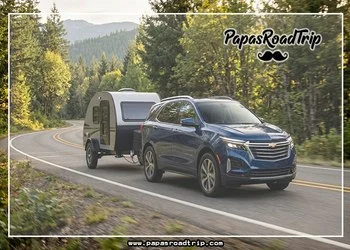
The Chevrolet Equinox is a compact SUV that has become a common sight in driveways across the country, valued for its comfortable ride and family-friendly features. But when it comes time to haul a small trailer, a boat, or a pair of jet skis, owners quickly discover that the chevrolet equinox towing capacity isn’t a single, universal number. The maximum capacity for most recent models falls in the range of 1,500 to 3,500 pounds, a figure that depends heavily on the model year, the engine under the hood, and whether the vehicle came from the factory with the necessary trailering equipment. Understanding these variations is the first step toward towing safely and legally, and it’s a crucial detail that can be the difference between a capable setup and an overloaded one.
Key Takeaways
- Towing capacity varies by engine: The 1.5L turbo engine is rated for 1,500 lbs, while the 2.0L turbo engine can tow up to 3,500 lbs.
- Trailering package is essential: The higher 3,500-lb rating requires the factory-installed 2.0L engine and the Advanced Trailering Package, which includes a hitch and wiring.
- Payload is the real limit: Even if your trailer is within the towing capacity, the weight of passengers and cargo in the SUV (payload) must not exceed the vehicle’s specific payload rating.
- Check the driver’s door jamb: The most accurate towing and payload figures for your specific vehicle are on the Certification/Tire label, not just in a brochure.
- Front-wheel drive is standard: All-wheel drive is an option, but it doesn’t change the maximum towing capacity for the Equinox.
Towing Capacity by Model Year
The Chevrolet Equinox has been through several generations, and the towing capacity has changed significantly over time. The most dramatic shift occurred with the introduction of the third-generation model in 2018, which offered a new engine lineup. The table below breaks down the maximum towing capacity for the most common recent model years, assuming the vehicle is properly equipped with the optional towing package and the more powerful engine.
| Model Year | Standard Engine | Max Towing Capacity | Engine Required for Max |
|---|---|---|---|
| 2010-2017 | 2.4L 4-cylinder | 1,500 lbs | 3.6L V6 (3,500 lbs) |
| 2018-2021 | 1.5L Turbo | 1,500 lbs | 2.0L Turbo (3,500 lbs) |
| 2022-2024 | 1.5L Turbo | 1,500 lbs | 2.0L Turbo (3,500 lbs) |
| 2025 | 1.5L Turbo | 1,500 lbs | N/A (1.5L only) |
For the 2025 model year, Chevrolet discontinued the 2.0L turbo engine option for the Equinox, making the 1.5L turbo the sole engine choice. This means the maximum towing capacity for the latest model is 1,500 pounds, a significant drop from previous years. This is a critical detail for anyone shopping for a new Equinox with towing in mind.
The Engines That Determine Towing
The engine is the single most important factor in determining your Equinox’s towing capacity. The base engine is designed for fuel efficiency, not for hauling heavy loads, and its towing rating reflects that.
The 1.5L Turbocharged Engine
This engine is the standard powerplant in most Equinox models from 2018 onwards. It’s a capable engine for daily driving, but its towing capacity is limited to 1,500 pounds. This is enough for a small utility trailer, a lightweight pop-up camper, or a small aluminum boat. It isn’t sufficient for larger travel trailers, car haulers, or heavy-duty work trailers.
The 2.0L Turbocharged Engine
Available as an option on the LT and standard on the Premier trim from 2018 to 2024, the 2.0L turbo engine is a different beast. It provides significantly more horsepower and torque, which is what allows the Equinox to achieve its maximum 3,500-pound towing rating.
If you’re looking at a used Equinox and towing is a priority, finding one with the 2.0L engine is essential. This engine is also paired with a more robust 9-speed automatic transmission, which is better suited to the stresses of towing than the 6-speed found with the 1.5L.
The 3.6L V6 (Previous Generation)
For the second-generation Equinox (2010-2017), the top towing engine was the 3.6L V6, which also carried a 3,500-pound rating. These older models can be a good value for someone needing a budget-friendly tow vehicle, but they’re older and may require more maintenance.
The Advanced Trailering Package
You can’t simply add a hitch to any Equinox and expect to hit the 3,500-pound maximum. The vehicle must be equipped with the Advanced Trailering Package. This package isn’t just a hitch; it includes a number of components that are crucial for safe towing.
- Trailer Hitch: A factory-installed receiver hitch with the correct weight rating.
- 7-Pin Wiring Harness: A full wiring harness for trailer lights and, on some models, a brake controller.
- Trailering Assist: A feature that helps with steering at low speeds while towing.
- Heavy-Duty Cooling: An upgraded cooling system to manage the extra heat generated by towing.
If you’re buying a used Equinox, check the original window sticker or the RPO codes (Regular Production Option codes) in the glovebox to confirm if the vehicle was built with the trailering package. A dealer can run the VIN to tell you the exact factory configuration.
Payload and Tongue Weight: The Real Limits

Towing capacity is only half the story. The other half is payload and tongue weight. These are often the limiting factors that people overlook.
- Payload: This is the maximum weight of everything you put in the vehicle, including passengers, cargo, and the tongue weight of the trailer. Every Equinox has a payload rating on its driver’s door jamb. It’s typically around 1,000 to 1,200 pounds. If you have four large adults in the car, you may have less than 500 pounds of payload left for the trailer tongue.
- Tongue Weight: This is the downward force the trailer exerts on the hitch. It should be between 10% and 15% of the total trailer weight. For a 3,500-pound trailer, that means a tongue weight of 350 to 525 pounds. This weight must be subtracted from your payload capacity.
Warning: Exceeding your payload or tongue weight rating can lead to dangerous sway, loss of control, and premature wear on your vehicle’s suspension and brakes. It’s a safety violation and can void your warranty.
How to Find Your Specific Rating
The generic numbers in this article are useful for shopping, but the only rating that matters for your specific vehicle is the one printed on the vehicle itself. The most reliable source is the Certification/Tire label on the driver’s side door jamb. This label lists the maximum payload capacity and the gross vehicle weight rating (GVWR), but it doesn’t always list the towing capacity directly.
To find the specific towing capacity, you should:
- Check the owner’s manual: The “Driving and Operating” section has a detailed breakdown of towing capacities based on engine and equipment.
- Use the VIN: A Chevrolet dealer can use your Vehicle Identification Number to look up the exact factory build and the corresponding towing capacity.
- Look for the trailering label: Some models have a separate sticker in the glovebox or on the hitch itself that lists the maximum trailer weight.
For a definitive answer based on the vehicle’s configuration, the National Highway Traffic Safety Administration (NHTSA) provides a VIN decoder that can be used to verify the vehicle’s specs, though it doesn’t list towing capacity directly. The owner’s manual remains the best source for the specific rating.
What You Can Tow with an Equinox
To make the numbers practical, here is what a 1,500-pound and a 3,500-pound rating look like in the real world.
With a 1,500-lb rating (1.5L engine):
- A small utility trailer (e.g., 4×8 ft) for light hauling.
- A single personal watercraft (jet ski) on a trailer.
- A small, lightweight pop-up camper (e.g., a basic 8-foot model).
- A small aluminum fishing boat.
With a 3,500-lb rating (2.0L engine with trailering package):
- A larger, mid-size pop-up camper or a small hybrid camper.
- A pair of jet skis on a tandem trailer.
- A larger fishing boat or a small runabout.
- A small car hauler for a motorcycle or a compact car.
- A utility trailer with a side-by-side (UTV) or a pair of ATVs.
Pro Tip: Always check the Gross Vehicle Weight Rating (GVWR) of the trailer itself, not just the dry weight. A trailer’s wet weight (with water, propane, and gear) is often significantly higher than the dry weight listed in the brochure.
Common Towing Mistakes to Avoid

Even if you’re within the weight limits, towing with a compact SUV like the Equinox has some inherent challenges. Avoiding these common mistakes will make your towing experience much safer.
- Overloading the rear axle: Loading the cargo area and the trailer tongue without considering the rear axle weight can cause the front end to lift, reducing steering and braking effectiveness.
- Ignoring the payload sticker: The payload capacity is the most restrictive limit. A family of four and a full tank of gas can consume a large portion of the payload before you even hitch up a trailer.
- Not using a weight-distributing hitch: For trailers near the 3,500-pound limit, a weight-distributing hitch (WDH) is highly recommended. It helps level the vehicle and distribute the tongue weight across all axles. However, not all Equinox models are compatible with a WDH, so check the owner’s manual.
- Skipping the break-in period: If you’re towing a new trailer, you should follow the trailer manufacturer’s break-in procedure and re-torque the lug nuts after the first 50 miles.
- Forgetting the trailer brakes: The Equinox isn’t rated to tow a trailer with a gross weight over 3,500 pounds, and many trailers over 1,500 pounds require their own brakes. The Equinox’s 7-pin wiring harness is designed to support a trailer brake controller, but you need to install one.
Related guides
- Chevrolet Equinox Years to Avoid: Expert Tips Before You Buy
- Hyundai Palisade Towing Package: Ultimate Guide for Heavy Hauls
- Ford Bronco Towing Package: Ultimate Guide for Heavy Hauling
Frequently Asked Questions
Can I tow a 3,500-lb trailer with a 1.5L Equinox?
No. The 1.5L turbocharged engine is only rated to tow 1,500 pounds. Attempting to tow a 3,500-pound trailer with this engine will exceed the vehicle’s limits, potentially causing damage to the transmission and cooling system and creating a serious safety risk. You must have the 2.0L engine and the Advanced Trailering Package to reach the 3,500-lb rating.
Does the Equinox need a trailering package to tow?
You can add an aftermarket hitch to a base Equinox, but the maximum towing capacity is only achieved with the factory-installed Advanced Trailering Package. This package includes the necessary cooling upgrades and a 7-pin wiring harness that aren’t present on base models. Without it, you’re limited to the 1,500-lb rating, and you may not have the proper wiring for trailer brakes.
What is the tongue weight limit for a Chevy Equinox?
The tongue weight limit is typically 10% to 15% of the towing capacity. For the 1,500-lb rating, that is 150 to 225 pounds. For the 3,500-lb rating, it is 350 to 525 pounds. However, the actual limit is also constrained by the vehicle’s payload capacity. You must ensure the tongue weight plus the weight of passengers and cargo doesn’t exceed the payload rating on the driver’s door jamb.
Can I flat-tow an Equinox behind an RV?
Yes, a front-wheel-drive Equinox can be flat-towed (dinghy-towed) behind an RV, but it must be an all-wheel-drive model or a front-wheel-drive model with the correct transmission. According to Chevrolet, the 2018-2024 Equinox with the 1.5L or 2.0L engine and the 6-speed or 9-speed automatic transmission can be flat-towed, but the procedure is specific: the vehicle must be in neutral, the parking brake released, and the battery disconnected. You must follow the owner’s manual procedure exactly.
Does the 2025 Equinox have a different towing capacity?
Yes. For the 2025 model year, Chevrolet discontinued the 2.0L turbo engine, making the 1.5L turbo the only engine available. As a result, the maximum towing capacity for the 2025 Equinox is 1,500 pounds. There’s no longer a 3,500-pound option. If you need to tow more than 1,500 pounds, you’ll need to look at a different vehicle or a previous model year.
Is the Equinox AWD better for towing?
All-wheel drive (AWD) can provide better traction when launching a boat on a slippery ramp or driving on a gravel road, but it doesn’t increase the vehicle’s towing capacity. The maximum towing rating is the same for FWD and AWD models. The AWD system adds weight to the vehicle, which slightly reduces the payload capacity, so you have to be even more careful about your load.
Making Your Towing Decision
The Chevrolet Equinox is a versatile and comfortable compact SUV, but its towing capabilities are modest. It’s a great choice for someone who needs to occasionally haul a small utility trailer, a pair of jet skis, or a lightweight pop-up camper.
For those tasks, the standard 1.5L engine with a 1,500-pound rating is perfectly adequate. However, if you need to tow a larger camper, a boat, or a car hauler, you must find a model equipped with the 2.0L turbo engine and the Advanced Trailering Package to access the 3,500-pound rating.
Always verify the specific ratings on the vehicle’s door jamb and in the owner’s manual before you hook up a trailer, and remember that payload and tongue weight are just as important as the headline towing number. Your next step should be to locate the Certification/Tire label on your own Equinox and compare its payload rating against the weight of your passengers, cargo, and the trailer tongue you plan to carry.