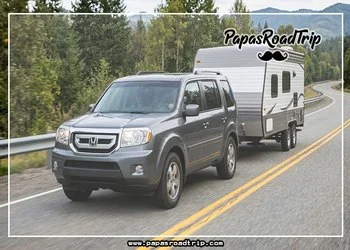
The 2012 Honda Pilot can tow up to 4,500 pounds, but only when the trailer has its own brakes. That figure applies to every 2012 Pilot trim — LX, EX, EX-L and Touring — when properly equipped. Without trailer brakes, the limit drops to 3,500 pounds on every trim. The vehicle’s rating doesn’t change with trim level, but what you actually carry inside the SUV does change how much trailer you can pull safely. Here’s what the rating assumes, what cuts it down, and how to match a real trailer to this SUV.
What the 4,500-pound rating really means
The 2012 Honda Pilot is a mid-size, eight-passenger SUV with a 3.5-liter V6 engine. Honda rates it to pull a braked trailer weighing up to 4,500 pounds. That’s the vehicle’s maximum, and it’s the same on every trim because the engine and frame don’t change between them.
Towing capacity is the weight of a fully loaded trailer — not the empty trailer. Water in the tanks, propane, gear and food all count. The number people carry inside the Pilot counts separately, and that’s where the real limit usually bites.
The misconception is that the 4,500 pounds is a free pass. It isn’t. Honda’s figure assumes a properly equipped vehicle: trailer brakes on anything heavy, a weight-distributing hitch for big loads, and the Pilot itself not overloaded. Honda publishes the full ratings and equipment notes in the 2012 Pilot owner’s manual, and that’s the page to check for your exact trim.
The Pilot’s gross vehicle weight rating covers everything riding on its own four tires: passengers, cargo, the hitch, and the tongue weight the trailer presses down with. Tongue weight is typically 10 to 15 percent of a loaded trailer, so a trailer near 4,500 pounds puts roughly 450 to 675 pounds on the hitch before anyone climbs in.
That’s the number to subtract first. Fill the third row with adults and load the back for a camping weekend, and the Pilot can run out of payload while the trailer is still well under its rating.
Weigh the loaded Pilot and the loaded trailer at a public scale before a long trip. If the Pilot is over its gross vehicle weight rating, leave gear behind or take the smaller trailer, whatever the trailer itself weighs.
How to match a trailer to your Pilot
- Read the trailer’s GVWR, not its dry weight. The GVWR plate is on the trailer frame. Dry weight leaves out water, propane and gear — often 500 to 1,000 pounds on a small camper.
- Check whether the trailer has brakes. Brakes on both axles are common on campers over 3,000 pounds. If it has none, your ceiling is 3,500 pounds.
- Find your Pilot’s payload on the door jamb sticker. It lists the maximum weight of people and cargo. Subtract passengers and gear — what’s left is your real towing headroom.
- Add the tongue weight. Aim for 10 to 15 percent of the loaded trailer weight on the hitch. A 4,000-pound trailer needs roughly 400 to 600 pounds of tongue weight.
- Pick the hitch and wiring. A Class III hitch and a 7-pin connector cover most braked trailers. Honda sells an official towing kit for the Pilot.
- Fit a weight-distributing hitch above about 3,500 pounds. It spreads load onto the front axle and stops the rear from sagging.
- Load the trailer nose-heavy and the Pilot light. Heavy items go over the trailer axles, not behind the tailgate.
The judgement call that decides everything is payload, not towing capacity. A family of five plus luggage can use up most of the Pilot’s payload before a trailer is even hitched. Weigh the loaded vehicle at a public scale if you’re close to the limit.
2012 Honda Pilot towing capacity at a glance
Use this table to find your situation, then confirm the exact figure on your door jamb sticker and in the owner’s manual.
| Your situation | What to use or do | The figure that matters | What to watch for |
|---|---|---|---|
| Trailer with brakes on both axles | Class III hitch, 7-pin wiring | 4,500 lb loaded trailer | Tongue weight at 10–15% |
| Trailer with no brakes | Keep it light, no highway speeds | 3,500 lb loaded trailer | Braking distance grows fast |
| Trailer around 3,500 lb or more | Add a weight-distributing hitch | 4,500 lb ceiling still applies | Rear sag and steering feel |
| Full car of passengers and gear | Weigh the loaded Pilot first | Payload from the door sticker | Payload runs out before tow rating |
| Boat trailer with surge brakes | Check the coupler works | 4,500 lb with working brakes | Surge brakes need a working actuator |
| Small utility trailer, 4×8 | Standard ball mount, 4-pin | Well under 3,500 lb unbraked | Secure the load, check lights |
| Long highway trip with a camper | Scale the rig loaded | GCWR from the owner’s manual | Combined weight, not just trailer |
Where good towing goes right
The people who tow happily with a Pilot do the boring things first. They load the trailer and the SUV, then drive to a public scale before their first real trip. That one stop tells them whether the rear axle is overloaded, and it costs less than a tank of fuel.
They also set the hitch height before hitching. The trailer should sit level, or slightly nose-down. A nose-up trailer wanders at highway speed, and no amount of steering correction fixes it.
Checks halfway through a trip
Stop after the first 30 to 50 miles and put a hand near each trailer hub. Warm is normal; too hot to touch means a bearing or brake problem. Check the hitch bolts, the safety chains and the lights at the same time.
Tire pressure matters more when towing. Run the Pilot’s rear tires at the pressure on the door sticker for a full load, not the lighter comfort setting. Under-inflated rear tires are where sway starts.
Experienced towers also leave the overdrive alone on long climbs and let the transmission pick its own gear. Fighting the gearbox heats the fluid. If the temperature gauge climbs, pull over and let it cool — that’s cheaper than a transmission.
Common towing problems and fixes

| What you notice | What it usually means | What to do first |
|---|---|---|
| Trailer sways at speed | Too little tongue weight or a tail-heavy load | Move gear forward over the trailer axles |
| Rear of the Pilot sags | Tongue weight too high or no weight distribution | Add a weight-distributing hitch, reload |
| Brakes feel weak | Trailer brakes not working or not adjusted | Test the breakaway and check the wiring |
| Transmission runs hot on hills | Working too hard in a tall gear | Slow down, let it downshift, stop to cool |
| Trailer lights flicker | Corroded 7-pin or 4-pin connector | Clean the pins, check the ground wire |
Sway that starts around 55 mph and builds is almost always loading, not the hitch. Pull over and shift weight forward before you blame the Pilot.
If the rear sags with the trailer empty, the tongue weight is too high for the spring rate. Reload first, then add the weight-distributing hitch.
Weak brakes on a loaded trailer usually mean the breakaway cable or the wiring, not the pads. Test both before a long descent.
On a grade, let the transmission downshift and hold the lower gear. Lugging in a tall gear is what raises the temperature.
Flickering lights after a rain point to the connector, not the bulbs. Clean the pins and check the ground wire at the frame.
One mistake ties these together: fixing the symptom at the hitch instead of the load. Correct the tongue weight and most of the list clears.
Rules and limits you should confirm
Honda’s own rating is the rule that matters most here, and it’s printed in your owner’s manual. Don’t trust a dealer’s verbal figure or a forum post — the manual for your exact model year is the source.
Beyond that, check four things for your own case. Your state’s trailer brake law: many states require brakes above a set weight, and your state DMV or motor vehicle office publishes it. Your driver’s license class: some states add an endorsement for heavier trailers. Your insurance policy: confirm the trailer is covered while hitched. And your hitch’s own rating, stamped on the hitch itself — it can be lower than the vehicle’s.
The hitch rating is where most people get caught. A Pilot rated to pull a given trailer can still be held back by a Class III hitch bolted on after purchase, so read the sticker before you assume the vehicle’s number applies.
If your state requires trailer brakes at a weight your trailer exceeds, budget for a brake controller install before your first trip, not after.
If your rig needs a commercial-scale weight certificate or a modified hitch, that’s a job for a qualified hitch shop, not a driveway fix.
Keeping the setup working
After each trip, wash the hitch ball and receiver and put a thin film of grease on the ball. Check the hitch bolts with a wrench every few trips — they loosen with vibration. Store the ball mount inside the vehicle, not on the hitch, so it doesn’t rust solid.
Look at the trailer tires for cracks and check the date code on the sidewall. Trailer tires age out before the tread wears down, and a blowout at highway speed is the worst kind of surprise.
Recheck your payload math whenever your setup changes: a new camper, an extra passenger, a rooftop box. The Pilot’s rating doesn’t move, but your margin does. Signs it’s time to re-weigh: the rear sits lower than before, or the steering feels light.
Grease the coupler latch too, not just the ball. A dry latch sticks, and a latch that sticks is one you start forcing — that’s how couplers wear loose.
Check the trailer’s lug nuts before every long trip, cold, with a torque wrench. Trailer wheels spin faster than the Pilot’s and work their nuts loose sooner.
If the trailer sits for months between trips, pull the wheels and repack the bearings before the first long haul. Short local tows are fine on old grease; a loaded highway run is not.
Keep a small kit in the Pilot: a spare coupler pin, a tube of grease, a torque wrench and a tire gauge. Most roadside fixes on this setup are five-minute jobs with the right part and an hour without it.
If you tow in salt or near the coast, rinse the receiver tube after every trip. Rust inside the tube seizes the ball mount, and then it’s a shop job.
When the Pilot isn’t the right tow vehicle
The Pilot is the wrong choice for a travel trailer much over 4,500 pounds loaded, and no hitch fixes that. Step up to a half-ton pickup or a full-size SUV with a higher rating.
It’s also a poor fit for long mountain trips with a heavy camper. The V6 works hard on sustained climbs, and a vehicle with more torque and a transmission cooler handles that better.
Watch the payload sticker on the driver’s door jamb, not just the tow rating. A loaded Pilot with a family of five and gear in the back can run out of payload before it runs out of tow capacity.
And it’s not the tool for a boat that needs launching from a steep, slippery ramp with a heavy tongue load. A four-wheel-drive truck with low range gives you far more control there.
If your trailer stays under 4,500 pounds and you tow on flat ground a few weekends a year, the Pilot is fine. If you’re planning a cross-country summer with a camper, buy the truck first.
Related guides
Frequently asked questions
Can a 2012 Honda Pilot tow 5,000 pounds?
No. Honda rates the 2012 Pilot at 4,500 pounds maximum, and only with a braked trailer. A 5,000-pound trailer is over the limit on every trim.
Does the 2012 Pilot need trailer brakes?
Yes, for anything over 3,500 pounds. Honda’s 4,500-pound rating assumes the trailer has its own brakes. Without them, the limit is 3,500 pounds. Your state may also require brakes above a set weight — check with your state motor vehicle office.
How much tongue weight can a 2012 Pilot handle?
Plan for 10 to 15 percent of your loaded trailer weight, so 400 to 675 pounds for a trailer between 4,000 and 4,500 pounds. That weight counts against the Pilot’s payload, which is printed on the driver’s door jamb sticker. Weigh your setup if you’re near the limit.
Is it safe to tow 4,500 pounds with a 2012 Pilot?
It’s safe only if the trailer has working brakes, the hitch is rated for the load, and the Pilot itself isn’t overloaded. Payload is the usual weak point — a full car of passengers can use up the margin before the trailer is hitched. Weigh the loaded rig before your first trip.
What happens if I tow more than the rating?
You overload the brakes, the transmission and the rear suspension, and your insurance may not cover damage from an overloaded rig. Handling gets worse and stopping distances grow. The fix is a lighter trailer or a bigger tow vehicle — not a different hitch.
How often should I check the hitch and trailer?
Before every trip, and again after the first 30 to 50 miles. Check the hitch bolts, safety chains, lights and tire pressure each time. Feel the trailer hubs for heat at that first stop. Replace trailer tires by their sidewall date code, not by tread depth.
Conclusion
Before you head out, load your Pilot the way you’ll actually travel and swing by a scale to confirm your real weights. That’s the only way to be sure you’re within limits. It’s a quick stop, and it’ll save you a lot of worry on the road.