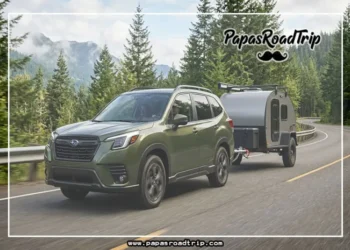
The 2025 Subaru Forester is rated to tow 1,500 pounds when properly equipped, and that figure is unchanged from the previous generation — a maximum of 1,500 lbs with a tongue weight limit of 150 lbs. If you were hoping the redesigned 2025 model brought a bump for camper or boat duty, it didn’t: the 2025 Forester towing capacity stays at 1,500 pounds across every trim, from Base to Touring. That’s enough for a small utility trailer, a pair of jet skis, or a lightweight aluminum fishing boat — but it’s well short of what a mid-size SUV can pull. Below is everything that number means in practice: what you can actually hitch up, what Subaru requires before you tow, how the trim levels compare, and where the Forester’s limits will show up on a real trip.
Key Takeaways
- Every 2025 Forester trim — Base, Premium, Sport, Limited, and Touring — is rated for the same 1,500 lb maximum with a 150 lb tongue weight limit.
- Subaru’s rating assumes the trailer has its own brakes above roughly 1,000 lbs; unbraked trailers should stay lighter.
- You need the Genuine Subaru Trailer Hitch (or an equivalent Class I/II hitch) plus a wiring harness — the Forester doesn’t come from the factory with a hitch receiver.
- The 2.5-liter flat-four and CVT are built for fuel economy, not torque; expect slow acceleration and lower mpg with a trailer attached.
- Payload, not just towing capacity, is often the real constraint — passengers and cargo count against the same gross vehicle weight rating.
- Towing with the Forester typically voids nothing, but exceeding the rating can affect warranty claims and, more importantly, braking and stability.
What the 2025 Subaru Forester’s Towing Capacity Actually Is
Subaru publishes a single towing figure for the 2025 Forester: 1,500 pounds, with a maximum tongue weight of 150 pounds (10 percent of the trailer weight, which is the standard rule of thumb). That rating applies whether you buy the base model or the top Touring trim, and it applies to both the standard 2.5-liter engine and any configuration Subaru sells in the US.
A few things sit underneath that headline number:
- Trailer brakes. The rating assumes a trailer equipped with its own brakes once you get above roughly 1,000 pounds. A 1,500-lb unbraked trailer is technically within the number but puts all the stopping work on the Forester’s brakes, which isn’t a recipe for confidence on a downhill grade.
- Passengers and cargo. Towing capacity and payload are separate limits that apply at the same time. A fully loaded Forester with four adults and a trunk full of gear has less margin for tongue weight.
- Altitude and grade. Naturally aspirated engines lose power at elevation. A 1,500-lb trailer that feels fine at sea level will feel noticeably weaker crossing a mountain pass.
Pro Tip: Weigh your loaded trailer at a public scale before your first trip. Trailer manufacturer “dry weight” figures exclude battery, propane, water, and gear — a 1,200-lb dry trailer can easily exceed 1,500 lbs loaded.
What 1,500 Pounds Lets You Tow
The honest answer is: small stuff. Here’s how common trailer types stack up against the Forester’s rating.
| Trailer type | Typical loaded weight | Within 2025 Forester rating? | Notes |
|---|---|---|---|
| 4×8 utility trailer (empty) | 400–600 lbs | Yes | Plenty of margin for light cargo |
| Single jet ski on trailer | 800–1,000 lbs | Yes | Comfortable tow |
| Two jet skis on tandem trailer | 1,400–1,800 lbs | Borderline to no | Weigh it — often over |
| 12–14 ft aluminum fishing boat | 1,000–1,500 lbs | Usually yes | Watch motor and gear weight |
| Small pop-up camper | 1,200–2,000 lbs | Sometimes | Most exceed 1,500 lbs loaded |
| 5×8 enclosed cargo trailer (loaded) | 1,500–2,500 lbs | Often no | Easy to overload |
| Small teardrop camper | 1,500–2,500 lbs | Usually no | Check dry weight carefully |
| ATV/UTV on trailer | 1,200–2,000 lbs | Borderline | Side-by-side usually too heavy |
The pattern is clear: the Forester is a light-duty tow vehicle. It handles utility runs, watercraft, and the smallest campers, and it struggles with anything that has walls, appliances, or a second axle.
Trims, Hitch, and Wiring: What You Need
Subaru doesn’t ship the 2025 Forester with a hitch receiver installed. You’ll add one, and you have two realistic paths.
Genuine Subaru accessory hitch
Subaru sells a Genuine Subaru Trailer Hitch as a dealer-installed accessory. It’s a Class I-style receiver, integrates cleanly with the rear bumper, and comes with a factory-style wiring harness option. The advantage is fit, warranty compatibility, and resale cleanliness. The disadvantage is cost — dealer-installed hitches typically run several hundred dollars more than aftermarket, and the install is billed as labor.
Aftermarket hitch
Brands like Curt, Draw-Tite, and U-Haul sell Class I and Class II receivers for the Forester. A Class I hitch (typically rated to 2,000 lbs) is more than enough for the Forester’s 1,500-lb limit, and aftermarket options are usually cheaper and can be self-installed with basic hand tools on most model years. Confirm the hitch is listed for the 2025 model year specifically — the redesigned body means older-generation hitches may not fit.
Wiring
You need a 4-pin flat wiring harness for lights on a standard utility or boat trailer. Subaru offers a plug-and-play harness; aftermarket versions that tap into the tail-light circuit are common and inexpensive. Don’t skip this — trailer lights are a legal requirement in every state and a safety requirement everywhere.
Warning: Don’t assume a hitch shop’s “fits Forester” listing covers the 2025 redesign. Verify the part number against the 2025 model year before you pay for installation.
How the Forester Tows in the Real World
The 2025 Forester uses a 2.5-liter naturally aspirated flat-four making 180 horsepower and 178 lb-ft of torque, paired with a continuously variable transmission. That’s adequate for daily driving and modest for towing. A few practical realities:
- Acceleration is leisurely. Merging onto a highway with 1,500 lbs behind you requires planning and a long on-ramp.
- The CVT prefers steady loads. Subaru’s CVT is durable in normal use, but sustained heavy towing raises transmission fluid temperatures. If you tow regularly, shorten your fluid change intervals.
- Fuel economy drops noticeably. Expect a meaningful mpg penalty with a trailer, especially at highway speed where aerodynamic drag dominates.
- Stability is fine within the rating. The Forester’s relatively low center of gravity and standard all-wheel drive help, but a 1,500-lb trailer is close to the vehicle’s comfort ceiling on windy days.
- Braking is the weak point. Without trailer brakes, stopping distances grow substantially. Leave extra following distance.
Subaru’s own owner’s manual lays out the towing limits, break-in guidance, and trailer-brake thresholds for the vehicle — it’s the authoritative source for your specific configuration, and worth reading before your first tow.
Payload: The Limit Nobody Checks
Towing capacity gets all the attention, but payload — the total weight of people, cargo, and tongue weight — is frequently the binding constraint. Every vehicle has a gross vehicle weight rating (GVWR), and the payload figure is GVWR minus curb weight.
Here’s why it matters for the Forester:
- Four adults at 175 lbs each is 700 lbs of payload before you’ve loaded a single bag.
- Add 150 lbs of tongue weight from a maxed-out trailer.
- Add luggage, a cooler, and a dog.
You can be comfortably under the 1,500-lb towing limit and still be over the vehicle’s payload and gross axle weight ratings. The fix is simple: check the tire placard on the driver’s door jamb for your specific vehicle’s payload rating, then do the math with real numbers.
Pro Tip: If your tongue weight plus passengers plus cargo exceeds the door-jamb payload figure, you need a lighter trailer or fewer passengers — not a different hitch.
Where the Forester Falls Short
If your towing needs run beyond occasional light duty, the Forester’s 1,500-lb ceiling will frustrate you. Specific scenarios where it’s the wrong tool:
- Travel trailers with bathrooms or slide-outs. These almost always exceed 1,500 lbs loaded.
- Two-person sit-on-top kayak trailers with gear. Closer to the limit than people expect.
- Landscaping or construction trailers. A loaded 5×8 utility trailer with soil or equipment blows past the rating quickly.
- Any tandem-axle trailer. The weight adds up fast.
- Long highway trips through mountains. Power and braking margin both shrink.
Buyers in those categories should look at mid-size SUVs rated for 3,500–5,000 lbs, or a properly equipped pickup. The Forester is a superb everyday vehicle; it isn’t a tow rig.
How It Compares to Other Small SUVs
The 1,500-lb rating is on the low end for the compact crossover class. Here’s the rough landscape:
| Vehicle | Typical max tow rating | Notes |
|---|---|---|
| 2025 Subaru Forester | 1,500 lbs | Unchanged across trims |
| Subaru Outback | 2,700–3,500 lbs | Higher with the turbo engine |
| Toyota RAV4 | 1,500–3,500 lbs | Varies by trim and drivetrain |
| Honda CR-V | ~1,500 lbs | Hybrid models often lower |
| Mazda CX-5 | ~2,000 lbs | Trim dependent |
| Ford Escape | 1,500–3,500 lbs | Depends on engine and tow package |
If towing is a priority and you like the Subaru brand, the Outback is the obvious step up. If you’re set on the Forester for its visibility, ride, and cargo space, accept the 1,500-lb ceiling and plan around it.
Setting Up Your Forester to Tow

A short checklist before your first trip:
- Confirm your hitch is rated for at least 1,500 lbs and installed to spec with the correct torque on the mounting bolts.
- Test the wiring with a trailer-light tester before you load up — every time, not just the first time.
- Check tire pressures on both the Forester and the trailer. Trailer tires are frequently neglected and are a common failure point.
- Load the trailer tongue-heavy, roughly 10 percent of trailer weight, and secure cargo so it can’t shift.
- Practice stopping in an empty lot before you hit traffic.
- Know your payload math from the door jamb, not from a brochure.
- Carry a basic kit: a spare trailer tire, lug wrench, and a flashlight.
Related guides
Frequently Asked Questions
Can the 2025 Subaru Forester tow a camper?
Only the smallest campers. Most pop-up campers and virtually all teardrop and hard-sided travel trailers exceed 1,500 lbs once loaded with water, propane, battery, and gear. Weigh the camper loaded before you commit — a “1,200-lb dry” camper is frequently over 1,500 lbs on the road.
Does the 2025 Forester need a special tow package?
Subaru doesn’t offer a distinct “tow package” for the Forester. You need a hitch receiver and a 4-pin wiring harness, both available as Genuine Subaru accessories or from aftermarket brands like Curt and Draw-Tite. There’s no transmission cooler or upgraded cooling package to add.
Is the towing capacity different on the Forester Hybrid?
Subaru has expanded hybrid availability in the Forester lineup, and hybrid models generally carry the same or lower tow rating than the gas version. Check the specific window sticker or owner’s manual for the exact trim you’re buying rather than assuming it matches the 1,500-lb gas figure.
Does towing void the Subaru warranty?
Towing within the published limits with a properly installed hitch doesn’t void your warranty. Towing beyond the rated capacity, or damage traceable to overloading, can give Subaru grounds to deny a related claim. Keep your hitch installation receipts and stay inside the numbers.
What’s the tongue weight limit on the 2025 Forester?
The maximum tongue weight is 150 pounds, which lines up with the standard 10-percent guidance for a 1,500-lb trailer. Exceeding tongue weight overloads the rear suspension and reduces steering authority on the front axle — it’s a real safety limit, not a formality.
Can I tow with the Forester’s spare tire installed?
Yes, but check that your hitch and trailer coupler clear the spare tire and rear bumper at full articulation. Some aftermarket hitches sit lower than the factory unit and can interfere with certain couplers. Test the connection before your first trip.
Conclusion
The 2025 Subaru Forester is a capable, comfortable compact SUV with a modest 1,500-lb towing ceiling that suits utility trailers, jet skis, and small aluminum boats — and rules out most campers. Before you buy a trailer, weigh it loaded, confirm your door-jamb payload figure, and have a Class I hitch and 4-pin harness installed by a shop that has done a 2025 specifically.