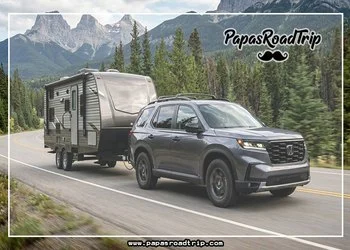
The 2026 honda pilot towing capacity is 5,000 pounds on every trim when the Pilot has the factory tow package and the right hitch setup. That figure drops to 3,500 pounds for the base LX without the added transmission cooler.
Those two figures are the whole answer, but the gap between them decides what you can pull. This guide covers the trims, the tongue weight, the gear that changes the rating, and the Honda Pilot towing setup that keeps you legal in 2026.
What the 5,000-pound rating really means
The 5,000-pound figure is the gross trailer weight — the trailer plus everything loaded on it. It assumes a properly installed hitch, a weight-distributing setup for heavier loads, and the towing package Honda fits to most trims. It isn’t a promise that any 5,000-pound trailer will feel safe behind the Pilot.
Honda builds the Pilot as a three-row family SUV, not a work truck. The rating is there for boats, small campers, utility trailers and jet skis. People buy it expecting half-ton pickup numbers and come away disappointed. That’s the main misconception: a 5,000-pound limit is a ceiling, not a target.
The rating also depends on how much weight is already inside the SUV. Honda publishes a gross vehicle weight rating (GVWR) and a gross combined weight rating (GCWR) in the owner’s manual. Your real trailer limit is the lower of the two after you subtract passengers and cargo. With a full family and a loaded trunk, the trailer number shrinks.
Tongue weight is the second half of the picture. Honda’s manual sets it at roughly 10% of the trailer weight, so a 5,000-pound trailer needs about 500 pounds pressing down on the hitch. Too little and the trailer sways; too much and you overload the rear axle.
How to set up a 2026 Pilot for towing
- Check the trim and the tow package. Look at the window sticker or the manual for the “towing package” line.
- Confirm the hitch class. You need a Class III hitch rated for at least 5,000 pounds. Honda’s factory hitch meets this; a used Class II hitch does not.
- Add a weight-distributing hitch for loads over about 3,500 pounds. It spreads tongue weight across both axles and keeps the rear from squatting.
- Wire the trailer lights and brake controller. The Pilot needs a 7-pin connector and, for trailers over 1,000–1,500 pounds in most states, working trailer brakes. Check your state’s motor vehicle department for the exact threshold.
- Load the trailer front-heavy. Put about 60% of the cargo ahead of the trailer axle so tongue weight lands near 10% of the total.
- Weigh it at a public scale. A truck stop scale costs a few dollars and tells you the real trailer weight and tongue weight. Don’t guess.
- Check tire pressure cold. Inflate the rear tires to the pressure on the door-jamb sticker for a loaded vehicle.
The single judgement call is tongue weight. Get it near 10% and the Pilot tracks straight; get it wrong and you’ll feel the trailer push the SUV around at highway speed. If you’re not sure how to set up a brake controller or a weight-distributing hitch, a trailer shop or Honda dealer does it properly — this isn’t a job to learn on a busy road.
2026 Honda Pilot towing capacity at a glance
Here are the figures you’ll come back to. Every number assumes the factory tow package is fitted and the trailer is loaded within Honda’s gross weight limits.
| Your situation | What to use | Figure that matters | What to watch |
|---|---|---|---|
| EX-L, Touring, Elite, Trailsport | Standard towing | 5,000 lb limit | Confirm tow package on sticker |
| Tongue weight target | Any trailer near the limit | ~10% of trailer weight | Too little causes sway |
| Trailer over ~3,500 lb | Weight-distributing hitch | Spreads load to front axle | Set bars per hitch maker’s guide |
| Trailer over 1,000–1,500 lb | Trailer brakes + controller | State law threshold | Check your state DMV |
| Full family + cargo aboard | Subtract from GCWR | Lower real limit | Weigh at a truck scale |
| Long steep grades | Lower gear, slower speed | Watch transmission temp | Don’t ride the brakes downhill |
The 5,000 lb figure isn’t a license to load 5,000 lb of trailer and then fill the cabin. That rating already assumes a driver and a full tank, and nothing else.
Add three adults, a cooler and a weekend of gear and you have eaten into the payload the tongue weight sits on. The trailer didn’t get heavier; the Pilot’s margin did.
The fix is a morning at a truck scale. Weigh the loaded Pilot with everyone aboard, subtract that from the GCWR on the door jamb sticker, and the remainder is what your trailer can weigh. Most families find it lands well under 5,000 lb.
Two mistakes cost people real money here. Check for the package code, not the hitch.
The second is skipping the weight-distributing hitch because the trailer “only” weighs 4,000 lb. Above roughly 3,500 lb, the bars are what keep the front axle planted and the headlights pointed at the road instead of the trees.
If your trailer stays under 3,500 lb and your tongue weight sits near 10%, a standard ball mount is fine. If either number climbs past that, add the bars before your first highway trip.
Details that separate a safe tow from a scary one
Experienced towers prepare before they hitch up. They read the door-jamb sticker for the payload and GVWR, then do the math on passengers and gear before they ever look at a trailer. That way they know the real limit before money changes hands.
They also work in a set order: hitch, then wiring, then brakes, then load, then weigh. Skipping the weigh step is where things go wrong. A trailer that “feels fine” in the driveway can be 800 pounds over the limit once it’s loaded with water, fuel and gear.
Partway through a trip, they check the hitch bolts, the safety chains and the tire pressures. They leave the SUV’s drive mode in a tow setting if it has one, and they don’t use overdrive on long climbs. The Pilot’s transmission is built for family duty, not constant heavy pulling.
What they leave alone matters too. They don’t add a lift kit or oversized tires, because both change the rating and can void the warranty. They don’t tow in the highest gear on hills. And they don’t trust a dealer’s verbal “it’ll pull anything” — they check the manual.
Common towing problems and fixes

| What you notice | What it usually means | What to do first |
|---|---|---|
| Trailer sways at speed | Too little tongue weight | Move cargo forward, re-weigh |
| Rear of SUV squats low | Tongue weight too high or no distributing hitch | Add a weight-distributing hitch |
| Brakes feel weak downhill | Trailer brakes not working | Check controller and 7-pin wiring |
| Transmission runs hot on hills | Too much load for the gear | Downshift, slow down, check fluid |
| Warning light on the dash | Overload or sensor fault | Stop, check weights, see dealer |
Sway that starts only above 55 mph and settles when you slow down is usually tongue weight. Sway that starts at 40 mph points to a hitch setup that needs a distributing hitch.
On the Pilot, a squatting rear is often the Pilot itself, not the trailer. Load the Pilot’s cargo area first, then re-check the hitch ball height.
If the trailer brakes grab or pulse instead of feeling weak, the controller gain is set too high for an empty trailer. Turn it down before you blame the wiring.
A hot transmission on a long climb is a gearing problem before it’s a fluid problem. Lock out the top gears and hold a steady speed rather than letting it hunt.
What Honda and the law require
Honda’s owner’s manual is the authority on your specific vehicle, and it lists the GCWR, GVWR and axle ratings that set your real limit. The manual also states that exceeding these ratings can void warranty coverage on the drivetrain. That’s the rule that matters most, and it’s published with every Pilot.
Your state sets the trailer-brake threshold and the maximum trailer width and length. Most states require trailer brakes somewhere between 1,000 and 3,000 pounds, but the exact figure differs — check your state motor vehicle department’s website for the current rule. Some states also require a special license endorsement for heavier trailers.
Where the two sets of rules meet, the lower one wins. If your state says brakes are required at 1,500 pounds but your trailer weighs 1,200, you still need them once you cross that state line. Honda’s ratings don’t move when you drive into a state with looser rules.
Before you buy a trailer, confirm four things: your Pilot’s tow package, the hitch class, the trailer’s loaded weight, and your state’s brake rule. If the trailer needs brakes you can’t wire yourself, or the load is near the limit, have a trailer shop or Honda dealer do the setup. Getting it wrong risks your safety and your warranty.
Keep the manual in the glovebox and the state rule saved on your phone. A roadside check asks for paperwork, not for your memory of it.
Keeping the setup working
Once you’re towing, check the hitch bolts and safety chains before every trip. Look at the trailer tires for cracks and correct pressure, and test the lights with a helper before you pull away. These checks take five minutes and catch most failures early.
After a long tow, let the transmission cool before you park, and check the fluid level and color. Dark or burnt-smelling fluid means the transmission worked hard — have a dealer look at it. Honda’s maintenance schedule in the manual tells you when to change the fluid; follow that interval rather than guessing.
The Pilot’s tow rating assumes the transmission cooler the factory installs on tow-package trucks. If your Pilot wasn’t built with that package, adding a hitch doesn’t raise the number, and a long climb with a loaded trailer is where the missing cooler shows up first.
Store the hitch and bars clean and dry, and grease the ball before each use. If the setup sits for months, re-check the wiring for corrosion before your next trip. A corroded connector is the most common reason trailer lights fail.
Wash the underside after winter driving, when road salt sits on the hitch receiver and the chain loops. Salt left there pits the metal and seizes the pins by spring.
When the Pilot isn’t the right tow vehicle
The Pilot is the wrong choice if your trailer’s loaded weight tops 5,000 pounds. A travel trailer with water tanks, a car hauler or a loaded horse trailer will exceed it. Step up to a half-ton pickup or a full-size SUV with a higher rating.
Weigh the trailer loaded, not empty, before you decide. A 4,500-pound dry travel trailer gains several hundred pounds with water, propane and gear, and that’s the case where a Pilot buyer gets caught out.
It’s also wrong if you tow heavy loads every week. The Pilot’s transmission and cooling are built for occasional family towing, not daily commercial work. A truck with a tow-haul transmission and a heavier frame will last longer under that load.
A few weekends a season is fine. Five days a week with a loaded utility trailer is not, and the repair bill lands on you rather than the warranty.
And it’s the wrong pick if you need to tow with a full load of passengers and cargo at the same time. The payload runs out fast with seven people aboard. In that case, a larger SUV or a truck with more payload is the honest answer.
Check the yellow door-jamb sticker for your Pilot’s payload figure, then subtract every passenger and every bag.
Related guides
- Honda Pilot Emissions System Problem: Quick Fixes
- Honda Passport Vs Pilot: Which SUV Reigns Supreme?
- Honda Pilot Transmission System Problem: Quick Fixes
Frequently asked questions
Can a 2026 Honda Pilot tow 5,000 pounds?
Yes, the 2026 Pilot is rated to tow up to 5,000 pounds with the proper hitch setup. Check your window sticker or owner’s manual for the exact rating on your vehicle before you hitch up.
What’s the tongue weight limit on a 2026 Pilot?
About 500 pounds at the full 5,000-pound rating, which is roughly 10% of the trailer weight. Honda’s manual sets this figure. For lighter trailers, keep tongue weight near 10% of the loaded trailer weight. Too little causes sway; too much overloads the rear axle.
Do I need a weight-distributing hitch?
Yes for trailers over about 3,500 pounds. A weight-distributing hitch spreads tongue weight across both axles and keeps the rear from squatting. For light utility trailers under that weight, a standard ball mount is usually enough. Follow the hitch maker’s setup guide.
How much can a 2026 Pilot tow without the tow package?
That’s enough for a small utility trailer or a pair of jet skis. If you plan to tow more, confirm the tow package is fitted before you buy the trailer.
Is it safe to tow at the full 5,000-pound limit?
It’s legal and within Honda’s rating, but it leaves little margin. Keep the load balanced, use trailer brakes, and slow down on hills. Weigh the loaded trailer at a truck scale so you know the real number. Towing at the limit demands more attention than towing well under it.
What happens if I tow more than the rating?
You risk transmission and brake damage, poor handling and a voided drivetrain warranty. Honda’s manual states that exceeding the ratings can void coverage. You may also break state law if you exceed trailer weight or brake rules. Stay within the manual’s figures.
How often should I check the hitch and wiring?
Before every trip. Check the hitch bolts, safety chains, lights and tire pressures each time you hook up. After a long tow, check the transmission fluid. A five-minute pre-trip check catches most problems before they become roadside failures.
Conclusion
Before you head out, check your owner’s manual for the exact hitch and tongue-weight limits on your trim, and practice a short loaded drive on quiet roads. It’s worth the extra hour—you’ll feel more confident, and your transmission will thank you.