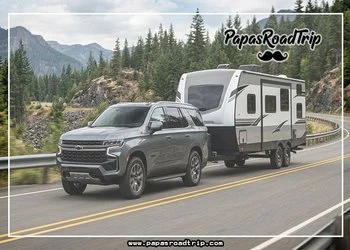
The chevy tahoe towing capacity tops out at 8,400 pounds on two-wheel-drive models with the 5.3L V8 and the Max Trailering Package. Most four-wheel-drive Tahoes with that same engine are rated at 7,800 pounds. Rear-wheel drive, engine choice and axle ratio all move the number, and the door-jamb sticker on your own truck is the final word.
What the rating really means
The towing rating is the most weight a Tahoe is built to pull, and it comes from the manufacturer after testing the truck’s frame, brakes, cooling and hitch together. Chevrolet publishes a separate figure for every build. A Tahoe with the 5.3L V8, two-wheel drive and the Max Trailering Package is rated at 8,400 pounds. Change any one of those and the number drops.
People use a Tahoe to pull boats, travel trailers, utility trailers and car haulers. It seats up to eight, so it works as a family truck that tows on weekends. The rating applies to the trailer’s total loaded weight, not the dry weight in the sales brochure.
The misconception is that the biggest engine always tows the most. It doesn’t here. Buyers who pay more for the 6.2L expecting a higher tow number end up surprised.
Payload is a separate limit. Towing capacity is what the trailer weighs; payload is what goes inside the truck — people, cargo, tongue weight. Both caps apply at once, and payload usually runs out first on a loaded family trip.
How to read your own Tahoe’s tow rating
- Find the door-jamb sticker. Open the driver’s door and look for the yellow-and-white label. It lists GVWR (the most the truck can weigh loaded) and the axle ratios. That label beats any chart.
- Confirm the engine. The 5.3L V8 and the 6.2L V8 have different ratings. Check the VIN or the underhood label if you’re unsure which one you have.
- Check drive type. Two-wheel drive tows more than four-wheel drive on the same engine, because the 4WD hardware adds weight.
- Look for the Max Trailering Package. This package — with its taller axle ratio and extra cooling — is what unlocks the 8,400-pound figure on the 5.3L. Without it, expect less.
- Subtract payload from the sticker. Take the “occupants and cargo” figure, subtract your family and gear, and what’s left is your real tongue-weight budget.
- Weigh the trailer loaded. A trailer weighs more with water, fuel and gear than it did empty. A public scale gives you the real number for a small fee.
- Match the hitch and ball. The hitch class and ball size must handle the loaded trailer weight. A weight-distributing hitch is needed above certain trailer weights — your hitch maker states the threshold.
The judgement call is tongue weight. Aim for roughly 10–15% of the loaded trailer weight on the hitch, a range the trailer and hitch makers publish. Too little and the trailer sways; too much and you eat your payload. If the numbers don’t fit, the trailer is too big — not the truck too small.
Chevy Tahoe towing capacity by build
These are the figures Chevrolet publishes for current-generation Tahoes. Your own sticker overrides them.
| Your Tahoe | What to use | Towing figure | What to watch |
|---|---|---|---|
| 5.3L V8, 2WD, Max Trailering Package | Best-case build | 8,400 lb | Needs the package; check the sticker confirms it |
| 5.3L V8, 4WD | Most common family build | 7,800 lb | 4WD weight cuts the rating |
| Any Tahoe, tongue weight | Hitch load | 10–15% of trailer weight | Counts against payload, not just towing |
| Any Tahoe, payload | People plus cargo plus tongue | Read the door sticker | Usually the first limit you hit |
| Trailer with water tanks | Loaded weight | Weigh it at a scale | Full tanks add weight fast |
The Max Trailering Package is the only way to reach 8,400 lb, and it isn’t on every 2WD Tahoe. Look for it on the sticker by name. A dealer saying “it’s rated for 8,400” means nothing if the package is missing.
Weigh your trailer loaded, with water and gear aboard, before your first long trip. A trailer that scaled fine empty can sit well past its rating once tanks are full.
Then do the payload math with people and tongue weight included. If payload runs out first, the towing figure never comes into play.
What experienced towers get right
The first thing they do is weigh before they buy. A trailer’s dry weight means nothing once you add water, propane, batteries and gear. A trip to a public scale with the trailer loaded tells you what you’re actually pulling, and that number decides whether the Tahoe is the right truck at all.
They also load the trailer with weight forward of the axle, not behind it. Too much weight at the rear lightens the tongue and invites sway. Keeping heavier items over or slightly ahead of the trailer axle keeps the tongue load in that 10–15% band and the trailer tracking straight.
Setup order matters
Experienced towers set the hitch height before they load anything. The trailer should sit level when hitched, so the ball height matches the coupler. Then they load, then they recheck. Doing it the other way — loading first, adjusting later — means redoing the work.
They check tire pressure on both truck and trailer before every long trip. Underinflated trailer tires run hot and fail. They also test the trailer brakes in an empty lot at low speed before trusting them on a highway.
What they leave alone is the truck itself. They don’t add lift kits or oversized tires to a tow vehicle without checking what it does to the rating — both change the stability the manufacturer tested for. If a build needs that, a dealer or a shop that specializes in tow setups is the right call.
Common towing problems and fixes

| What you notice | What it usually means | What to do first |
|---|---|---|
| Trailer sways at highway speed | Too little tongue weight, or weight loaded too far back | Move cargo forward of the trailer axle and re-weigh |
| Truck sags at the rear | Tongue weight too high, or payload overloaded | Weigh the tongue and check the door sticker |
| Brakes feel weak downhill | Trailer brakes not working or not set | Test the brake controller in an empty lot |
| Overheating on long climbs | Load near the limit in hot weather | Slow down, and check the cooling system |
| Poor steering feel | Hitch height wrong, trailer not level | Reset the ball height to level the trailer |
Sway that starts only above 60 mph and settles when you ease off is usually loading, not the truck. Sway that starts at 45 mph means stop and re-weigh before the next trip.
If the Tahoe sags with an empty trailer, the tongue weight is the problem. If it sags only when the trailer is loaded, you’re over payload, and airbags won’t fix that.
A brake controller set too high locks the trailer tires on gravel. Set it low, then raise it until the trailer pulls up without skidding.
Overheating on a climb in July is often just speed. Drop 10 mph and watch the gauge before you spend money on the cooling system.
Rules and limits worth checking
Chevrolet’s own trailering guide is the source for every rating by build, and it’s the document to check before you trust any chart, including this one. The door-jamb label on your truck carries the GVWR and payload figures that legally apply to your vehicle.
Those two numbers can disagree with a brochure. The guide rates a truck as it left the factory; the label describes the one in your driveway. If a previous owner added a lift, bigger tires or a heavy bumper, the label still governs, and payload is what’s left after passengers and cargo.
Your state’s driver licensing rules matter too. Some states require a special endorsement or a non-commercial Class A license once the trailer passes a certain weight — the threshold differs by state, so check your state DMV’s own page rather than a forum.
Your insurance policy may also have conditions on towing.
If a trailer is heavier than your Tahoe’s rating, no hitch or add-on part legally fixes that. Moving up to a larger truck is the answer, and a dealer who sells tow vehicles can walk you through the options.
Keeping your setup safe over time
Recheck the door sticker and your loaded weights at the start of every towing season, not just once. Gear accumulates, families grow, and a trailer that fit last year may not fit this year.
Weigh the Tahoe loaded, with the whole family and the cargo you actually carry, not an estimate. A CAT scale at a truck stop gives you steer, drive and trailer axle readings for a few dollars, and the ticket settles the argument about whether you’re still under your numbers.
Inspect the hitch, ball and safety chains before each trip. Look for cracks, rust or loose bolts, and confirm the coupler latches fully. Trailer tires age out even when the tread looks fine — check the date code on the sidewall and replace them when they’re old, following the tire maker’s guidance.
Keep a simple log: loaded trailer weight, tongue weight, and the date you last checked tire pressure and brakes. When something feels different on the road, the log tells you what changed. Wash the hitch and ball area after winter road salt, since corrosion weakens the connection over time.
If the truck sits for months between trips, check the hitch hardware and trailer brake wiring before the first pull of the season, not after.
When a Tahoe isn’t the right truck

A Tahoe is the wrong choice when your loaded trailer sits close to or above 8,400 pounds. At that point you’re at the ceiling with no margin for hills, heat or a full water tank. A three-quarter-ton pickup or a larger SUV is the honest answer.
It’s also wrong when payload is the real problem. A big family plus a heavy tongue weight can exceed the payload sticker long before the trailer hits the towing limit. A truck with a higher payload rating solves what a Tahoe can’t.
Check both numbers before you shop, and check them loaded. A trailer that weighs 7,000 pounds on the scale can put 900 pounds of tongue weight on the hitch once you add water and gear. Add the family and the dog and you may be over on payload while the trailer still looks fine.
And it’s wrong for full-time towing. A Tahoe is a family SUV that tows well on weekends. If you’re pulling a trailer every week, a vehicle built for that duty will last longer and feel safer.
The tell is how often you tow. A few trips a season and a Tahoe does the job well. Weekly hauls, or a trailer that grows every year, and you’re better off buying the heavier truck first instead of trading up in two years.
Related guides
- Chevy Tahoe Years to Avoid: Expert Tips for Smart Buyers
- Chevy Tahoe Transmission Problems: Avoid Costly Repairs!
- Do Airbags Increase Payload Capacity
Frequently asked questions
What is the max towing capacity of a Chevy Tahoe?
8,400 pounds, on a two-wheel-drive Tahoe with the 5.3L V8 and the Max Trailering Package. Check your own door-jamb sticker, because the build decides the number.
Can a Tahoe tow a 7,000-pound travel trailer?
Yes, on most builds — but only if the loaded trailer stays under your rating and your payload covers the tongue weight. A 7,000-pound trailer puts roughly 700–1,050 pounds on the hitch at 10–15% tongue weight. Add your family and gear, and check the payload sticker before you commit.
Why is the 6.2L rated lower than the 5.3L for towing?
More horsepower doesn’t automatically mean a higher tow number — the manufacturer’s trailering guide lists the figure for each build.
How much tongue weight can a Tahoe handle?
It depends on your payload, not a single fixed number. Tongue weight counts against the payload figure on your door sticker. Aim for 10–15% of the loaded trailer weight on the hitch, then subtract that and your passengers from the payload to see what’s left.
Is it safe to tow at the maximum rating?
It’s legal and within the manufacturer’s tested limit, but it leaves no margin. Long climbs, hot weather and headwinds all stress a truck at its ceiling. Most experienced towers stay a few hundred pounds under the max so the truck has room to work.
What happens if I tow more than the rating?
You overload the frame, brakes and cooling system beyond what they were tested for, and your insurance may not cover damage or a crash in that state. It can also break state weight laws. If your trailer is heavier than the rating, you need a bigger tow vehicle.
Do I need a special license to tow with a Tahoe?
Usually no, for trailers within the Tahoe’s rating. Some states require an endorsement or non-commercial Class A license once a trailer passes a weight threshold that differs by state. Check your state DMV’s own page for the rule where you live.
Conclusion
Before you hook up a trailer, open the driver’s door and read the sticker yourself, since that’s what actually counts for your truck. If it’s lower than you hoped, check your axle ratio and whether you’ve got the trailering package—a quick call to a dealer can confirm what you’re working with.