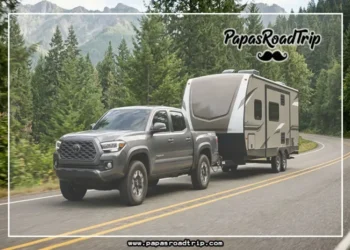
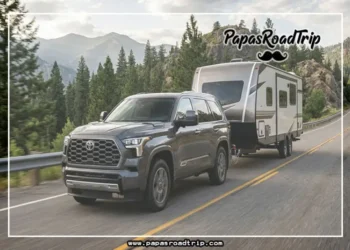
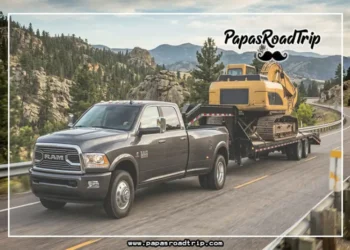
The number that actually limits a half ton truck’s towing capacity is printed on your own door jamb, and this guide shows you how to read it, match a trailer to it, and stay inside it on a real road.
What the towing number really means

A half ton truck is a light-duty pickup, the class that carries about half a ton in the bed and tows a trailer behind it. Ford, Chevrolet, Ram, Toyota and Nissan all build them. People buy them for work, for camping, for boats and for moving equipment, and most of them tow far less than the truck can handle.
The one misconception to drop is this: the big number in the brochure isn’t your truck’s limit. That figure comes from one specific build — often a regular cab, two-wheel drive, the strongest axle and the heaviest-duty cooling. Your truck has its own rating based on its own parts, and you’ll find it on the driver’s door jamb sticker.
Towing capacity is set by the manufacturer, and the rating depends on the whole vehicle: engine, transmission, axle ratio, cooling, brakes, tires and suspension. Change one part and the rating changes. That’s why two trucks that look the same can carry very different limits.
How to match your truck to a trailer
Work through these in order. Skipping a step is how people end up overloaded without knowing it.
- Read the door jamb sticker first. Find the GVWR (gross vehicle weight rating) and the GAWR for each axle. This is your truck’s own limit, set by the maker for that exact build.
- Check the owner’s manual for the towing chart. The manual lists capacity by cab, bed, engine and axle ratio. Match your build to the row, and don’t use a higher row that doesn’t fit your truck.
- Add up what goes in the truck. Driver, passengers, tools, fuel and anything in the bed all count. Subtract that from the GVWR to get your real payload left over.
- Estimate the tongue weight. A 6,000 lb trailer means about 600 to 900 lb on the ball.
- Subtract tongue weight from payload. If your leftover payload is 1,200 lb and the tongue weight is 800 lb, you have 400 lb for people and gear. That’s often the real ceiling, not the tow rating.
- Check the hitch and ball rating. A weight-carrying hitch and a weight-distributing hitch have different limits. Read the sticker on the hitch itself.
- Confirm the trailer’s gross weight. Use the trailer’s GVWR plate, not the empty weight, because you’ll load it.
The judgement call that separates a good setup from a bad one is honesty about payload. Most half ton trucks run out of payload before they run out of tow rating. Weigh your truck and trailer at a public scale loaded, and you’ll know the truth in five minutes.
Half ton towing figures at a glance
These are typical ranges, not promises. Your own sticker and manual override every row.
| Your situation | What to check | Figure that matters | What to watch for |
|---|---|---|---|
| Base V6, 2WD work truck | Manual towing chart | About 7,000–8,000 lb | Small payload; little room for passengers |
| Crew cab, V8, standard axle | Door jamb and manual | About 9,000–11,000 lb | Payload drops as cab size grows |
| Max tow package, correct axle | Window sticker and manual | Up to about 12,000–13,000 lb | Needs the exact build; often 2WD only |
| Boat or utility trailer under 5,000 lb | Hitch sticker | 10–15% tongue weight | Easy load, but check the ball size |
| Travel trailer 6,000–8,000 lb | Scale weights | Payload after tongue weight | Wind sway; use a weight-distributing hitch |
| Fifth-wheel trailer | Bed and hitch rating | Pin weight, often 15–25% | Payload limit hits fast on a half ton |
| Towing in mountains | Manual and cooling spec | Lower speed, lower gear | Heat; watch transmission temperature |
What careful towers do differently
Careful towers start with the scale, not the brochure. Before a big trip they load the truck and trailer the way they’ll actually travel, then weigh each axle at a public scale. That tells them the real tongue weight and the real payload use. It takes one stop and settles every argument about whether the setup is safe.
They also set the hitch height before they drive. A trailer that sits nose-high or nose-low tows badly, and the fix is a drop or rise ball mount, not a change in speed. Level the trailer frame, then tighten everything and check it again after the first few miles.
Partway through a long tow, they stop and touch the tires and hubs. A hub that’s hot to the touch means a bearing or brake problem, and it’s cheaper to find it at a rest stop than on a shoulder. They also re-check the hitch, the safety chains and the lights at that stop.
What they leave alone is the truck itself. They don’t add lift kits, oversized tires or heavy bumpers and expect the rating to hold. Those change the truck’s geometry and weight, and the manufacturer’s rating no longer describes the vehicle. If you change the truck, check with the maker or a qualified shop before you trust the old number.
Common towing problems and fixes

| What you notice | What it usually means | What to do first |
|---|---|---|
| Trailer sways at speed | Too little tongue weight or a light hitch setup | Slow down, reload weight forward, fit a weight-distributing hitch |
| Truck sags at the rear | Tongue weight over payload | Weigh the setup; move gear off the tongue |
| Brakes feel weak downhill | Trailer brakes not working or not set | Check the brake controller and trailer wiring |
| Engine runs hot on climbs | Cooling or load beyond the setup | Downshift, slow down, check coolant and transmission temperature |
| Poor steering feel | Hitch height wrong or tires under-inflated | Level the trailer, set tire pressure to the door sticker |
Sway that starts around 55 mph and builds is usually tongue weight, not the hitch brand. Load the trailer so roughly 10 to 15 percent of its weight sits on the tongue, then reweigh.
Sway that appears only when a semi passes is often a hitch setup problem instead. A weight-distributing hitch with sway control is the fix there, and it’s worth the cost on a half ton.
Sagging is the one to catch early. If the rear drops more than an inch or two, you’re likely over payload, and airbags only hide it. Weigh the truck and trailer loaded, at a CAT scale if one is near.
Weak trailer brakes on a long descent mean a controller gain set too low or a broken ground. Test them at 20 mph in a lot before every trip.
Rules and ratings you can trust
The ratings on your truck come from the manufacturer, and they’re the only numbers that legally describe your vehicle. The National Highway Traffic Safety Administration publishes vehicle safety and towing information that helps you understand tire load limits, which is where many overload problems hide.
Beyond that, state law sets the rules you must follow on the road. Many states require trailer brakes above a certain trailer weight, and some require a special license for heavy combinations. Those thresholds differ by state, so check your state’s department of motor vehicles or licensing agency before you tow a heavy trailer.
The two numbers that matter most are the gross vehicle weight rating and the gross combined weight rating. Load the truck and trailer, then weigh them at a public scale. If either figure comes in over the rating, you’re overloaded no matter how well the truck pulls.
If you’re towing commercially, different rules apply, including weight limits and logbook requirements. That’s a job for a licensed commercial operator or a transport compliance advisor, not a weekend DIY check. For private towing, a quick call to your state DMV office settles most questions.
Keep the scale ticket in the glovebox. If you’re stopped or involved in a crash, it’s the clearest proof of what you were actually hauling.
Keeping your setup safe over time
Once your setup works, write it down. Record the truck’s door jamb figures, the trailer’s GVWR, the tongue weight you measured and the hitch you used. Keep that note in the glovebox. Next season you won’t have to guess, and anyone else driving the truck can see the limits.
Check the hitch hardware before every trip. Look for loose bolts, rust and worn pins, and torque the ball to the hitch maker’s spec. Tires need a pressure check when cold, set to the door sticker, not the tire sidewall.
Trailer brakes and bearings need attention on a schedule from the trailer maker. If you don’t have that schedule, use the sign instead: squealing, a hot hub or a brake pedal that feels different means stop and get it checked. A shop that services trailers can inspect bearings and brakes properly.
Recheck the whole setup whenever the load changes. A different trailer, a heavier machine on the deck or a full water tank all move the numbers. Weigh the tongue again at a public scale rather than trusting the old figure.
After a long trip, walk the trailer with a hand on each hub. A hub warmer than the others points to a bearing or brake dragging. Catch it in the driveway, not on the shoulder.
When a half ton isn’t the right truck

A half ton is the wrong choice when the trailer’s gross weight sits near the top of your truck’s rating before you’ve added people and gear. In that case, move up to a three-quarter ton truck, which carries more payload and handles a heavier tongue weight with less strain.
Run the real numbers before you decide. Take the trailer’s gross weight, add the weight of every passenger and every tool in the bed, and compare that total to the payload sticker on the driver’s door jamb, not the brochure figure. If the total lands within a few hundred pounds of the sticker, you’re in three-quarter ton territory.
It’s also wrong for a heavy fifth-wheel trailer. Pin weight on a fifth-wheel is much higher than a bumper pull, and most half tons run out of payload fast. A three-quarter ton or larger is the honest answer there.
And it’s wrong if you plan to tow every day for work. A truck running at its limit constantly wears faster. A heavier truck costs more up front but lasts longer under daily load. If you’re unsure which class fits, a dealer’s towing guide for each model gives the build-by-build numbers.
Related guides
Frequently asked questions
Can a half ton truck tow 10,000 pounds?
Yes, many can, but only with the right build. A crew cab V8 with the correct axle ratio and tow package often reaches that figure. A base work truck may not. Check your door jamb sticker and the owner’s manual towing chart for your exact truck before you hook up a 10,000 lb trailer.
Why is my truck’s towing capacity lower than the brochure says?
Because the brochure figure comes from one specific build, usually the strongest one. Your truck’s rating depends on its cab, bed, engine, axle ratio and cooling. The sticker on your driver’s door jamb and your owner’s manual give the real number for the truck you own.
How much tongue weight can a half ton take?
It depends on your payload, not a fixed number. Subtract the weight of people and cargo from your truck’s GVWR, and what’s left is your payload. A conventional trailer puts about 10% to 15% of its weight on the hitch, so a 7,000 lb trailer adds roughly 700 to 1,050 lb of tongue weight.
Is it safe to tow at the maximum rating?
It’s legal and within the manufacturer’s limit, but it leaves almost no margin. You’ll be at the edge of payload, braking and cooling. Most experienced towers stay below the max, especially in mountains or heat. Weigh your loaded setup at a scale to see how much room you really have.
What happens if I tow more than my rating?
You overload the truck’s axles, brakes and tires, which raises the risk of sway, brake fade and tire failure. It can also void your warranty and leave you liable if there’s a crash. Insurance may refuse a claim if the vehicle was over its rated limit. Stay within the sticker figures.
Do I need trailer brakes on a half ton?
Often yes, depending on the trailer’s weight and your state’s rules. Many states require trailer brakes above a set weight, and that threshold varies. Check your state DMV rules and the trailer maker’s spec. A brake controller is a cheap addition compared with the cost of a crash.
How often should I check my hitch and trailer?
Before every trip, and again after the first few miles. Look for loose bolts, worn pins and rust, and check tire pressure when cold. Have trailer bearings and brakes inspected on the trailer maker’s schedule, or sooner if you hear squealing or feel a hot hub.
Conclusion
Before your next trip, load the truck and trailer the way you’d actually travel, then swing by a public scale and weigh each axle. It’s a cheap hour that’ll tell you more than any brochure. You’ll likely find a little margin to spare, and that’s exactly the feeling you want pulling out onto the highway.