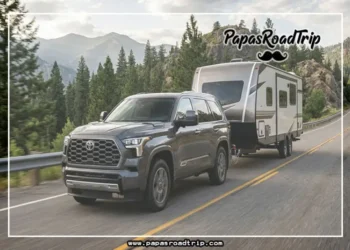
The toyota sequoia hybrid towing capacity is 9,000 pounds for the 2024 and 2025 model years, when the SUV is properly equipped with the tow package. That figure applies to both rear-wheel drive and four-wheel drive versions. Payload sits around 1,400 pounds, so the tongue weight of a heavy trailer eats into what you can carry inside. This guide covers the trims, the hitch setup, and the real-world limits that decide whether your trailer fits.
What the Sequoia Hybrid Tow Rating Really Means
The Sequoia hybrid is a full-size three-row SUV. Toyota pairs a twin-turbo V6 with an electric motor, and the combined setup makes 437 horsepower and 583 lb-ft of torque. That torque is why it pulls well from a stop. The hybrid system here isn’t built for fuel savings first — it’s there to add low-end pull.
People use it for family hauling, boat ramps, and travel trailers. It seats up to eight, depending on the trim. The i-FORCE MAX badge on the tailgate tells you it’s the hybrid version.
Here’s the misconception to clear up: a high tow rating doesn’t mean you can tow 9,000 pounds and load the SUV full of people and gear. The tow rating and the payload rating are two separate limits, and you have to stay under both at the same time.
The gross combined weight rating (GCWR) caps the whole picture — SUV, trailer, passengers, and cargo together. Toyota prints these figures on the driver’s door jamb label, so check yours rather than trusting a brochure.
The hybrid battery sits under the second-row floor. It doesn’t steal cargo space, but it does add weight, which is part of why payload is tighter than some rivals.
Run the arithmetic before you hitch up. Take the trailer’s loaded weight, add the tongue weight, then add every passenger and every pound of cargo in the Sequoia. If that total lands over the GCWR on your door jamb, the trailer is too heavy for this trip no matter what the tow rating says.
Tongue weight is the figure people skip. It counts against payload, not just against the trailer, so a heavy-hitched boat can push a loaded Sequoia over on payload while the trailer itself looks fine.
Two Sequoias with the same badge can carry different payloads, because trim and options change the curb weight. A Platinum with a sunroof and power third row weighs more than a base model, and that comes straight out of what you can load.
If your trailer is near the limit, weigh the setup at a public scale loaded as you actually travel. If the numbers come back tight, move gear into the trailer over the axle rather than behind the third row.
How to Match a Trailer to Your Sequoia Hybrid
Work through these decisions in order. Each one settles the next.
- Find your actual trim’s rating. Read the door jamb label and the Toyota towing guide for your model year. The 9,000 lb figure assumes the tow package is fitted; a base SR5 without it’s rated lower.
- Weigh your trailer loaded, not empty. A travel trailer’s dry weight is a sales number. Water, propane, and gear add hundreds of pounds. Use a public scale.
- Calculate tongue weight at 10–15% of the loaded trailer. On a 7,000 lb trailer that’s 700–1,050 lb. This comes straight off your payload.
- Add up everything inside the SUV. Passengers, pets, car seats, coolers, and the hitch itself. Subtract that from payload.
- Compare the two numbers. If tongue weight plus cargo is over payload, you need a lighter trailer — not a weight-distribution hitch alone.
- Check the hitch hardware. The Sequoia needs a weight-distributing hitch above roughly 5,000 lb trailer weight, and Toyota’s own guide gives the exact threshold for your year.
- Confirm your driver’s license covers it. Some states require a special endorsement for heavy trailers; check your state DMV.
The judgement call that matters most is step 5. A weight-distribution hitch moves weight around, but it doesn’t create payload. If you’re over on payload, the hitch won’t save you.
Sequoia Hybrid Towing Numbers by Setup
The figures below assume the factory tow package and a properly loaded vehicle. Your door jamb label is the final word.
| Your situation | What to do | Figure that matters | What to watch for |
|---|---|---|---|
| Standard 2024–25 Sequoia Hybrid, 2WD or 4WD | Tow with the factory hitch and 7-pin connector | 9,000 lb max trailer | Payload near 1,400 lb runs out fast |
| Trailer over ~5,000 lb | Fit a weight-distributing hitch | Per Toyota’s towing guide for your year | Sway control needs correct setup |
| Tongue weight check | Aim for 10–15% of loaded trailer | 700–1,050 lb on a 7,000 lb trailer | Too light causes sway; too heavy overloads |
| Family of 5 plus gear aboard | Weigh passengers and cargo first | Subtract from payload, not tow rating | Kids and coolers count as payload |
| Boat trailer with surge brakes | Confirm brake type works with the 7-pin | Electric-over-hydraulic needs a controller | Surge brakes don’t use the controller |
| Steep mountain grades | Slow down and use tow/haul mode | GCWR caps total weight | Heat builds on long descents |
| Base trim without tow package | Add the package or reduce the trailer | Lower than 9,000 lb | Check the label before buying |
Toyota publishes the full breakdown in its official towing guide, which lists ratings by trim and drivetrain.
Where Experienced Towers Get It Right
The difference between a calm tow and a white-knuckle one usually comes down to preparation before the trailer is even hitched. People who tow often weigh the loaded rig at a public scale before a long trip. That single stop settles the payload question and takes ten minutes. It also catches the surprise that a “half-ton” trailer gained 800 pounds once water and gear went in.
The order of work matters too. Set the hitch height first, with the trailer level and the SUV loaded as it will travel. Then torque the ball nut, connect the sway bars, and check the breakaway cable last. Doing it in that order means you’re not re-adjusting after the weight settles.
Partway through any long drive, pull over and check three things: the trailer tires for heat, the hitch bolts for movement, and the brake controller for a steady reading. Leave the trailer’s axle bearings alone unless they’re due — over-greasing blows seals.
What to skip
Don’t add a lift kit or oversized tires before a big tow. Both change the effective gearing and hitch height, and Toyota’s rating assumes the stock setup. If you’ve already lifted it, the rating may no longer apply — ask a Toyota dealer to confirm.
Common Sequoia Hybrid Towing Problems
Most complaints trace back to setup, not the SUV. Here’s what people notice and what to check first.
| What you notice | What it usually means | What to do first |
|---|---|---|
| Trailer sways at highway speed | Tongue weight too low or load sitting too far back | Move cargo forward and re-weigh |
| SUV squats at the rear | Tongue weight too high for the springs | Fit a weight-distributing hitch and check payload |
| Brakes feel weak on descents | Trailer brakes not engaging | Check the brake controller gain setting |
| Warning light on the dash while towing | A sensor or the blind-spot system reacting to the trailer | Check the owner’s manual for the tow-mode setting |
| Poor fuel economy, worse than expected | Normal for a loaded hybrid at speed | Slow to 60 mph and use tow/haul mode |
| Grinding or clunk from the hitch | Loose ball nut or worn coupler | Re-torque the ball and inspect the coupler |
The sway row is the one that catches people. A trailer loaded slightly tail-heavy will sway, and the fix is moving weight forward — not speeding up to “push through it.”
Rules and Ratings You Should Confirm
No single law sets your tow limit. The binding numbers come from Toyota and from your state. Toyota’s owner’s manual and towing guide give the ratings for your exact trim, and they override any dealer claim or forum post. Your state DMV sets licensing rules — some states require a non-commercial Class A or a trailer endorsement above a certain combined weight, and the threshold differs by state.
Read the door jamb sticker as well as the manual. It lists the gross vehicle weight rating for your Sequoia, and that ceiling includes passengers and cargo, not just tongue weight. A trailer that’s within the tow rating can still put you over if the SUV is loaded.
Your insurance policy matters too. Most policies cover a trailer hitched to your SUV, but the coverage limits and whether the trailer needs its own policy vary by insurer. Ask yours before a long trip.
If your rig crosses into commercial weight territory, or you plan to tow for hire, that’s a different rulebook. Talk to your state’s motor carrier office rather than guessing.
Keeping the Setup Working
Once you’re dialed in, keep a simple record. Note the loaded trailer weight, the tongue weight, and your hitch settings in your phone. Next season you’ll start from a known point instead of re-measuring everything.
Weigh the rig again whenever the load changes. A full fresh-water tank, a second cooler, or a new set of trailer tires can move tongue weight enough to matter. If the number drifts more than a few dozen pounds from your record, reset the hitch before the next trip.
Check the hitch hardware before each trip — the ball nut, the safety chains, and the breakaway cable. Inspect the trailer tires for cracking and check pressure cold. Toyota’s maintenance schedule in the owner’s manual lists the hybrid service intervals; follow it, since the hybrid system and the transmission cooler both work harder under load.
Bring the setup back to spec after winter storage by re-torquing the hitch bolts and re-checking tire pressure. If the SUV sat for months, drive it unloaded for a short trip before hitching up.
Replace trailer tires on age, not tread. A trailer tire that looks fine can still be years old and heat-cracked from sitting. Read the date code on the sidewall; if you can’t decode it, have a tire shop check.
When the Sequoia Hybrid Isn’t the Right Tow Rig

Three cases where you should look elsewhere. First, if your loaded trailer tops 9,000 pounds, you need a heavy-duty truck — a three-quarter-ton pickup is built for that class. Second, if your payload need is high — a big family plus a heavy tongue weight — a truck with a higher payload rating gives you more headroom.
Payload is where most families get caught. Add the tongue weight, the weight of every passenger, and the gear in the cargo area. If that total lands within a few hundred pounds of the rating on the door jamb, you’re already at the limit before you load a cooler.
Third, if you tow every week for work, a diesel pickup usually costs less to run over many miles and handles the duty cycle better. The Sequoia hybrid shines as a family SUV that tows on weekends. Treat it as a work truck and you’ll feel the payload squeeze.
A weekend boat or a travel trailer a few times a season is the Sequoia hybrid’s lane. If you’re weighing a move up, count your heaviest realistic trip, not your average one.
Related guides
Frequently asked questions
Can a Toyota Sequoia Hybrid tow 9,000 pounds?
Yes, when it’s properly equipped with the factory tow package and you stay within payload and GCWR limits. That 9,000 lb figure covers the 2024 and 2025 models in both 2WD and 4WD. A base trim without the tow package is rated lower, so check the door jamb label on your own vehicle before you plan a trip.
How much can a Sequoia Hybrid actually tow with a full family aboard?
Less than 9,000 pounds, because people and cargo count against payload, not the tow rating. With five passengers and gear, you may have only a few hundred pounds of payload left for tongue weight. Weigh your loaded SUV at a public scale to see your real number before choosing a trailer.
What’s the tongue weight limit on a Sequoia Hybrid?
Toyota lists a maximum tongue weight in its towing guide for your model year, and it’s tied to using a weight-distributing hitch above a certain trailer weight. Aim for 10–15% of your loaded trailer weight, then confirm it fits under your payload. Your door jamb label and the Toyota guide give the exact cap.
Is it safe to tow at the maximum rating?
It’s safe only if every limit lines up — payload, GCWR, tongue weight, and hitch hardware — and the trailer has working brakes. Towing at the max leaves no margin for error, so many drivers prefer to stay 10–15% under the rating. Check your state’s licensing rules too, since heavy trailers may need an endorsement.
How long does it take to set up a Sequoia Hybrid for towing?
About 30–45 minutes for a first-time hitch setup: leveling the trailer, setting hitch height, torquing the ball, and connecting the 7-pin and sway bars. After that, a routine hookup takes 10–15 minutes. Add a scale stop on your first trip, which takes another 10 minutes or so.
What happens if I tow over the rating?
You risk transmission and brake overheating, poor handling, and in a crash your insurance may refuse the claim. It also puts you outside Toyota’s spec, which can affect warranty coverage on related parts. If your trailer is over the limit, move to a heavier truck rather than pushing the Sequoia.
Do I need a special license to tow with a Sequoia Hybrid?
It depends on your state and the combined weight of SUV plus trailer. Some states require a trailer endorsement or a non-commercial Class A above certain weight thresholds, and those thresholds differ. Check your state DMV’s rules for your exact rig before you head out.
Conclusion
Before you sign for a trailer, load your vehicle and trailer the way you’d actually travel, then hit a public scale to confirm both axles stay within their ratings. It’s a cheap half hour that’ll save you white-knuckle moments on the road.