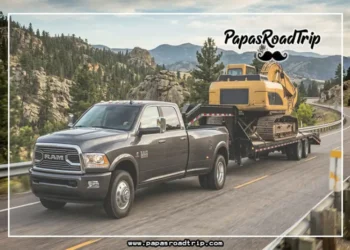
The 2018 Ram 3500 can tow up to 30,380 pounds when properly equipped. That top figure belongs to a two-wheel-drive 3500 with the 6.7L Cummins diesel, the Aisin heavy-duty transmission, a regular cab, dual rear wheels and the 4.10 axle ratio. Most 2018 Ram 3500 trucks on the road tow far less, because cab size, drivetrain and rear-wheel setup all pull the number down. This guide breaks the figure apart by configuration, so you can find the rating for your own truck.
What is the Ram 3500 towing capacity?
The 2018 Ram 3500 towing capacity is the maximum weight Ram says the truck can pull, and it changes with almost every option you pick. Ram publishes a separate rating for each mix of engine, transmission, cab, bed, drivetrain, axle ratio and rear-wheel style. There’s no single number for the truck.
Ram builds this truck as a heavy-duty pickup for people who haul trailers most days. That means a fifth-wheel or gooseneck hitch, a flatbed trailer, a horse trailer or a large travel trailer. It’s a work truck first, and the ratings reflect that.
The rating covers the trailer’s total loaded weight, not just the trailer frame. Water in the tanks, gear in the bed and fuel in the truck all count toward a separate limit — the gross combined weight rating, or GCWR. Ram lists a GCWR for each setup, and the towing figure comes from subtracting the truck’s own weight from it.
The most common misconception is that the 30,380-pound figure applies to any 3500 you buy. It doesn’t. A crew cab 4×4 with single rear wheels and a 68RFE transmission carries a much lower rating, and that’s the truck sitting on most dealer lots.
How to find your truck’s rating
Start with the driver’s door jamb. Every 2018 Ram 3500 carries a tire and loading information label, plus a certification label that lists the truck’s own weight limits. Those labels describe your exact truck, not a brochure average. Then work through these decisions in order.
- Read the door labels first. The certification label gives your truck’s gross vehicle weight rating (GVWR) and gross axle weight ratings. Write them down. These are the limits you can’t exceed, whatever the brochure says.
- Check the engine. The 6.7L Cummins diesel carries the highest ratings. The 6.4L HEMI V8 sits well below it. The engine decides everything that follows.
- Identify the transmission. With the diesel, the Aisin AS69RC automatic carries higher ratings than the 68RFE automatic. The 68RFE comes with a lower GCWR.
- Note the cab and bed. A regular cab with an 8-foot bed weighs least and tows most. Crew cab and mega cab bodies add weight and cut the rating.
- Check two-wheel drive or four-wheel drive. A 4×4 system adds weight and lowers the rating compared with a 2WD truck of the same spec.
- Look at the rear wheels. Dual rear wheels (DRW) raise the rating a lot. Single rear wheels (SRW) lower it. The rear axle ratio — 3.42, 3.73 or 4.10 — then sets the final number.
- Match your setup to Ram’s towing chart. Ram publishes a full chart in the 2018 Ram 3500 owner’s manual and towing guide. Find the row that matches every choice above. That row is your rating.
The judgement call that matters most is this: the chart gives a maximum, and your actual trailer weight is what counts. Load the trailer, fill the water tank, then weigh it at a public scale. If the real weight sits close to the chart figure, move up to a stronger configuration rather than running at the edge.
2018 Ram 3500 towing figures by setup
These are the main variations a buyer or owner will meet. Treat each figure as the maximum for that exact setup, with the conditions noted in the row beside it.
| Your setup | What to use or do | Figure that matters | What to watch for |
|---|---|---|---|
| 2WD, regular cab, diesel, Aisin, DRW, 4.10 axle | The top-rated build | Up to 30,380 lb | Fifth-wheel or gooseneck hitch needed to reach it |
| 2WD, crew cab, diesel, Aisin, DRW | Common heavy-haul build | Lower than 30,380 lb by cab weight | Check the exact chart row for your bed length |
| 4×4, crew cab, diesel, DRW | All-weather heavy hauling | Below the 2WD figure | Four-wheel-drive hardware adds truck weight |
| Diesel, SRW, any cab | Everyday trailer towing | Noticeably lower than DRW | Rear axle and tire load limits arrive sooner |
| 6.4L HEMI V8, any cab | Lighter trailers, lower cost | Well below the diesel figures | GCWR is the real limit, not the hitch |
| Any 3500 with a bumper-pull hitch | Standard trailer towing | Lower than fifth-wheel rating | Hitch receiver rating can cap you first |
| Any 3500 loaded to GVWR | Heavy pin weight in the bed | Pin weight counts against payload | Payload runs out before towing capacity |
One figure decides more rows than any other: payload. A fifth-wheel trailer pushes 15% to 25% of its weight onto the truck as pin weight, and that weight comes straight out of your payload. A truck rated to pull 30,000 pounds can still be overloaded by a 15,000-pound fifth-wheel if the pin weight plus passengers and gear passes the payload limit on the door label.
What separates a safe setup from an overloaded one
The people who get this right start at the scale, not the brochure. They weigh the empty truck with a full tank and themselves inside, then subtract that from the GCWR. The gap is the real trailer allowance, and it’s often smaller than the chart number suggests.
They also load the trailer before the first long trip. A travel trailer with full fresh water and a full pantry can gain hundreds of pounds over its dry weight. Weighing the loaded trailer at a public scale takes ten minutes and settles the question for good.
Order matters too. Set the hitch height and the weight distribution bars with the trailer loaded, then re-check the truck’s stance. A truck sitting nose-high means the tongue weight is wrong, and steering feel changes with it.
What experienced owners leave alone is the truck itself. They don’t add lift kits, oversized tires or heavy bumpers and then trust the original rating. Ram’s figures assume a stock truck, and added weight or a raised center of gravity changes how the combination behaves on the road.
Common 2018 Ram 3500 towing problems

| What you notice | What it usually means | What to do first |
|---|---|---|
| Trailer sags the rear of the truck | Too much tongue or pin weight | Weigh the tongue, then move cargo back on the trailer |
| Truck feels light in the front | Weight distribution bars set wrong | Reset the bars with the trailer loaded |
| Rating on the door label doesn’t match the brochure | Different cab, axle or drivetrain spec | Use the door label and Ram’s chart for your VIN |
| Trailer brakes feel weak | Controller gain set too low | Adjust the gain per the brake controller manual |
| Truck struggles on long climbs | Load near the GCWR limit | Weigh the combination and lighten the trailer |
The mistake that costs people most is trusting the number from the sales conversation. A truck sold as “tows 30,000 pounds” may be a crew cab 4×4 SRW that’s rated far lower, and the owner finds out with a loaded trailer on a mountain pass. The fix is free: read the door label and the chart row before you hook up.
Rules and ratings you should confirm
Ram’s towing chart is the authority for your truck, and the owner’s manual prints it. Ram also states that ratings assume a properly equipped truck with the correct hitch, and that you must not exceed the GVWR, GAWR or GCWR on the certification label. Those labels are the legal limits for your vehicle.
Your state’s rules matter as much. Many states require trailer brakes above a set weight and a special license or endorsement for heavy combinations. The Commercial Driver’s License Program page from the Federal Motor Carrier Safety Administration explains which vehicles fall under federal CDL rules, and your state DMV lists its own trailer and endorsement requirements.
Check these four things before you tow: the exact chart row for your VIN, the payload figure on your door label, your state’s trailer brake and license rules, and your insurance policy’s coverage for trailer use. A dealer can print the build sheet from your VIN if the chart leaves you unsure.
Keeping the setup right over time
Re-check the numbers whenever something changes. A new set of tires with a different load range, an added toolbox, a heavier hitch or a different trailer all move the figures. Weigh the truck again after any of those changes, and write the new numbers inside the owner’s manual.
Check tire pressure before every heavy tow, and check the trailer tires too. Underinflation is the most common cause of trailer tire failure on a long trip. Look at the sidewall for the pressure that matches the load, and follow Ram’s label for the truck.
Inspect the hitch, the safety chains and the breakaway cable each time you hook up. A worn hitch or a frayed chain is a cheap fix at home and a serious problem on the highway.
The 3500’s diesel and gas engines carry different ratings, so confirm which one your truck has before you trust any chart. A crew cab with four-wheel drive and a long bed weighs more than a regular cab, and that weight comes straight off your payload.
Keep a small notebook in the glovebox with the scale ticket, the date and what changed. When you sell the truck, that record answers the buyer’s first question.
Replace trailer tires by age as well as tread. A tire that sits in the sun between trips can crack before the tread wears down.
When a 3500 isn’t the right truck

If your trailer stays under about 10,000 pounds and you tow a few weekends a year, a Ram 2500 or a half-ton truck will do the job with better ride comfort and lower running costs. The 3500’s stiff suspension is built for constant heavy loads, and it feels harsh when empty.
The gap between those two cases is where most buyers get it wrong. A 12,000-pound trailer used eight or ten times a season sits right at the line, and the answer depends on terrain. Flat highway miles favor the 2500. Repeated mountain grades with that load favor the 3500’s brakes and cooling.
If your combined weight climbs past the 3500’s top rating, you’re in commercial truck territory. A medium-duty truck or a properly licensed hotshot setup is the honest answer there, and it comes with different licensing and insurance rules.
If you only tow occasionally and the trailer is light, renting a truck for those trips can cost less than owning a heavy-duty diesel. Run the numbers for your own use before you buy. Count the rental days against a year of payments, insurance and diesel maintenance, not just the sticker price.
Related guides
- Toyota Highlander Tow Package: Ultimate Guide to Towing Power
- Honda Passport Tow Package: Ultimate Guide for Powerful Towing
- Jeep Gladiator Max Tow Package: Ultimate Towing Power Unleashed
Frequently asked questions
What is the max towing capacity of a 2018 Ram 3500?
Up to 30,380 pounds, and only on the highest-rated build: 2WD, regular cab, 6.7L Cummins diesel, Aisin transmission, dual rear wheels and 4.10 axle ratio. Any other combination carries a lower rating. Find your exact figure in Ram’s 2018 towing chart using your VIN.
Can a 2018 Ram 3500 tow 30,000 pounds?
Only specific builds can. A 2WD regular cab diesel with dual rear wheels and the Aisin transmission comes closest to that figure. Crew cab, 4×4 and single rear wheel versions fall below it. Check the chart row for your exact configuration before you plan a load that heavy.
How much can a 2018 Ram 3500 diesel tow with a fifth-wheel hitch?
Fifth-wheel ratings are usually the highest for a given truck, because the hitch sits over the rear axle. The exact figure depends on cab, drivetrain and rear wheels. The limiting factor is often payload, since 15% to 25% of the trailer weight lands in the bed as pin weight.
Is a 2018 Ram 3500 with the 6.4L HEMI good for towing?
Yes, for lighter trailers. The 6.4L HEMI V8 carries lower ratings than the Cummins diesel across every configuration. It suits a travel trailer or a small equipment trailer. For a large fifth-wheel or a heavy work trailer, the diesel is the better match.
What happens if I tow more than the rating?
You exceed the truck’s design limits, and that affects braking, handling and stability on the road. It can also void warranty coverage and put you outside your insurance terms. In many states, exceeding the rated limit can lead to a citation. Weigh your loaded combination and stay under the label figures.
How do I find the towing capacity for my own 2018 Ram 3500?
Read the certification label on the driver’s door jamb first. Then match your engine, cab, drivetrain, rear wheels and axle ratio to the row in Ram’s 2018 towing chart. A dealer can pull your build sheet from the VIN if you’re unsure of any option.
Do I need a special license to tow with a 2018 Ram 3500?
It depends on the combined weight and your state. Many states require an endorsement or a non-commercial class for heavy combinations, and federal CDL rules apply to some commercial uses. Check your state DMV’s trailer rules and the FMCSA guidance before you tow at the top of the rating.
Conclusion
Before you hook up a trailer, check the sticker inside your driver’s door jamb—it lists the exact ratings for your specific truck, and that’s what really counts. If the numbers don’t match what you expected, talk to a Ram dealer or a hitch shop. They’ll help you stay safe and legal on the road.