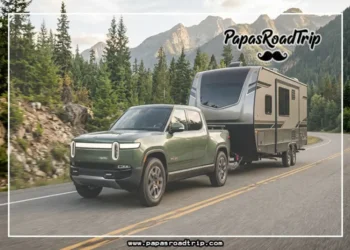
The Rivian R1T towing capacity is up to 11,000 lb (4,990 kg) when the truck is fitted with the Max Pack battery and 21-inch or 22-inch road wheels. The standard and Large Pack versions are rated lower, and the figure drops again as you add people, cargo and tongue weight. This guide covers the exact rating for each setup, the real-world limits that shrink it, and what to check before you hook up a trailer.
What the rating actually means
The number on the door jamb is a maximum, not a promise. Rivian publishes a towing figure for each combination of battery pack, wheel size and tire, and that figure assumes a driver plus one passenger and nothing else in the truck. Load the bed, fill all five seats, or add a heavy hitch, and the usable trailer weight falls below the headline.
Towing capacity is the total weight of a fully loaded trailer, including everything inside it. It isn’t the same as tongue weight, which is the downward force the trailer puts on the hitch, and it isn’t the same as payload, which is what the truck itself can carry. These three limits work together. The lowest one wins.
The main misconception is that one number covers every R1T. It doesn’t. A Quad-Motor with the Max Pack and road tires is rated differently from a Dual-Motor with the Standard Pack and all-terrain tires. Rivian’s own towing specification page lists the current figures by configuration, and that page is the one to trust over any forum post.
How to work out your own safe trailer weight
You don’t start with the trailer. You start with the truck as you’ll actually drive it, then work backward. Follow these decisions in order.
- Find your exact configuration. Check the battery pack, motor setup and wheel size on your build sheet or in the Rivian app. Each combination has its own rating, so write yours down before you shop for a trailer.
- Weigh the truck loaded. Fill the seats with the people who’ll ride, add the gear you’ll carry, and weigh it at a public scale. Subtract that from the truck’s gross vehicle weight rating (GVWR) on the door sticker. What’s left is your real payload.
- Estimate tongue weight. Plan for about 10-15% of the loaded trailer weight on the hitch. A 7,000 lb trailer puts roughly 700-1,050 lb on the tongue, and that comes straight out of your payload.
- Check the hitch and receiver limit. The R1T’s receiver has its own maximum tongue weight, printed on the hitch or in the owner’s manual. If your calculated tongue weight is higher, you need a lighter trailer or a weight-distributing hitch.
- Subtract tongue weight from payload. If your remaining payload after passengers and cargo is 900 lb and your tongue weight is 1,000 lb, you’re over — even if the trailer is well under the towing rating.
- Compare the trailer’s loaded weight to the rating. Use the trailer’s gross vehicle weight rating (GVWR), not its dry weight. Water tanks, propane and gear add hundreds of pounds fast.
- Check your driver’s license rules. Some states require a special endorsement or a non-commercial Class A license above certain trailer weights. Your state DMV’s website lists the threshold for your situation.
The judgement call that separates a good setup from a bad one is honesty about payload. Most people calculate towing capacity and stop there. The ones who tow safely run the payload math first, because on an electric truck with a heavy battery, payload runs out before towing capacity does.
Rivian R1T towing figures by setup
Ratings change with battery pack, wheels and tires. The table below shows how the main configurations compare, using Rivian’s published figures.
| Your setup | What it’s rated for | Figure that matters | What to watch |
|---|---|---|---|
| Max Pack, 21″ or 22″ road wheels | Highest rating | Up to 11,000 lb | Assumes driver plus one passenger only |
| Large Pack, road wheels | Mid rating | Lower than Max Pack | Confirm on Rivian’s spec page for your model year |
| Standard Pack | Lowest rating | Lowest of the three | Best for small trailers and utility loads |
| All-terrain tires fitted | Reduced rating | Below the road-tire figure | Tire choice alone can cut the number |
| Tongue weight at hitch | Receiver limit | Printed on hitch or in manual | Exceed it and you risk hitch failure |
| Payload after passengers | What’s left for tongue + cargo | GVWR minus loaded truck weight | Usually the real bottleneck |
| Trailer with full water tanks | Loaded trailer weight | Trailer GVWR, not dry weight | Water adds weight fast |
Two things shift these numbers. First, model year: Rivian has changed pack options and ratings since launch, so a 2022 truck and a 2025 truck may not match. Second, accessories: a bed rack, a rooftop tent or a heavy bumper all eat payload before the trailer does.
What experienced towers get right
The people who tow without drama do the boring work before the trailer is hitched. They weigh the truck loaded, once, at a public scale, and keep that number. They know their real payload instead of guessing, and they pick trailers that fit inside it with room to spare.
They also match the hitch to the load. A weight-distributing hitch spreads tongue weight across the truck’s frame instead of loading the rear axle alone, and it keeps the truck level. A sagging rear end means the weight is in the wrong place, and it makes steering feel vague at speed.
Range and braking change with a trailer
Towing cuts driving range sharply, and the drop is bigger than most people expect. Rivian’s own guidance says to plan on roughly half your normal range when towing a heavy trailer, though wind, hills and speed all move that figure. Charge stops need to be planned around trailer-friendly charging spots, because many stations aren’t laid out for a truck plus trailer.
Braking deserves the same attention. A trailer over a certain weight needs its own brakes, and most states set that threshold in law. Your state DMV lists it. Test the trailer brakes in an empty lot before you trust them on a highway.
What experienced towers leave alone: they don’t chase the maximum rating. They run at 70-80% of it, because that margin absorbs a full water tank, a headwind or an unexpected climb.
Common towing problems and fixes

Most towing complaints trace back to weight distribution or setup, not the truck itself. The table below matches what you notice to what to do first.
| What you notice | What it usually means | What to do first |
|---|---|---|
| Rear of the truck sags | Too much tongue weight on the rear axle | Recheck tongue weight; add a weight-distributing hitch |
| Trailer sways at speed | Tongue weight too low, or load sitting too far back | Move cargo forward to raise tongue weight to 10-15% |
| Range drops much faster than expected | Normal for heavy towing | Plan shorter legs and trailer-friendly charge stops |
| Truck feels slow to stop | Trailer brakes not set up or not working | Test trailer brakes in an empty lot; check the controller |
| Warning about payload or hitch | You’re over a rated limit | Remove weight from the truck or lighten the trailer |
If a warning appears and you can’t find the cause by rechecking weights, stop towing and contact Rivian service. Hitch and brake repairs aren’t a driveway job for most owners.
Rules and limits you should confirm
Towing law in the US is split between federal vehicle safety rules and state driver licensing. The federal side sets equipment standards for trailers, but the weight at which you need a special license is set by each state. Check your state DMV’s website for the exact threshold that applies to you.
Before you tow, confirm five things for your own case:
- Your truck’s exact rating — Rivian’s support page, filtered by your model year and build.
- Your receiver’s tongue weight limit — printed on the hitch or in the owner’s manual.
- Your state’s trailer brake threshold — your state DMV website.
- Your state’s license requirement above a certain trailer weight — your state DMV website.
- Your insurance coverage while towing — call your insurer and ask directly.
The license question is where most owners guess wrong. A standard driver’s license covers a light trailer in most states, but the cutoff is often lower than people assume. If your loaded trailer crosses it, you need a different class of license before you hitch up.
Rivian’s rating also varies by build. Two R1Ts of the same model year can carry different limits depending on wheel and tire package, so search by your VIN rather than the brochure number. The door jamb sticker is the final word.
If your setup needs a commercial license, trailer brake installation or hitch repairs, that’s a job for your state DMV and a qualified trailer shop, not a DIY project.
Keeping your towing setup in good shape
Once your setup is dialed in, write the numbers down. Keep a note in the truck with your loaded weight, your real payload, your tongue weight target and your trailer’s loaded weight. That note saves you from redoing the math every trip, and it’s what you hand to anyone else who drives the truck with the trailer.
Check the hitch, the receiver bolts and the trailer wiring before every trip. Look for loose bolts, frayed wires and worn pins. A five-minute walk-around catches most problems before they become roadside ones.
Recheck your weights whenever something changes: a new accessory, a different trailer, or a passenger load that’s heavier than usual. There’s no fixed interval that fits every setup, so let the change itself be your signal. If you add a bed rack or swap to all-terrain tires, rerun the payload math that same week.
Tire pressure belongs on the same pre-trip walk-around. Run the R1T’s tires at the pressures on the door jamb for a loaded truck, not the lighter numbers you might use empty, and check the trailer tires cold.
On the R1T, watch range separately from weight. A loaded trailer can cut your driving range sharply, so plan charging stops around the towing figure rather than the truck’s normal estimate.
When the R1T isn’t the right tow vehicle

The R1T is a strong tow rig for mid-size trailers, but it’s the wrong choice in a few situations. If you’re pulling a trailer near or above 11,000 lb regularly, a heavy-duty diesel pickup handles that load with more margin and far easier refueling. If you tow long distances through remote areas with sparse charging, plan carefully or use a gas truck for those trips.
If you need to tow every day for work, the charging time between jobs may cost you more than the fuel savings. And if your trailer needs a commercial license in your state, sort that out before you buy anything — the truck choice comes after the legal one.
The daily-work case turns on your route, not the truck. A crew running under 150 miles between charges can top up overnight at home and never lose a job to the charger. If your days run longer than that, or your stops have no plug, the diesel wins on time alone.
Watch the payload sticker on the door jamb, not the towing figure. A well-equipped R1T carries less than the headline number suggests once passengers and gear are aboard.
Related guides
- Toyota Highlander Tow Package: Ultimate Guide to Towing Power
- Honda Passport Tow Package: Ultimate Guide for Powerful Towing
- Jeep Gladiator Max Tow Package: Ultimate Towing Power Unleashed
Frequently asked questions
What is the maximum towing capacity of a Rivian R1T?
Up to 11,000 lb with the Max Pack battery and 21-inch or 22-inch road wheels. That figure assumes a driver plus one passenger and no extra cargo. Other battery packs and all-terrain tires are rated lower, so check Rivian’s spec page for your exact build.
Can a Rivian R1T tow a 10,000 lb trailer?
Yes, if you have the Max Pack with road wheels and your payload math works out. A 10,000 lb trailer puts roughly 1,000-1,500 lb of tongue weight on the hitch, which comes out of your payload, so confirm your loaded truck has that much room. Weigh your loaded truck first to confirm you have room.
How much does towing reduce the R1T’s range?
Plan on roughly half your normal range when pulling a heavy trailer, per Rivian’s own towing guidance. Wind, hills, speed and trailer size all change that figure. A lighter, more aerodynamic trailer costs less range than a tall box trailer.
Is it safe to tow at the maximum rating?
It’s legal but not ideal. Running at 70-80% of the rating leaves margin for a full water tank, a headwind or a steep climb. At the maximum, every extra pound pushes you over a limit, and there’s no room left for error.
Do I need trailer brakes on a Rivian R1T?
It depends on your state’s weight threshold and your trailer’s weight. Most states require trailer brakes above a set weight, and your state DMV lists it. Test the brakes in an empty lot before towing on a highway.
How much tongue weight can the R1T handle?
The receiver’s limit is printed on the hitch or in the owner’s manual, and it’s usually the binding constraint before towing capacity. Aim for 10-15% of your loaded trailer weight on the tongue, then confirm it’s under the receiver’s rating.
What happens if I tow more than the rating?
You overload the truck’s frame, brakes and suspension, and you may exceed your legal limits. Handling gets worse, stopping distances grow, and you could void warranty coverage or face liability in a crash. If you’re over, lighten the load or change the trailer.
Conclusion
Before you book a trailer rental, pull up your R1T’s door-jamb sticker and compare its ratings against the trailer you’re eyeing. If the numbers leave you tight, you’ll want to weigh the setup at a public scale before committing to a long trip.