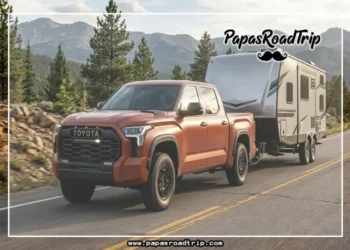
The 2026 toyota sequoia towing capacity is 9,000 pounds for both the SR5 and Limited trims, and 9,000 pounds for the Platinum, TRD Pro, and Capstone as well. Toyota publishes trim-specific figures, and each assumes a properly equipped vehicle — the right hitch, the right hitch ball, and a weight-distributing setup once the trailer gets heavy. The real limit for your truck depends on how yours is built and loaded. Below are the trims, the numbers behind them, and the checks that keep you inside the rating.
What the Sequoia’s tow rating actually means
The Sequoia is a full-size, body-on-frame SUV with three rows of seats. Toyota builds it for families who also tow — a boat, a camper, a utility trailer. The 9,000-pound figure is the maximum gross trailer weight the vehicle is rated to pull, and Toyota publishes it in the 2026 Sequoia specifications on its own site.
The one misconception people bring to this number is that it’s a fixed property of the truck. It isn’t. The rating assumes a specific build: the tow package fitted, the hitch Toyota installs, and the trailer loaded correctly. Change those conditions and the safe number changes with them.
A second point trips people up. The tow rating and the tongue weight rating are two different limits, and you have to stay under both. Tongue weight is a separate limit from trailer weight, and you have to stay under both.
Payload is the third limit, and it’s the one most often missed. Every pound of tongue weight and every passenger counts against payload before it counts against towing capacity. Toyota prints the GVWR and axle ratings on the driver’s door jamb label — that sticker, not the brochure, is your real starting point.
The Sequoia is for people who tow a few times a year and want one vehicle for everything. It’s not a substitute for a heavy-duty pickup if you tow a large fifth-wheel or a trailer near the top of the range every weekend.
How to match your trailer to the Sequoia
Work through these decisions in order. Each one settles the next.
- Read the door jamb label first. Find the payload figure on the sticker inside the driver’s door. That number, not 9,000, is your true ceiling once people and gear are aboard.
- Weigh the trailer loaded, not empty. A camper’s dry weight means nothing once water, propane, and gear are in. Use a public scale; most truck stops have one.
- Add up tongue weight and passengers. Aim for 10–15% of the loaded trailer weight on the tongue, then subtract that plus everyone in the cab from payload. If the result goes negative, the trailer is too much.
- Check your hitch hardware. The Sequoia’s receiver is rated for a specific weight, and the ball mount and ball must match. A ball rated below your trailer’s weight is the weak link.
- Decide on weight distribution. Above roughly 5,000 pounds of trailer, a weight-distributing hitch is the norm. Toyota’s own towing guide states the conditions; check it for your configuration.
- Confirm your trim’s equipment. The TRD Pro and Capstone often come with tow gear, but confirm the tow package is fitted on your build. On lower trims, confirm the tow package is fitted before you assume 9,000 pounds.
- Do a short test pull. Load up, drive 20 minutes on a quiet road, and check for sway, sag, and brake feel before any long trip.
The judgement call that separates a good setup from a bad one is tongue weight. Too light and the trailer sways at speed. Too heavy and you overload the rear axle and lift the front wheels, which costs you steering. If you can’t get it into the 10–15% window with your load, the trailer is the wrong match for the truck.
Anything involving a trailer brake controller, a custom hitch, or a trailer over the vehicle’s rating is a job for a qualified tow installer — not a driveway fix.
2026 Sequoia towing capacity by trim and setup
One lead figure, then the variations that change what you can actually pull.
| Your situation | What to use or do | Figure that matters | What to watch for |
|---|---|---|---|
| SR5 or Limited, tow package fitted | Standard receiver, ball mount matched to trailer | 9,000 lb max trailer weight | Confirm the tow package is on the build sheet |
| Platinum, TRD Pro, or Capstone | Same rating, tow gear standard | 9,000 lb max trailer weight | Extra trim weight eats into payload |
| Trailer under 5,000 lb | Standard ball mount is usually enough | Tongue weight at 10–15% of trailer | Don’t skip the scale check |
| Trailer over 5,000 lb | Weight-distributing hitch | Tongue weight at 10–15% of trailer | Follow Toyota’s towing guide conditions |
| Full load of passengers and gear | Subtract from payload, not from 9,000 | Payload on the door jamb label | Tongue weight counts against payload |
| Trailer with its own brakes | Trailer brake controller fitted | Check your state’s brake law | Some states require brakes above a set weight |
| Steep grades or high altitude | Reduce trailer weight | No fixed figure — derate for conditions | Engine and transmission heat |
What separates a safe Sequoia tow from a risky one
People who tow well do the boring things first. They weigh the trailer loaded before the first trip, not after a problem. They read the door jamb label and write the payload number down. Then they subtract tongue weight, passengers, and cargo before they ever hook up. That single habit catches most overloads before they leave the driveway.
They also set the hitch height before loading. The trailer should sit level when hitched, and a ball mount that’s too high or too low puts uneven load on the rear axle. Getting this right takes ten minutes with a tape measure.
The order matters too. Load the trailer first, then hitch, then check the lights, then check the mirrors. Doing it the other way round means re-checking everything twice.
Partway through a long trip, good towers stop and put a hand on each tire and the hitch. A hot tire or a warm hitch ball tells you something is wrong before it becomes a roadside problem. They also re-check the hitch after the first 50 miles, because new setups settle.
What they leave alone is the rating itself. They don’t try to stretch 9,000 pounds with “it’ll be fine” math. If the loaded trailer comes in at 9,400, they leave weight behind or take a second vehicle.
Preparation that pays off
A printed checklist in the glovebox beats memory. Tire pressures on the Sequoia and the trailer, hitch pin in place, safety chains crossed, breakaway cable connected, lights working. Run it every time, even for a short haul.
What to check mid-trip
After the first 50 miles, and again at every fuel stop, check the hitch, the chains, and the trailer tires. Sway that appears only at highway speed usually means the load has shifted rearward — pull over and move weight forward.
Common Sequoia towing problems and fixes
| What you notice | What it usually means | What to do first |
|---|---|---|
| Trailer sways at highway speed | Too little tongue weight, or load shifted back | Move cargo forward, re-weigh the tongue |
| Rear of the SUV sags badly | Tongue weight too high, or payload exceeded | Re-check payload against the door jamb label |
| Steering feels light | Front axle unloaded by too much tongue weight | Reduce tongue weight or fit a weight-distributing hitch |
| Trailer brakes feel weak | Controller not set for the load | Adjust the controller gain, test at low speed |
| Overheating on a long climb | Trailer near the limit on a steep grade | Slow down, drop a gear, reduce load next time |
| Hitch ball worn or loose | Ball size or torque wrong for the coupler | Match ball to coupler size and torque to spec |
Rules and limits you should confirm
Towing law in the US is set by your state, not by Toyota, and it varies. Most states require trailer brakes above a set weight, and that weight differs from state to state — check your state DMV’s towing page for the figure that applies to you. Some states also set a maximum trailer width and a speed limit for vehicles towing.
Your driver’s license matters too. A standard license covers most travel-trailer setups, but a heavy trailer or a combination over a certain weight can need a different class. Your state DMV publishes the thresholds.
Before you buy or borrow a trailer, confirm four things: your Sequoia’s payload from the door jamb label, the loaded trailer weight from a scale, your state’s brake requirement, and your insurance policy’s cover for trailer damage. Each has a place that gives the answer — the label, the scale, the DMV, and your insurer.
If your setup needs a custom hitch, a brake controller install, or a trailer beyond the vehicle’s rating, that’s a job for a licensed tow shop. Getting it wrong risks your safety and can void cover.
Keeping your tow setup in shape
Once the setup works, write it down. Note the trailer’s loaded weight, the tongue weight, the ball size, and the hitch height in a phone note or a card in the glovebox. Next season you’ll have the numbers without repeating the scale trip.
Store the ball mount and pins somewhere dry, and wipe grease off the ball before you store it — grit on the ball wears the coupler. Check the hitch receiver for rust and loose bolts at the start of each towing season.
Re-check your numbers whenever something changes: a new trailer, a different load, a new set of passengers. The rating doesn’t move, but your payload margin does. If the margin gets thin, that’s the sign to re-weigh and adjust.
When the Sequoia isn’t the right tow vehicle

The Sequoia is the wrong choice if you tow a large fifth-wheel trailer — that needs a pickup bed and a fifth-wheel hitch. Use a heavy-duty truck instead.
It’s also wrong if your loaded trailer sits near 9,000 pounds every trip. Running at the ceiling leaves no margin for passengers, gear, or hills. A three-quarter-ton truck gives you headroom the SUV can’t.
One more case: a trailer with a loaded tongue weight above roughly 10 percent of its total, such as a toy hauler loaded with heavy gear toward the front. Check the payload sticker on the driver’s door jamb before you sign. If the tongue weight plus passengers and cargo lands within a few hundred pounds of the Sequoia’s payload rating, move up to a truck.
And it’s the wrong tool if you tow weekly for work. The wear adds up fast, and a dedicated tow rig will last longer and cost less to run. For occasional family towing, the Sequoia is fine; for daily commercial hauling, it isn’t.
Related guides
- Toyota Sequoia Years to Avoid: Expert Tips Before You Buy
- Toyota Highlander Tow Package: Ultimate Guide to Towing Power
- Toyota Sequoia Troubleshooting: Quick Fixes for Common Issues
Frequently asked questions
What is the towing capacity of a 2026 Toyota Sequoia?
9,000 pounds across all trims, according to Toyota’s published specifications. That figure assumes the tow package is fitted, the hitch hardware is correctly rated, and the vehicle isn’t overloaded with passengers and cargo. Your real limit is the lower of 9,000 pounds and whatever your payload allows after tongue weight and passengers are counted.
Can a 2026 Sequoia tow a 7,000 lb travel trailer?
Yes, if the loaded trailer stays under 9,000 pounds and your payload covers the tongue weight. A 7,000-pound trailer puts roughly 700–1,050 pounds on the tongue at 10–15%. Check that against your door jamb payload figure with passengers aboard. Most Sequoia configurations handle this, but confirm on the label before you commit.
Do I need a weight-distributing hitch on a Sequoia?
It depends on trailer weight. Under about 5,000 pounds, a standard ball mount is usually enough. Above that, a weight-distributing hitch is the norm and is often required by the hitch maker’s own rating. Check Toyota’s towing guide and your hitch manufacturer’s instructions for your exact setup.
How much tongue weight can a 2026 Sequoia handle?
Toyota rates tongue weight separately from trailer weight, and the figure is printed in the owner’s manual and towing guide for your configuration. Aim for 10–15% of your loaded trailer weight, then confirm it sits under Toyota’s stated limit. If the two conflict, the lower number wins.
Is it safe to tow at the full 9,000 lb rating?
It’s legal and within spec, but it leaves no margin. At the ceiling, every passenger and every pound of cargo pushes you toward overload. For long trips, steep grades, or high altitude, staying well under the rating is the safer choice. Reduce trailer weight rather than testing the limit.
What happens if I tow more than the Sequoia’s rating?
You overload the axles, brakes, and cooling system, and you may break state law. Handling gets worse, stopping distances grow, and your insurance may not cover damage from an overloaded setup. The rating isn’t a suggestion — it’s the point where the vehicle’s systems are designed to stop coping safely.
How often should I check my hitch and trailer?
Before every trip, and again after the first 50 miles. Then at each fuel stop on a long haul — hitch pin, safety chains, lights, and tire temperatures. Replace worn hitch hardware when you see rust, cracks, or a loose fit, rather than waiting for a failure.
Conclusion
Before your next trip, load the trailer the way you’ll actually tow it and swing by a CAT scale to confirm your real weights. It’s a quick stop, and you’ll know for sure whether you’re within limits instead of guessing.