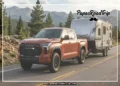
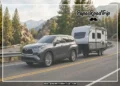
The 2024 Hyundai Santa Cruz towing capacity is 5,000 lb with the 2.5L turbo engine. With the standard 2.5L engine it is 3,500 lb. Payload and tongue weight change with the trim, so the door sticker on your own truck is the final word. Here’s what each setup can pull, what counts against the limit, and what to check before you hook up a trailer.
What the Santa Cruz Is Built to Do
The Santa Cruz is a compact pickup based on a crossover platform, not a full-size truck frame. Hyundai calls it a Sport Adventure Vehicle, and that name tells you what it’s for. It handles daily driving, light hauling and weekend towing. It isn’t built for heavy construction work or long-haul trailering.
The truck comes in SE, SEL, Night, XRT and Limited trims. Engine choice matters more than trim for towing. The standard 2.5L four-cylinder makes 191 horsepower. The optional 2.5L turbo makes 281 horsepower and 311 lb-ft of torque, and it’s the engine that unlocks the higher rating.
The one misconception people bring: they think the 5,000 lb figure applies to every Santa Cruz. It doesn’t. Engine, trailer brakes and how you load the truck all change the real number.
Hyundai publishes the ratings in its own towing guide, and the door jamb sticker on your truck lists your specific payload. Those two documents settle most arguments. If a seller tells you a number that doesn’t match them, trust the sticker.
How the Towing Rating Breaks Down
Towing capacity isn’t one number floating in the air. It’s the end result of several limits working together, and the smallest one wins. Here’s the order those limits come up.
- Check which engine you have. Look at the window sticker or the VIN. The 2.5L turbo gets the 5,000 lb rating. The standard 2.5L gets 3,500 lb. This is the first fork in the road, and nothing else matters until you know it.
- Confirm the trailer has brakes. Many states require trailer brakes above a set weight, and brakes shorten stopping distance regardless of what the truck is rated to pull. Most states also require brakes on trailers above a certain weight, so check your state’s rule.
- Read the payload sticker on the driver’s door jamb. That number is the total weight of people, cargo, accessories and tongue weight your truck can carry. It’s often the real limit, not the trailer rating.
- Work out tongue weight. Aim for 10% to 15% of the loaded trailer weight on the hitch. A 4,000 lb trailer wants roughly 400 to 600 lb of tongue weight, and that comes straight out of payload.
- Add up everything in the truck. Passengers, pets, tools, a cooler, a bed rack — all of it counts. Subtract that from payload before you subtract tongue weight.
- Check the hitch and ball. The factory hitch and the ball mount must be rated for the load. A hitch rated below your trailer weight is a hard stop, whatever the truck can pull.
- Weigh the loaded trailer. A trailer’s dry weight isn’t its travel weight. Water, propane, gear and food add up fast. A public scale gives you the real figure for a small fee.
The judgement call that separates a good setup from a bad one is tongue weight. Too little and the trailer sways at highway speed. Too much and you eat your payload and squat the rear suspension. Get it in the 10% to 15% window and the truck behaves.
Towing above the rated limit can void your warranty and may leave you liable if something goes wrong. If your load is close to the ceiling, have a hitch shop check the whole setup before you drive.
Santa Cruz Towing Numbers at a Glance
Use this table to match your truck and trailer to a figure. Every number assumes the factory hitch is installed and the load is properly distributed.
| Your situation | What to do | Figure that matters | What to watch for |
|---|---|---|---|
| 2.5L turbo, trailer with brakes | Tow up to the full rating | 5,000 lb max trailer weight | Payload runs out before the trailer rating does |
| 2.5L turbo, trailer without brakes | Add trailer brakes or keep the load light | 5,000 lb max trailer weight | Many states require brakes above set weights |
| Standard 2.5L engine, any trailer | Keep the load light | 3,500 lb max trailer weight | Less power on hills and at altitude |
| Tongue weight target | Load the trailer nose-heavy | 10%–15% of trailer weight | Too light causes sway; too heavy eats payload |
| Payload check | Read the door jamb sticker | Your truck’s own payload figure | Includes people, cargo and tongue weight |
| Trailer dry weight vs. real weight | Weigh it loaded | Add water, propane and gear | Dry weight is often far below travel weight |
| Hitch and ball mount | Match to the trailer | Rated at or above trailer weight | A weak hitch caps you below the truck’s rating |
What Experienced Towers Get Right
The people who tow happily with a Santa Cruz share a few habits. They start with the door sticker, not the brochure. They write down their payload figure and subtract every passenger and every bag before they even look at trailers. That single step prevents most overloaded setups.
They also load the trailer before they load the truck. Gear goes over the trailer axles or slightly forward of them, never all at the back. A trailer loaded tail-heavy will sway, and sway at highway speed is the thing that scares people off towing for good.
The order they work in
They check tires and pressures on both truck and trailer first, cold. They test the trailer lights — brake lights, turn signals, running lights — with a helper or a wall. They hook up, latch the coupler, and pin it. Then they cross the safety chains under the tongue in an X, so the tongue can’t drop to the road if the coupler fails.
They raise the jack, watch the truck squat, and check that the trailer sits level or slightly nose-down. A nose-up trailer invites sway. They pull forward a few feet and check the hitch again before they leave the driveway.
What they leave alone
They don’t add a lift kit or bigger tires and expect the same rating. Suspension and tire changes alter how the truck handles a load, and Hyundai’s rating assumes the stock setup. They also don’t chase the maximum number on every trip. Running at 80% of your rating leaves room for a hill, a headwind or a passing semi’s draft.
Common Towing Problems and Fixes

Most towing complaints trace back to setup, not the truck. Match what you notice to the likely cause and the first thing to try.
| What you notice | What it usually means | What to do first |
|---|---|---|
| Trailer sways at speed | Too little tongue weight or a tail-heavy load | Move cargo forward, then re-weigh the tongue |
| Rear of the truck squats hard | Tongue weight is over your payload | Shift gear to the trailer axles or leave some home |
| Brakes feel weak stopping | Trailer brakes not set up or not working | Check the brake controller and trailer wiring |
| Poor power on hills | Standard engine or a load near the limit | Downshift, slow down, accept the pace |
| Trailer lights don’t work | Wiring harness or a bad ground | Test the 4-pin or 7-pin connection with a tester |
| Truck feels pushed in crosswinds | Trailer too light on the nose or too tall | Rebalance the load and slow down |
Rules That Affect Your Towing
Hyundai’s own rating sets the ceiling for your truck, and the door jamb sticker sets your payload. Those two documents come from the manufacturer, and they override anything a dealer or a forum says. Read them before you buy a trailer, not after.
State law adds a second layer. Most states require trailer brakes above a certain gross trailer weight, and the figure differs by state. Some states also set their own speed limits for vehicles towing trailers. Your state’s department of motor vehicles or highway patrol publishes these rules, and that’s the page to check for your route.
The NHTSA towing safety guidance covers tire loading and inflation, which matters because underinflated tires are a common cause of trailer blowouts.
Licensing is the other thing people miss. Some states require a special endorsement or a different class of license for heavier trailers. If your combined rig crosses that line, a standard driver’s license may not cover you. Your state DMV is the place to confirm it.
Keeping the Setup Safe Over Time
Once your rig is dialed in, write the numbers down. Keep a note in the glovebox with your payload, your tongue weight target and your loaded trailer weight. That note saves you from redoing the math every season.
Check tire pressures on the truck and trailer before every trip where the trailer is loaded. Tires lose pressure sitting, and a soft trailer tire heats up fast on the highway. Look at the sidewall for the cold pressure figure and set it when the tires are cool.
Inspect the hitch, ball, coupler and safety chains each time you hook up. Look for rust, cracks or a worn latch. Grease the ball lightly so the coupler doesn’t bind. After a long trip, check the trailer lug nuts, since they can loosen with vibration.
The sign that your setup needs attention again is a change in how the truck sits or handles. New squat, new sway or a new vibration means something shifted. Stop and recheck before you keep driving.
When the Santa Cruz Isn’t the Right Truck

The Santa Cruz is the wrong choice if you plan to tow a travel trailer near 5,000 lb every weekend. A rig at the ceiling leaves no payload for a family and their gear, and the truck will work hard on long grades. A mid-size or full-size truck with a higher rating gives you margin.
Payload is the number people forget. Check the sticker on the driver’s door jamb, not the brochure. Subtract the tongue weight of the trailer, then the weight of every passenger and every cooler. On a crew cab with four adults and a weekend’s gear, that math runs out quickly.
It’s also wrong if you need to haul heavy equipment, a car trailer or a boat well above the rating. No amount of careful loading fixes a trailer that’s simply too heavy. Step up to a truck rated for it.
And it’s wrong if you tow without trailer brakes on a regular basis. Relying on the truck’s brakes alone to stop a heavy trailer wears them fast and lengthens your stopping distance. If your trailer has no brakes, either add them or keep the load well under the limit.
If you tow a few times a season and your trailer sits well under the rating, the Santa Cruz is fine. If you tow most weekends, buy the bigger truck first. Trading up later costs more than the difference at purchase.
Related guides
- Hyundai Santa Fe Years to Avoid: Expert Guide to Smart Buying
- Hyundai Santa Fe Engine Recall: What Owners Need to Know Now
- Hyundai Santa Fe Won’t Start: Troubleshooting Tips and Solutions
Frequently asked questions
Can the 2024 Hyundai Santa Cruz tow 5,000 lb?
Yes, but only with the 2.5L turbo engine and a trailer that has its own brakes. The standard 2.5L engine tops out at 3,500 lb. Check your engine and your door sticker before you plan a trip, because payload can cap you below the trailer rating.
How much can the Santa Cruz tow without trailer brakes?
3,500 lb is the rating with the standard 2.5L engine. Many states also require brakes on trailers above a set weight, so confirm your state’s rule before you tow anything heavy without them. Many states also require brakes on trailers above a set weight, so confirm your state’s rule before you tow anything heavy without them.
What’s the tongue weight limit on a Santa Cruz?
Aim for 10% to 15% of your loaded trailer weight, so a 4,000 lb trailer wants about 400 to 600 lb on the hitch. That tongue weight counts against your payload, which is printed on the driver’s door jamb sticker. Stay under that payload figure.
How much can I actually put in the bed while towing?
Whatever your payload sticker allows after you subtract passengers, tongue weight and cargo. Payload is often the real limit on a Santa Cruz, not the trailer rating. Weigh your setup at a public scale if you’re close to the number.
Is it safe to tow at the maximum rating?
It’s safe when the load is balanced, the trailer brakes work, tires are at the right pressure and you drive to the conditions. Running at the ceiling leaves no margin for hills or wind. Many towers prefer to stay around 80% of the rating for comfort.
Do I need a special license to tow with a Santa Cruz?
Usually not at these weights, but some states require an endorsement or a different license class for heavier trailers or combined rigs. Your state DMV publishes the rule. Confirm it before you plan a long trip across state lines.
How often should I check the trailer and hitch?
Before every trip where the trailer is loaded. Check tire pressures cold, test the lights, inspect the hitch and coupler, and confirm the safety chains are crossed and attached. A quick walk-around takes a few minutes and catches most problems early.
Conclusion
Before you buy or borrow a trailer, load your truck the way you’d actually travel and swing by a public scale to weigh each axle. That’ll tell you what you’ve really got to work with, and you’ll catch any surprises before they’re hitched up behind you.