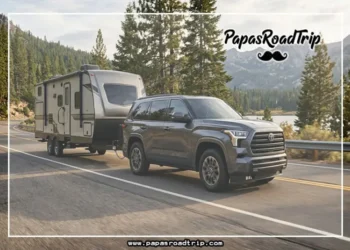
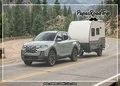
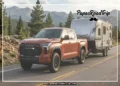
The Toyota Tundra TRD Pro is a half-ton pickup built for off-road capability first, and its towing capacity reflects that priority. Depending on the model year and drivetrain, you can expect a tundra trd pro towing capacity in the range of roughly 9,000 to 11,200 pounds, with payload typically landing between about 1,400 and 1,600 pounds. That’s meaningfully less than a similarly equipped Tundra SR5 or Limited, and understanding why — and whether it matters for your trailer — is the whole game.
Key Takeaways
- Third-generation TRD Pro Tundras (2022 and newer) generally tow between about 9,000 and 11,200 pounds depending on cab, bed, and trim configuration.
- The TRD Pro tows less than comparable Tundra trims because its off-road suspension, skid plates, and heavier wheels add weight and reduce the gross vehicle weight available for tongue load.
- Payload, not towing capacity, is usually the limiting number for half-ton trucks — check your door jamb sticker before you shop for a trailer.
- The hybrid i-FORCE MAX powertrain makes plenty of torque (583 lb-ft), so engine power is rarely the constraint; suspension and GVWR are.
- Tongue weight should land around 10–15 percent of your loaded trailer weight, and that weight counts against payload.
- Always verify your specific truck’s ratings on the manufacturer’s label rather than relying on marketing figures.
What the TRD Pro Is Actually Rated To Tow
Toyota publishes towing figures by configuration, and the TRD Pro sits at the lower end of the Tundra lineup. For the third-generation truck (2022–present), Toyota’s own published specifications put TRD Pro towing in the low-to-mid 11,000-pound range at best, and closer to 9,000 pounds in heavier configurations. The exact number depends on cab style, bed length, and whether you have the hybrid i-FORCE MAX.
The pattern holds for the second-generation truck (2014–2021) as well. Those TRD Pros were typically rated around 9,200–9,800 pounds, again trailing the volume trims. If you’re shopping used, the year matters enormously — ratings changed more than once across both generations.
Here is the practical way to think about it: the TRD Pro isn’t a towing package truck. It’s an off-road package truck that can tow. Toyota builds the Tundra SR5 with the TRD Off-Road package and the Towing Package mirrors specifically for people who need both, and those configurations carry higher ratings.
Why the TRD Pro Tows Less Than Other Tundras
This is the question that trips people up, because the TRD Pro has the most powerful engine option and the most aggressive hardware. The answer comes down to weight and suspension geometry.
The weight penalty
Every off-road component adds mass. The TRD Pro carries:
- Fox internal bypass shocks and revised coil springs
- Heavy-duty skid plates front to rear
- A TRD Pro exhaust and unique bumper treatments
- Larger, heavier all-terrain tires on forged wheels
- A standard hybrid battery pack on third-gen models
That mass comes straight out of your gross vehicle weight rating (GVWR) budget. The truck itself weighs more, so the difference between curb weight and GVWR — which is what payload and tongue weight must fit inside — shrinks.
The suspension trade-off
Off-road suspension is tuned for articulation and damping over rough terrain, not for carrying a heavy, stable tongue load on pavement. Softer spring rates and longer travel mean more squat and more movement under load. Manufacturers rate conservatively for this reason, and Toyota does exactly that.
Pro Tip: If towing is your primary use and off-road capability is secondary, price out an SR5 or Limited with the TRD Off-Road package and the Towing Package. You keep most of the capability and gain real rating headroom.
Towing Capacity by Configuration
The table below reflects typical published ranges. Treat these as a shopping guide and confirm against your specific truck’s certification label.
| Model Year / Configuration | Typical Towing Range (lb) | Typical Payload Range (lb) | Notes | |—|—|—|—|—| | 2022+ TRD Pro, CrewMax, 5.5 ft bed, i-FORCE MAX | 9,000–11,200 | 1,400–1,600 | Hybrid standard; heaviest curb weight | | 2022+ TRD Pro, CrewMax, 6.5 ft bed | 9,000–11,000 | 1,400–1,600 | Longer wheelbase helps stability | | 2014–2021 TRD Pro, CrewMax | 9,200–9,800 | 1,400–1,550 | 5.7L V8; ratings vary by year | | 2014–2021 TRD Pro, Double Cab | 9,400–10,000 | 1,450–1,600 | Lighter cab, slightly more headroom |
Two things to notice. First, the ranges overlap heavily — the difference between a good towing day and a bad one is usually how you load the truck, not which bed length you bought. Second, payload is the number that will bite you first.
Payload Is the Number That Matters Most

Most people shopping for a truck focus on towing capacity and ignore payload. That’s backwards for travel trailers and boats, which is what most half-ton buyers actually pull.
Here is the math that catches people:
- Start with your payload rating from the door jamb sticker (not the brochure).
- Subtract the weight of every passenger.
- Subtract the weight of gear in the cab and bed — coolers, tools, firewood, bikes.
- Subtract the weight of your weight-distributing hitch (typically 50–100 lb).
- What remains is your available tongue weight budget.
Take a TRD Pro with 1,450 lb of payload. Two adults at 350 lb combined, 150 lb of gear, and an 80 lb hitch leaves roughly 870 lb for tongue weight. At 12 percent tongue weight, that supports a trailer of about 7,250 lb — well under the truck’s towing rating. The towing number said 11,000. The payload number said 7,250. Payload wins.
Warning: Never exceed the payload or rear axle rating printed on your truck’s certification label, even if the trailer is under the advertised towing capacity. Overloading the rear axle is a stability and liability problem, and it’s the most common cause of half-ton towing accidents.
Matching a Trailer to Your TRD Pro
Use this as a decision framework rather than a shopping list.
| Trailer Type | Typical Loaded Weight | Realistic for a TRD Pro? | What to Watch |
|---|---|---|---|
| Small travel trailer (bunkhouse, 20–24 ft) | 4,500–6,500 lb | Yes, comfortably | Tongue weight and payload |
| Mid-size travel trailer (25–28 ft) | 6,500–8,000 lb | Yes, with a weight-distributing hitch | Sway control, rear axle load |
| Large travel trailer (30 ft+) | 8,000–10,000 lb | Marginal | Payload almost certainly exceeded |
| Boat on tandem trailer | 5,000–8,000 lb | Yes | Launch ramp traction, tongue weight |
| Utility or flatbed trailer | 5,000–9,000 lb | Yes | Load distribution over the axles |
| Fifth-wheel | 10,000 lb+ | No | Not a realistic pairing for this truck |
The honest summary: a TRD Pro is a great match for a trailer in the 5,000–7,500 lb loaded range, provided you travel light and use a proper weight-distributing, sway-control hitch. Above that, you’re working the truck harder than it was rated to work.
Setting the Truck Up Correctly
Configuration matters as much as the sticker. A few concrete steps:
- Use a weight-distributing hitch with integrated sway control. Brands like Equal-i-zer, Blue Ox, and Husky make units sized to your trailer’s tongue weight. Size the bars to the trailer, not to the truck.
- Install a trailer brake controller. Third-gen Tundras have integrated trailer brake control available; older trucks often need an aftermarket unit such as a Tekonsha P3.
- Check the receiver. The TRD Pro’s rear bumper and skid plate arrangement can complicate hitch installation — confirm your hitch manufacturer lists the TRD Pro as compatible.
- Upgrade the tires if you tow heavy. The stock all-terrains are fine, but a load-range E tire with a stiffer sidewall reduces sway on long highway pulls.
- Add a transmission cooler if your truck lacks one. Toyota’s towing package includes this; verify before you assume.
- Weigh your setup at a CAT scale. A three-pass weigh (truck alone, truck plus trailer with bars disengaged, truck plus trailer with bars engaged) tells you exactly where you stand for about $15.
Pro Tip: Load the trailer with heavy items over the axles and keep the fresh water tank empty until you reach camp. A few hundred pounds moved rearward can push you from stable to swaying.
Real-World Towing Behavior
The i-FORCE MAX hybrid powertrain in the third-gen TRD Pro produces 583 lb-ft of torque, which is more than enough to pull a 7,000 lb trailer up a grade without drama. Owners consistently report that power isn’t the issue — the truck pulls strong and the 10-speed automatic holds gears sensibly.
What you’ll notice is the suspension. The TRD Pro’s off-road tuning means more squat under tongue load and a slightly floatier feel than a Limited with the towing package. Weight distribution bars largely solve this. Expect fuel economy in the 9–12 mpg range when towing a mid-size travel trailer, which is normal for a half-ton gasser.
The hybrid battery also eats into payload on third-gen trucks, which is why the TRD Pro’s payload numbers aren’t dramatically higher than the previous generation despite the newer platform.
For official rating methodology and how J2807 testing works, the SAE J2807 towing standard is the document manufacturers certify against, and it explains why a truck rated at 11,200 lb may still be a poor match for an 11,000 lb trailer once payload is considered.
Common Mistakes to Avoid

- Quoting the brochure number as your limit. The brochure figure is for a specific configuration, often the lightest one. Your truck’s door sticker is the authority.
- Forgetting that passengers count. A family of four plus a dog can consume 500 lb of payload before you load a single bag.
- Assuming the TRD Pro is the towing trim. It’s the off-road trim. The Towing Package on an SR5 or Limited is the towing answer.
- Skipping the weight-distributing hitch. On a truck with soft off-road springs, it isn’t optional at highway speeds.
- Loading the bed and the trailer tongue at the same time. Both compete for the same payload budget.
- Ignoring the rear axle rating. You can be under GVWR and still over on the rear axle.
- Towing in overdrive on long grades in older trucks. Let the transmission downshift; heat is what kills them.
Related guides
- Toyota Tundra Tow Package: Maximize Hauling Power Today
- Toyota Highlander Tow Package: Ultimate Guide to Towing Power
- Honda Passport Tow Package: Ultimate Guide for Powerful Towing
Frequently Asked Questions
How much can a Tundra TRD Pro tow?
Most third-generation TRD Pro models are rated between roughly 9,000 and 11,200 pounds, depending on cab, bed, and whether the truck has the hybrid powertrain. Second-generation trucks were typically rated around 9,200–9,800 pounds. Always confirm your specific truck’s rating on the certification label in the driver’s door jamb.
Why does the TRD Pro tow less than other Tundras?
The TRD Pro carries heavier off-road hardware — Fox shocks, skid plates, larger tires, and on newer trucks a hybrid battery — which raises curb weight and reduces the payload left over for tongue weight. Its off-road suspension is also tuned for articulation rather than load carrying, so Toyota rates it conservatively.
Can a Tundra TRD Pro tow a 30-foot travel trailer?
Usually not safely. A 30-foot travel trailer typically runs 8,000–10,000 pounds loaded with a tongue weight of 900–1,300 pounds, which will exceed the payload of most TRD Pro configurations once passengers and gear are added. Step up to a three-quarter-ton truck for that trailer.
What is the payload of a Tundra TRD Pro?
Typical payload ratings fall between about 1,400 and 1,600 pounds, depending on model year and configuration. The hybrid battery on third-generation trucks reduces this somewhat. Check the yellow payload sticker on your driver’s door jamb for the exact figure for your truck.
Do I need a weight-distributing hitch on a TRD Pro?
Yes, for any trailer above roughly 5,000 pounds. The TRD Pro’s soft off-road suspension squats more under tongue load than a standard Tundra, and a weight-distributing hitch with sway control restores stability and levels the truck. Size the spring bars to your trailer’s tongue weight.
Does the hybrid powertrain reduce towing capacity?
It can reduce payload rather than towing capacity directly. The i-FORCE MAX battery adds weight, which lowers the difference between curb weight and GVWR. The powertrain itself produces ample torque, so the engine is rarely the limiting factor — the weight budget is.
Conclusion
Before you buy a trailer, take five minutes with your truck’s door jamb sticker and a calculator, subtract passengers, gear, and hitch weight from your payload, and see what tongue weight you actually have left. That single number will tell you more about what your TRD Pro can safely tow than any brochure ever will.