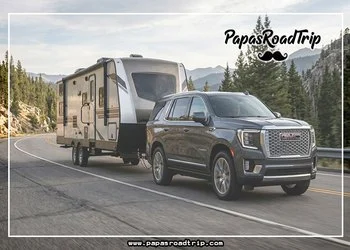
The 2025 GMC Yukon towing capacity ranges from 7,500 lbs to 8,400 lbs, depending on the model and how the SUV is built. A standard Yukon with the 5.3L V8 and two-wheel drive pulls up to 8,400 lbs. The longer Yukon XL and the off-road AT4 sit lower, at 7,500 to 7,800 lbs. Four-wheel drive also cuts the rating a little. This guide covers each trim, the numbers behind them, and what changes the figure once a trailer is hooked up.
What the tow rating really means
The tow rating is the most weight GMC says a properly equipped Yukon can pull. GMC publishes these numbers for each trim and build, and they assume a base vehicle with the right equipment. That means the max trailering package, the correct axle ratio and a weight-distributing hitch where needed.
The Yukon is a full-size SUV with three rows of seats. People buy it to move a family and still pull a boat, a camper or a work trailer. The rating is what makes that possible, and it’s why buyers compare trims so closely.
The misconception is simple. A lot of buyers think the top number applies to every Yukon on the lot. It doesn’t. The 8,400 lb figure belongs to a specific build, and a heavier trim or extra options can lower it. GMC’s own 2025 Yukon trailering guide lists the rating for each configuration, so check your exact build there before you trust a number.
Two numbers matter, and they aren’t the same. The tow rating covers what you pull behind the Yukon. Payload is what the SUV itself carries: passengers, cargo and the tongue weight of the trailer. A trailer light enough to tow can still push a loaded Yukon past its payload limit.
Read the door jamb sticker on the driver’s side. It lists the payload for that specific vehicle as built, and it beats any brochure figure. Subtract the weight of your family and gear, and what’s left is your real tongue weight budget.
If the sticker number works for your trailer, you’re fine. If it doesn’t, a lighter trailer or less gear is the fix, not a different hitch.
How to find your Yukon’s real tow number
- Open the driver’s door and read the certification label. It shows the gross vehicle weight rating (GVWR) for your exact SUV. This is your starting point, not the brochure.
- Find the gross combined weight rating (GCWR). GMC lists it in the owner’s manual for your trim and axle. It’s the total weight of the SUV, everything in it, and the trailer together.
- Weigh the Yukon as you’ll actually drive it. Load the family, the fuel and the gear, then use a public scale. A loaded SUV can be hundreds of pounds over its empty weight.
- Subtract that real weight from the GCWR. The gap is what’s left for the trailer and everything on it. This is the number that matters, not the marketing figure.
- Check the tongue weight. It should sit around 10% to 15% of the loaded trailer weight. Too little causes sway; too much pushes down the rear axle.
- Confirm the hitch and ball match the trailer. The ball size and hitch class must fit the trailer’s coupler, and a weight-distributing hitch is needed near the top of the range.
- Match the trailer’s loaded weight to your rating. Weigh the trailer loaded, not empty. Water tanks, fuel and gear add up fast.
The judgement call is between the brochure number and the scale. If your loaded SUV plus loaded trailer stays under the GCWR, you’re fine. If it doesn’t, no hitch setting fixes it — you need a lighter trailer or a bigger tow vehicle. Anything involving a commercial load or a vehicle over its rated limit is a legal and safety matter, so check with your state’s DMV or a licensed towing specialist.
2025 GMC Yukon towing capacity by model
These are the GMC-published maximums for properly equipped 2025 models. Your own build may sit lower, so confirm against the trailering guide for your trim.
| Your situation | What to drive | Figure that matters | What to watch for |
|---|---|---|---|
| Standard Yukon, 5.3L V8, 2WD | Max trailering package | Up to 8,400 lbs | Needs the right axle ratio |
| Standard Yukon, 5.3L V8, 4WD | Max trailering package | About 8,000 lbs | 4WD adds weight, cuts rating |
| Yukon with 6.2L V8, 2WD | Max trailering package | Around 8,200 lbs | Heavier engine, similar limit |
| Yukon XL, 5.3L V8, 2WD | Max trailering package | About 7,900 lbs | Longer body adds weight |
| Yukon AT4, 4WD | Standard AT4 equipment | About 7,500 lbs | Off-road gear lowers the cap |
| Yukon Denali, 6.2L V8 | Max trailering package | About 7,800 lbs | Luxury features add weight |
| Any trim near the top of its range | Weight-distributing hitch | 10%–15% tongue weight | Sway and rear-axle load |
Where good towing setups go right
The first thing careful owners do is weigh before they buy the trailer. They load the Yukon the way the family actually travels, then check the scale. That single step catches the gap between the empty SUV and the real one, and it’s where most surprises come from.
The second is the hitch setup. A weight-distributing hitch spreads the tongue load across both axles, and it’s needed once you’re near the top of the range. Getting the bars set right keeps the front wheels planted, which matters for steering and braking. A hitch that’s set too loose lets the trailer push the SUV around.
Partway through a trip, check the tire pressures cold and look at how the trailer sits. A trailer that runs nose-up or nose-down puts uneven load on the axles. Owners who tow often leave the SUV’s tow/haul mode on, which holds gears longer and reduces constant shifting.
What they leave alone is the SUV’s suspension and brakes. Changing springs or adding a lift can lower the rating and isn’t something to adjust on a guess. If the setup feels wrong, the fix is usually in the hitch, the load or the trailer — not the truck.
Common towing problems and fixes

| What you notice | What it usually means | What to do first |
|---|---|---|
| Trailer sways at speed | Too little tongue weight or a loose hitch | Reload gear forward, tighten the hitch |
| Rear of the SUV sits low | Tongue weight too high | Add a weight-distributing hitch |
| Brakes feel weak downhill | Trailer brakes not working or not set | Check the trailer brake controller |
| Transmission keeps shifting | Tow/haul mode off | Turn tow/haul mode on |
| Poor steering feel | Front axle unloaded by the trailer | Reset the weight-distributing bars |
Sway that starts around 55 mph and builds is almost always loading, not the Yukon. Move weight forward until the trailer tongue carries roughly 10 to 15 percent of the loaded trailer’s weight.
Weigh the tongue at a truck scale or with a bathroom scale and a lever. Guessing by feel is how people chase sway for a whole season.
If the rear squats but the trailer tracks straight, you need a weight-distributing hitch, not more air in the tires. Airbags level the truck but don’t move weight back to the front axle.
After hitching, measure the front fender height before and after. It should return close to its unloaded height once the bars are set.
Weak trailer brakes downhill usually mean the controller gain is too low or the breakaway battery is dead. Test the manual override in a parking lot before every trip.
Tow/haul mode holds gears longer and raises shift points. Leave it on any time the trailer is behind you, loaded or empty.
Rules and limits you should confirm
GMC sets the ratings, but the rules on the road come from other bodies. Your state’s DMV or motor vehicle agency sets registration, weight limits and licence classes for towing. Some states require a special endorsement for heavier trailers, so check before you plan a long trip.
The endorsement question is where owners get caught out. A Yukon Denali towing a large travel trailer can cross a state’s weight threshold for a non-commercial class, and the line differs by state. If you plan to cross state lines, check the strictest state on your route, not just your home state.
Your insurance company also matters. Tell them you tow, and confirm the trailer is covered. A policy that doesn’t list the trailer can leave you paying for damage yourself.
The hitch and ball must match the trailer’s coupler, and the trailer needs working brakes above certain weights — your state’s rules say where that line sits. If you’re unsure, a licensed hitch shop or your DMV can confirm it. Towing over the rated limit isn’t just unsafe; it can void coverage and put you on the wrong side of the law.
Keeping your tow setup in shape
After each trip, wash the hitch and check the ball for wear. A worn ball lets the coupler rattle and work loose. Look at the trailer tires for cracks and check the pressures cold before the next drive.
Store the weight-distributing bars clean and dry, and check the spring bars for bends. Keep a note of your loaded SUV and trailer weights so you don’t have to re-weigh every time. Re-check the setup whenever you add gear, change the trailer or carry extra passengers.
The sign it’s due for attention is a change in how the rig feels — new sway, a lower rear end or brakes that grab. Those tell you to re-check the hitch and the load before the next trip.
Grease the ball before each trip, not after. A dry ball wears a groove into the coupler, and a coupler that has worn thin won’t clamp tight no matter how far you crank the latch.
Check the receiver and the hitch bolts for looseness at the start of every season. On a Yukon the receiver takes the full trailer load, and bolts that have worked loose let the whole hitch shift under braking.
If you tow the same trailer all season, a full re-weigh once a year is enough. If you swap trailers, add a passenger load or move gear around, weigh again before the next long drive.
Replace the ball when you can feel a flat spot or see a step worn into it. A ball is cheap next to a coupler, and a coupler that lets go on the highway isn’t a repair you walk away from.
When the Yukon isn’t the right tow vehicle
The Yukon is the wrong choice if your loaded trailer sits near or above 8,400 lbs. A heavy fifth-wheel or a large travel trailer needs a proper pickup like a GMC Sierra 2500HD, which is built for that load.
Weigh your setup at a public scale before you decide, not after. Load the trailer as you would for a trip, fill the tank, and weigh the truck and trailer separately. A trailer that lists 7,800 lbs dry can pass 8,400 lbs once water, gear and batteries are aboard.
If the scale ticket lands within a few hundred pounds of the rating, treat the Yukon as maxed out. That margin disappears with passengers and cargo in the cab.
It’s also the wrong pick if you tow every week for work. A half-ton pickup with a longer bed and higher ratings handles constant loads better than a family SUV.
Count your towing days honestly. Ten weekends a season is occasional; three trips a week is a job, and the Yukon will wear faster doing it.
And if you only tow a small boat a few times a year, a smaller SUV saves fuel and money without giving up much.
Related guides
- Gmc Yukon Years to Avoid: Expert Guide to Smart Buying
- Gmc Yukon Xl Years to Avoid: Expert Tips for Smart Buyers
- Gmc Yukon Won’t Start Clicking Noise: Troubleshooting Guide
Frequently asked questions
What is the towing capacity of a 2025 GMC Yukon?
It ranges from 7,500 lbs to 8,400 lbs, depending on trim, engine and drive type. A standard 2WD Yukon with the 5.3L V8 and max trailering package reaches the top figure of 8,400 lbs. The AT4 and heavier trims sit lower, so check your exact build in GMC’s trailering guide.
Can a 2025 Yukon tow a 7,000 lb travel trailer?
Yes, most 2025 Yukon builds can tow a 7,000 lb trailer, as long as the loaded trailer and loaded SUV stay under the GCWR. Weigh both loaded, not empty. Keep tongue weight around 10% to 15% of the trailer weight and use a weight-distributing hitch.
Does 4WD lower the Yukon’s towing capacity?
Yes, it usually does. Four-wheel drive adds weight to the SUV, and that weight comes out of what’s left for the trailer. A 4WD Yukon typically rates a few hundred pounds lower than the same 2WD build. Check the trailering guide for your exact trim.
How much tongue weight can a 2025 Yukon handle?
Aim for 10% to 15% of your loaded trailer weight. For a 7,000 lb trailer, that’s 700 to 1,050 lbs on the hitch. The SUV’s hitch and rear axle have their own limits, so confirm the tongue weight rating for your build in the owner’s manual.
Is it safe to tow at the maximum rating?
It can be, if the SUV is properly equipped and every weight stays under its limit. The max figure assumes the right axle, hitch and trailer brakes. Towing at the limit leaves little margin for extra gear or passengers, so weigh everything and keep some room to spare.
What happens if I tow more than the Yukon’s rating?
You risk brake fade, sway and transmission strain, and you can lose control on a downhill or in wind. Towing over the limit can also void your insurance and break state weight rules. If your trailer is heavier, move to a larger tow vehicle.
Conclusion
Before you head to the dealer, jot down your trailer’s loaded weight and how many people and gear you’ll carry, then ask to see the specific door-jamb sticker on the exact Yukon you’re considering. That sticker is the final word, and it’ll keep you honest once you’re actually towing.