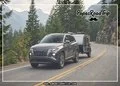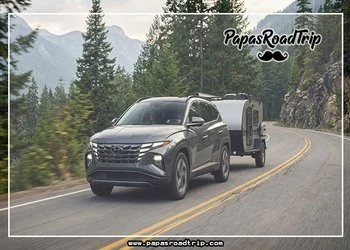


The Hyundai Tucson’s towing capacity depends on the model year, the engine, and whether it has all-wheel drive. For the current-generation Tucson sold in the US, Hyundai rates the 2.5L gasoline model at up to 2,000 lbs when properly equipped with a trailer brake setup. Most owners tow far less. This guide covers the real limits by year and trim, the tongue weight that matters, and the checks to make before you hitch a trailer.
What towing capacity really measures
Towing capacity is the maximum weight of a loaded trailer that Hyundai says the Tucson can pull safely. It’s not one fixed number. It changes with the engine, the drivetrain, and how the vehicle is equipped.
The rating covers the trailer and everything on it — cargo, water, tools, bikes. It doesn’t cover the people and luggage inside the car. Those count against a separate limit called the payload or gross vehicle weight rating (GVWR). This is the part many owners miss.
Say your Tucson is rated to pull 2,000 pounds and the whole family is aboard with a full tank and a trunk of gear. Subtract all of that from the GVWR before you trust the trailer number. A tongue weight of roughly 10 percent of the trailer counts against the SUV too, not just the trailer.
The Tucson is a compact SUV built mainly for passengers and daily driving. It’s for people who tow a small utility trailer, a light boat, or a pair of jet skis now and then. It’s not a truck.
The one misconception to drop: a big engine number on the spec sheet doesn’t mean the car can pull a heavy camper. The body, brakes, and cooling system set the real ceiling, not horsepower alone.
How to read Hyundai Tucson towing capacity
Start with the sticker, not the brochure. The driver’s door jamb has a label with your vehicle’s GVWR and axle ratings. That label is specific to your car, so it beats any general figure online.
- Find your model year and trim. Ratings differ between the 2016–2021 Tucson and the 2022-and-newer generation. Check the year first.
- Check the engine. The newer 2.5L gasoline engine carries the 2,000 lb rating in the US. Older and hybrid versions can be lower. Confirm in your owner’s manual.
- Confirm the drivetrain. All-wheel drive and front-wheel drive can be rated differently. Match your exact setup.
- Look for the tow package. A factory hitch and trailer wiring are rated for towing. A hitch added later may not match the factory rating.
- Add up your trailer’s loaded weight. Weigh it at a public scale, full of gear and water. Don’t trust the dry weight on the sales sheet.
- Keep tongue weight in range. Aim for about 10–15% of the loaded trailer weight on the hitch. For a 2,000 lb trailer, that’s roughly 200–300 lbs.
- Check the payload. Subtract the tongue weight, passengers, and cargo from your payload limit. If it goes negative, the trailer is too heavy for your setup.
The single judgement call that separates a safe tow from a risky one is the tongue weight. Too little and the trailer sways at speed. Too much and you overload the rear axle and lose steering grip. Aim for that 10–15% window and weigh it, don’t guess.
Towing a trailer safely needs practice with reversing, braking distance, and sway control. If you’ve never towed, take a lesson or start with an empty trailer on quiet roads before loading up.
Tucson towing figures at a glance
These are the ranges owners work with. Your exact number is on your door label and in your owner’s manual — check those before you tow.
| Your situation | What to do | Figure that matters | What to watch for |
|---|---|---|---|
| 2022+ Tucson, 2.5L, properly equipped | Tow a light trailer | Up to 2,000 lbs | Needs trailer brakes above the state limit |
| Older Tucson (2016–2021) | Check your manual first | Rating varies by year and engine | Often lower than the newer model |
| Hybrid Tucson | Confirm with Hyundai | Rating can be lower than gasoline | Don’t assume the 2,000 lb figure |
| Small utility trailer | Weigh it loaded | Keep under your rating | Gear and tools add up fast |
| Light boat or jet skis | Check tongue weight | 10–15% of trailer weight | Water and fuel add weight |
| Trailer without brakes | Stay light | Many states require brakes above 3,000 lbs | Check your state’s rule |
| Towing in hills or heat | Slow down, watch temperature | Coolant and transmission temp | Overheating on long climbs |
What careful Tucson owners do differently
Experienced towers load the trailer before they load the car. They put heavy items over the trailer’s axle, not at the back, because weight at the rear causes sway. Then they weigh the tongue with a bathroom scale or a gauge and adjust until it sits in the 10–15% range.
They also check tire pressure on both car and trailer cold, before the drive. Under-inflated trailer tires heat up and fail. On the Tucson, the rear tires carry the extra tongue load, so they run at the pressure listed on the door label for a loaded vehicle — not the lighter everyday pressure.
Partway through a long drive, they stop and feel the trailer hubs and tires with a hand. A hub too hot to touch means a bearing or brake problem. They also check that the hitch ball and coupler are locked and the safety chains are crossed under the tongue.
What they leave alone: they don’t add a heavy roof box and a full trailer at the same time. Roof load counts against payload and raises the center of gravity, which makes sway worse. They pick one.
A common mistake is trusting the dry weight on the trailer’s sales sheet. A 1,800 lb camper with water, propane, and gear can pass 2,000 lbs fast — and that puts you over the Tucson’s rating without any warning light.
Common towing problems and fixes

| What you notice | What it usually means | What to do first |
|---|---|---|
| Trailer sways at speed | Too little tongue weight, or load too far back | Move weight forward over the axle, re-weigh tongue |
| Rear of the car sags | Too much tongue weight or overloaded payload | Shift cargo, check payload math |
| Brakes feel weak | Trailer too heavy for the car’s brakes | Add trailer brakes, slow down |
| Transmission runs hot on hills | Working near the limit on a climb | Downshift, slow down, check fluid |
| Trailer lights don’t work | Wiring or connector problem | Check the plug and ground wire |
Sway that starts around 50 mph and builds is almost always loading, not the Tucson. Pull over at the first sign and move gear forward. If the tongue weight is already right and it still sways, check tire pressure on both vehicles before you blame the hitch.
Sag with a light trailer points at payload, not tongue weight. The Tucson’s rating assumes people and cargo in the car count against it, so a full trunk plus a loaded trailer can put you over even when the trailer itself is modest.
On a long climb, watch the temperature gauge rather than the speedometer. If it starts climbing, downshift and back off; pulling over for ten minutes costs less than a transmission.
Lights that work at the plug but not at the trailer usually mean a bad ground. Clean the contact points before replacing anything.
Rules and limits you should confirm
Towing law in the US is set by your state, not by Hyundai. Speed limits while towing, brake requirements for trailers, and mirror rules all come from your state’s department of motor vehicles or highway patrol. Check your state’s official page before your first tow — the rules differ a lot between states.
Some states require trailer brakes above a set weight, and that weight is often lower than people expect. If your loaded trailer crosses it, you need brakes on the trailer, not just a bigger hitch.
Hyundai’s own limit is the one in your owner’s manual and on the door label. That’s the figure the warranty and safety rating rest on. Going over it can affect your coverage, so confirm it for your exact year and trim rather than trusting a forum post.
Also check your trailer’s own rating and its tire load limit. The weakest link sets the safe maximum, and it’s often the trailer, not the car. A trailer rated for less than your Tucson cancels out the car’s figure entirely.
If you plan to tow near the limit regularly, or tow a heavy camper, that’s beyond what a compact SUV is built for. Talk to a dealer or a towing specialist about a vehicle rated for that load.
Keeping your tow setup in good shape
After each trip, rinse the hitch ball and coupler and add a little grease to stop rust and wear. Check the hitch bolts for tightness once a season, and look at the wiring connector for corrosion — a green tint means it needs cleaning.
Store the trailer with the tongue supported and the tires off bare ground if you can. Trailer tires age even when they sit, so check them for cracks before each season, not just tread depth.
The sign that your setup needs attention again is a change in how it feels: new sway, a sag, or a hot hub. Those tell you to re-check weight and hardware before the next tow.
Feel the hubs by hand after the first few miles of any tow, then again at each stop. A hub that’s too hot to hold means a bearing or brake problem, and you should stop rather than push on.
On the Tucson, the hitch and wiring are dealer-fit accessories, so ask the dealer to check the bolts and connector at your first service after fitting. If you tow often, have the bolts checked at every oil change instead of once a year.
For the car itself, follow the maintenance schedule in your owner’s manual, and check the NHTSA recall page for your VIN before a long trip.
When a Tucson isn’t the right tow vehicle
A Tucson is the wrong choice if your loaded trailer passes its rating — a heavy camper, a car trailer, or a large boat. No hitch or brake upgrade raises the car’s structural limit. For those loads, you need a vehicle rated for them, like a mid-size or full-size truck.
Weigh the trailer loaded, not empty. Water, propane, batteries and gear add up fast, and a camper that looked fine on the lot can go over the rating before you leave the driveway. A public scale settles it for a few dollars.
It’s also the wrong choice for frequent long-distance towing in mountains. The compact drivetrain and cooling system work harder than a truck’s, and repeated heavy climbs wear them faster. One mountain trip a year is fine if you stay under the rating. A summer of them is not.
And if you tow only once or twice a year, renting a truck for those trips can cost less than buying and maintaining a trailer setup for a car that isn’t built for it. Price the rental against a hitch, wiring, a brake controller and trailer upkeep before you decide, and remember that how often you service the setup depends on how you use it, with the owner’s manual as the authority.
Related guides
- Hyundai Tucson Troubleshooting: Quick Fixes & Tips
- Hyundai Tucson Years to Avoid: Expert Guide to Smart Buying
- Toyota Highlander Tow Package: Ultimate Guide to Towing Power
Frequently asked questions
Can a Hyundai Tucson tow 3,500 lbs?
No. The current US-market Tucson with the 2.5L engine is rated at up to 2,000 lbs when properly equipped. A 3,500 lb trailer is well over that. Ratings in other countries can differ, so check your own owner’s manual and door label rather than a US figure.
How much can a Hyundai Tucson tow without trailer brakes?
It depends on your state, not just the car. Many states require trailer brakes above roughly 3,000 lbs, which is already over the Tucson’s rating. In practice, keep any unbraked trailer well under 2,000 lbs and check your state’s DMV rule.
Why does my Tucson’s towing capacity change by year?
Because Hyundai changes engines, cooling, and drivetrain options between generations. The 2022-and-newer Tucson with the 2.5L engine carries the 2,000 lb US rating. Older and hybrid versions can be rated lower. Your owner’s manual for your exact year is the source to trust.
Is it safe to tow at the maximum rating?
Yes, if the trailer is loaded correctly and you stay within every limit — trailer weight, tongue weight, and payload. The risk comes from going over one of them. Weigh your loaded trailer and keep tongue weight at 10–15% before you trust the number.
What happens if I tow more than the Tucson’s rating?
You overload the brakes, suspension, and cooling system, and you can lose control in a stop or a swerve. It can also affect your warranty and put you at fault in a crash. The rating exists for a reason — stay under it.
How much tongue weight can a Tucson handle?
Aim for about 10–15% of your loaded trailer weight on the hitch. For a 2,000 lb trailer, that’s roughly 200–300 lbs. Your payload limit also caps it, so subtract tongue weight, passengers, and cargo from your payload before you load up.
Conclusion
Before you buy or borrow a trailer, check your own Tucson’s door-jamb sticker and owner’s manual, since the ratings vary by year and setup. If anything’s unclear, call a Hyundai dealer with your VIN—they’ll confirm what your vehicle can safely handle.