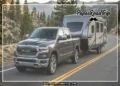


The 2013 Toyota Tacoma can tow up to 6,500 pounds in 4×2 V6 form with the towing package. The 4×4 V6 drops to 6,400 pounds, the four-cylinder 4×2 is rated around 3,500 pounds, and the four-cylinder 4×4 around 3,400 pounds. Toyota lists these in the owner’s manual and the Toyota Tacoma towing guide. This guide shows how the cab, bed, drivetrain and tongue weight change those numbers.
What the rating really means

The 2013 Toyota Tacoma towing capacity is a maximum figure set by Toyota for each build. It assumes a base truck: a driver, full fluids, and nothing else in the bed. Add passengers, tools or a camper shell and the real limit drops. That’s because the truck has a second ceiling — the Gross Vehicle Weight Rating (GVWR) — that covers the truck’s own load plus the tongue weight of the trailer.
It’s a mid-size pickup from the second generation, sold in the US for the 2013 model year. People use it for small boats, utility trailers, campers and light work loads. It isn’t a heavy-duty hauler, and it was never built to be one.
One misconception follows this truck everywhere: that every Tacoma tows the same. It doesn’t. A four-cylinder Access Cab and a V6 Double Cab 4×4 are different tools with different limits, and the gap between them is thousands of pounds. Two trucks that look alike on a lot can have very different ratings.
Toyota prints the exact figure for your truck on a label inside the driver’s door jamb. That label, not a forum post, is the number that applies to your vehicle.
How to read your own Tacoma’s rating
- Open the driver’s door and find the certification label. It lists GVWR and GAWR (axle limits) for your exact truck. This takes 1 minute and settles most arguments.
- Check the engine. The 2.7L four-cylinder and the 4.0L V6 have very different ratings. The V6 is the one that reaches the 6,500 lb figure.
- Check the drivetrain. A 4×2 V6 is rated 6,500 lbs with the towing package. A 4×4 V6 is rated 6,400 lbs. The 4×4 hardware adds weight, and that weight comes off the tow rating.
- Confirm the towing package. The V6 tow package includes a receiver hitch, a transmission cooler and an upgraded alternator. Without it, don’t assume the top figure applies — check the manual for your build.
- Work out your payload. Take the GVWR from the label and subtract the truck’s actual weight (a public scale gives this for a small fee). What’s left covers passengers, cargo and tongue weight.
- Set your tongue weight. Aim for 10–15% of the loaded trailer weight on the ball. A 5,000 lb trailer wants roughly 500–750 lbs of tongue weight, and that counts against payload.
- Weigh the loaded trailer at a scale. Trailer weight on paper and trailer weight with water, fuel and gear are two different numbers.
The judgement call that decides everything: you’re limited by whichever ceiling you hit first — the tow rating or the payload. A V6 Tacoma with four adults, a bed full of gear and a 6,000 lb trailer can be over on payload while still “under” its tow rating. Weigh the whole rig once, loaded, and you’ll know.
2013 Tacoma towing capacity by build
Here are the main configurations. Treat these as starting points and confirm against your door label and owner’s manual.
| Your truck | What to plan for | Figure that matters | Watch for |
|---|---|---|---|
| 4×2 V6 with tow package | Boats, utility trailers, small campers | Up to 6,500 lbs | Payload runs out before tow rating |
| 4×4 V6 with tow package | Same loads, rougher access | Up to 6,400 lbs | Extra drivetrain weight cuts payload |
| V6 without tow package | Light trailers only | Below the top figure — check manual | No trans cooler; heat builds on grades |
| 4-cylinder 4×2 | Small utility trailers, jet skis | Around 3,500 lbs | Slow on hills; plan the route |
| 4-cylinder 4×4 | Very light loads | Around 3,400 lbs | Least headroom of all builds |
| Any build, tongue weight | Stability at speed | 10–15% of trailer weight | Too little causes sway |
| Any build, payload | People plus cargo plus tongue | GVWR minus curb weight | Often the real limit |
What experienced towers get right
The first thing they do is load the trailer, not the truck. Gear goes over the trailer’s axles and slightly ahead of them, never at the very back. A trailer loaded tail-heavy will sway at highway speed no matter how good the hitch is, and no weight-distribution bar fixes a badly loaded trailer.
They also check the hitch height before hitching up. The trailer should sit level, or slightly nose-down. A nose-high trailer puts less weight on the ball and invites sway; a nose-down one adds tongue weight you may not have payload for. Adjust the ball mount, not the load.
Checks partway through
After the first 10–20 miles, pull over somewhere safe. Put a hand near each trailer hub — a hub that’s hot to the touch means a bearing or brake problem, and it’s better found now than on a mountain pass. Check the hitch, the safety chains and the lights. Re-check the load straps; they loosen as the load settles.
On the 4.0L V6, the automatic transmission is the part that works hardest. On long climbs, dropping out of overdrive keeps the transmission from hunting between gears, and that keeps heat down. Toyota’s owner’s manual covers this for your specific build.
What they leave alone: the truck’s factory suspension and brakes, unless a scale says they’re overworked. Adding parts doesn’t raise the rating on the door label, and it can make the truck ride worse when empty.
Common towing problems and fixes

| What you notice | What it usually means | What to do first |
|---|---|---|
| Trailer sways at speed | Too little tongue weight or tail-heavy load | Move cargo forward, re-check the 10–15% target |
| Truck feels light in front | Tongue weight too high for payload | Shift load back slightly or remove cargo from the bed |
| Transmission runs hot on hills | Torque converter working hard under load | Slow down, drop out of overdrive, check fluid level |
| Trailer lights don’t work | Wiring connection or a blown fuse | Check the plug, then the truck’s fuse box |
| Brakes feel weak stopping | Trailer overloading the truck’s brakes | Weigh the trailer; add trailer brakes if it’s heavy |
Sway that starts only above 55 mph and settles when you slow down is usually loading. Sway that begins at 40 mph points to a bent axle or mismatched tire pressure.
On the Tacoma, the tow rating assumes a driver and a full tank of fuel. Every passenger and every pound in the bed comes off the payload figure on the door jamb sticker, not the brochure.
If the truck squats at the rear and the steering feels vague, stop and move weight before you drive another mile. That combination is the one that ends in a highway accident.
Check the trailer plug with the key on and the engine off. If the lights work then but fail once the engine runs, the fault is the ground, not the fuse.
Rules and limits you should confirm
Toyota publishes the ratings, and the owner’s manual for your model year is the document that applies to your truck. Read the towing section before you buy a trailer, not after. It covers the tow package contents, the tongue weight target and the break-in advice for a new truck.
Your state’s DMV sets the registration and weight rules. Many states require trailer brakes above a certain trailer weight, and that threshold differs by state — check your state DMV’s website for the figure that applies where you live.
Your auto insurer sets the policy terms. Ask whether your trailer needs its own coverage and whether the truck’s policy covers a trailer you’re towing. Get the answer in writing before a trip.
If your combined rig approaches or passes 26,001 lbs gross combination weight rating, federal commercial-driving rules can apply — that’s a question for the FMCSA or your state DMV, not a guess. Anything involving trailer brake installation or hitch welding is a job for a qualified shop.
Keeping the setup sound over time
Write the numbers down once: GVWR, curb weight, your loaded trailer weight and your tongue weight. Keep that sheet in the glovebox. When you add a camper shell, a winch bumper or a bed full of tools, the payload number changes, and you’ll want the old figure to compare against.
Re-weigh the rig whenever the load changes meaningfully — a new trailer, a different boat, a move across the country. A public scale costs little and takes minutes.
Check tire pressures on both truck and trailer before every trip. Under-inflated trailer tires run hot and fail; the pressure figure is on the trailer tire’s sidewall, and it assumes a cold tire.
The sign that service is due: the transmission fluid looks dark or smells burnt, or the truck shifts differently under load. Check the fluid against the owner’s manual’s schedule rather than a number someone quoted online.
On a Tacoma that tows often, the rear leaf springs and the hitch hardware deserve a look at every oil change. Look for cracked or flattened leaves and loose or rusted hitch bolts.
If you tow the same trailer all season, one weigh-in at the start is enough. If the load changes trip to trip, weigh each time.
Torque the lug nuts on the truck and trailer to the owner’s manual spec after any wheel work, and check them again after the first 50 miles of a trip. A trailer wheel that works loose at highway speed is the failure that ends a weekend early.
When a Tacoma isn’t the right truck

If your loaded trailer sits above 6,500 lbs, this truck is the wrong choice. No hitch, airbag or tune changes the door label. Step up to a full-size pickup with a higher rating.
The gap matters most on long grades and at highway speed, where a trailer near the limit leaves no reserve for a headwind or a passing lane. If your trips stay local and flat, a Tacoma at 6,000 lbs is workable. If they cross mountain passes, move up.
If you tow a heavy trailer every week, the Tacoma’s payload and transmission will wear faster than a heavier truck’s. A three-quarter-ton truck costs more up front and less in repairs over years of daily towing.
If your family plus gear plus tongue weight exceeds payload on a V6 Tacoma — common with a camper and four adults — you need more payload, not more hitch. Check the numbers before you shop for the trailer.
The mistake is buying the trailer first and the truck second. Shoppers fall for a camper that fits the hitch rating, then find four people and their gear push them past payload. Weigh the tongue, count the passengers, then pick the truck.
Related guides
- Toyota Highlander Tow Package: Ultimate Guide to Towing Power
- Toyota Tacoma Transmission Problems: Quick Fixes
- Toyota Tundra Tow Package: Maximize Hauling Power Today
Frequently asked questions
What is the towing capacity of a 2013 Toyota Tacoma V6?
Up to 6,500 lbs for a 4×2 V6 with the towing package, and 6,400 lbs for a 4×4 V6. Those figures assume a base truck with a driver and full fluids. Passengers, cargo and tongue weight come off your payload, so your real limit is often lower. Check the label in your driver’s door jamb.
Can a 4-cylinder 2013 Tacoma tow a car trailer?
Usually no, not safely. The four-cylinder 4×2 is rated around 3,500 lbs, and a car plus a steel trailer often weighs more than that. Weigh the trailer and car together at a scale before you decide. If the total is over your rating, use a bigger truck.
How much tongue weight can a 2013 Tacoma handle?
Aim for 10–15% of your loaded trailer weight on the ball — roughly 500–750 lbs for a 5,000 lb trailer. That weight counts against payload, not just the tow rating. Check your door label’s GVWR and subtract the truck’s weight to see what’s left.
Is it safe to tow at the maximum rating?
Yes, if you stay under both the tow rating and the payload limit, and load the trailer correctly. Towing at the maximum leaves no margin for hills, heat or wind. Many experienced towers stay 10–20% below the top figure for long trips, especially in mountains.
What happens if I tow more than the rating?
You overload the truck’s brakes, transmission and frame beyond what Toyota designed for. Handling gets worse, stopping distances grow, and you may be outside your insurance terms if there’s a crash. The rating on the door label is a limit, not a target.
How often should I check the transmission fluid when towing?
Check it before each towing season and any time the fluid looks dark or smells burnt. Towing works the automatic transmission harder than normal driving. Follow the schedule in your owner’s manual for your build, and check the level on a level surface with the engine at operating temperature.
Does a lift kit change my towing capacity?
No. A lift kit doesn’t change the rating Toyota printed on your door label. It can change how the truck handles a trailer, and a tall lift can make hitching and stability worse. If you’ve lifted the truck, keep well below the top figure and check the hitch height.
Conclusion
Before you hook up a trailer, check the sticker inside your driver’s door jamb and your owner’s manual for the ratings that apply to your exact truck. If you’re still shopping, bring the trailer’s weight and tongue weight to the dealer and ask them to confirm the setup fits.