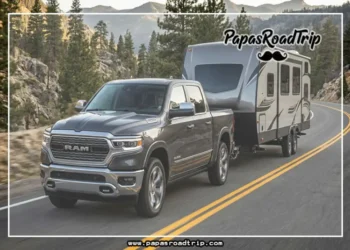


The 2023 Ram 1500 towing capacity ranges from 6,390 lbs to 12,750 lbs. The 12,750-lb figure belongs only to the rear-wheel-drive Quad Cab 4×2 with the 5.7L HEMI V8 and the Max Tow Package. A standard 4×4 Crew Cab with the same engine tows less. This guide covers the real limits by cab, bed, drive type and axle ratio, and the payload number that decides whether you can actually use that rating.
What Towing Capacity Actually Means
The rating is the maximum weight of a loaded trailer the truck is built to pull. Ram publishes it for each build, and the number changes with the body style, the engine, the axle ratio and whether the truck drives two wheels or four. It’s not one number for “a Ram 1500” — it’s one number per build, and your door jamb label’s payload and axle ratings are what actually limit your setup.
You use it to match a trailer to your truck before you buy or borrow one. It’s aimed at people who tow a boat, a travel trailer, a flatbed with equipment or a car hauler a few times a year, not at commercial hotshot drivers.
The misconception people bring is this: they read the biggest number in the brochure and assume their truck does it. A Ram 1500 built for heavy towing has specific options, and most trucks on a dealer lot don’t have them. The rating is a build spec, not a model-wide promise.
One rule you can trust: the door jamb label’s gross vehicle weight, axle and payload ratings are the physical limits for your exact truck, and they win over any brochure figure.
How to Find Your Truck’s Real Limit
- Read the door jamb label first. Open the driver’s door and find the sticker with the tire and loading information. It lists the front and rear gross axle weight ratings and the total payload for your truck as built. Write those down.
- Check the axle ratio. Look at the window sticker or the build sheet from Ram or a dealer. The 3.92 ratio tows more than the 3.21, and that single option moves the rating by thousands of pounds.
- Confirm the Max Tow Package. It’s a specific option group, not standard. If your truck doesn’t have it, cross the top figure off your list.
- Weigh the truck loaded. Fill the tank, add your passengers and gear, and weigh it at a public scale. Subtract that from the gross vehicle weight rating on the label. The result is your real payload.
- Subtract the tongue weight. Take 10–15% of the loaded trailer weight as a starting tongue weight, then take that off your payload. What’s left is what you can still carry in the cab and bed.
- Check the trailer’s gross weight, not its dry weight. Use the trailer’s gross vehicle weight rating plate. Water, propane and gear add up fast.
- Compare the two numbers. If the loaded trailer weight is under your rating and the tongue weight fits inside your payload, you’re good. If either one fails, the truck isn’t right for that trailer.
The judgement call that separates a safe setup from a nervous one is payload, not towing capacity. Almost every half-ton truck runs out of payload before it runs out of towing rating. A trailer that sits comfortably under the tow number can still overload the truck once people, fuel and tongue weight are counted.
If your setup needs a weight-distribution hitch, brake controller wiring or a commercial inspection, that’s work for a trailer shop or your state’s motor vehicle office, not a driveway guess.
2023 Ram 1500 Towing Numbers by Build
The table below covers the main combinations. Figures assume a properly equipped truck with the listed engine and axle, a driver only, and no extra cargo.
| Your setup | What to use | Rating that matters | Watch for |
|---|---|---|---|
| V6 eTorque, 4×2 | Pentastar V6 with 3.55 axle | Around 7,730 lbs | Lowest rating in the range; light trailers only |
| V6 eTorque, 4×4 | Pentastar V6 with 3.55 axle | Around 7,300 lbs | Four-wheel drive cuts the figure |
| 5.7L HEMI, 4×2, standard | HEMI with 3.21 axle | Around 8,000–8,500 lbs | Common rental and fleet build |
| 5.7L HEMI, 4×2, Max Tow | HEMI with 3.92 axle and Max Tow Package | Up to 12,750 lbs | Needs the exact package and Quad Cab body |
| 5.7L HEMI, 4×4 Crew Cab | HEMI with 3.92 axle | Around 11,000 lbs | Payload drops with the bigger cab |
| 3.0L EcoDiesel, 4×4 | Diesel with 3.92 axle | Around 12,500 lbs | Check the specific cab and bed combo |
| Any build, payload check | Door jamb label | Payload, often 1,300–1,800 lbs | Tongue weight comes out of this first |
Ram publishes the full chart in its 2023 Ram 1500 towing and payload guide. Use it to confirm your exact combination, then trust your door label over the chart.
Where Good Setups Go Wrong
The order you work in matters more than the equipment. Start with the trailer’s loaded weight, then check payload, then look at the rating. People who start with the rating and work backward usually talk themselves into a setup that’s over on payload.
Experienced towers weigh the truck once, fully loaded, and keep that number. It doesn’t change unless the load does, and it turns every future trailer question into simple subtraction. They also set the hitch height with the trailer loaded, not empty, because a trailer squats when it’s full.
Partway through a trip, they check the hitch ball nut, the safety chains and the tire pressures on both vehicles. A trailer tire running low is the most common cause of a blowout on the shoulder.
What they leave alone is the truck’s suspension and the trailer’s brakes. Adding airbags or helper springs doesn’t raise the ratings on the door label, and it doesn’t make an overloaded truck legal.
Common Towing Problems and Fixes

| What you notice | What it usually means | What to do first |
|---|---|---|
| Trailer sways above 55 mph | Too little tongue weight, or the load sits too far back | Move cargo forward to reach 10–15% tongue weight |
| Rear of the truck sits low | Tongue weight is over payload, or the hitch is set too high | Weigh the tongue and check the door label |
| Brakes feel weak downhill | Trailer brakes aren’t working or aren’t adjusted | Test the brake controller before the next trip |
| Truck feels light in the front | Weight distribution is off | Reset the weight-distribution hitch with the trailer loaded |
| Tires wear fast on the rear | Overloading, or wrong tire pressure for the load | Check pressures against the door label |
Sway that starts around 55 mph and builds is almost always a loading problem, not a truck problem. Slow down, pull over, and shift weight forward before you blame the Ram.
If the rear sags only when the trailer is loaded, weigh the tongue on a public scale rather than guessing. A bathroom scale under the jack works for lighter trailers.
Weak trailer brakes on a downhill grade usually mean the controller gain is set too low for the load. Test it in an empty lot at low speed before you trust it on a pass.
Tires that wear fast on the rear while the fronts look fine point to overloading or underinflation for the load. Check pressures cold, against the door label, not the tire sidewall.
One mistake costs people a set of tires or a white-knuckle descent: fixing the symptom without reweighing the whole rig. After any change, load the trailer as you’ll tow it and check tongue weight and pressures again.
Rules and Paperwork to Check
Before you hook up, confirm four things for your own truck and state. First, the door jamb label — its weight ratings are specific to your build and are what you must stay within.
Second, your state’s trailer brake and lighting rules; most states require brakes above a certain trailer weight, and your state motor vehicle department publishes the figure. Third, your driver’s license class — some states require a different class for heavier trailers. Fourth, your insurance policy, which may exclude commercial towing.
The door jamb label’s payload and axle ratings beat any brochure or dealer claim, and they decide whether your truck can carry the tongue weight of a trailer rated within Ram’s published 2023 figures. Those numbers describe a properly equipped truck in a specific configuration. Your truck’s label describes yours, with the options, cab and bed it actually left the factory with.
Ram’s own owner’s manual covers the hitch setup, the break-in period for a new truck and the tongue weight guidance for your build. Read the towing section for your cab and bed, because the instructions differ.
Break-in matters if the truck is new. Follow the manual’s mileage figure before you tow anything heavy, and check the fluid and hitch torque specs it lists for your first long pull.
If you’re towing for hire, or the combined weight crosses your state’s commercial threshold, that’s a question for your state motor vehicle office and a commercial insurance broker. Don’t guess on it.
Keeping the Setup Reliable
Once the truck and trailer are matched, keep a simple record: the loaded truck weight, the trailer’s loaded weight and the tongue weight. Write them on a card in the glovebox. Any future trailer decision starts from those three numbers, and you won’t have to weigh everything again.
Weigh the truck with the trailer hitched and loaded, not empty. A 1500 with the 5.7-liter Hemi and a mid-size travel trailer can gain several hundred pounds of tongue weight once water and gear go in. An empty-truck number tells you nothing about that.
Check the hitch hardware, the safety chains and the breakaway cable before every trip. Look at the trailer tires for cracks and check pressures cold. After a long trip, inspect the receiver and the ball for wear.
Bring the setup back to spec by reweighing after any change — new gear, a different trailer, a passenger load that grew. The sign it’s due is simple: if the truck sits lower than it did on the last trip, reweigh before you drive.
When a Ram 1500 Isn’t the Right Truck

A Ram 1500 is the wrong choice when your loaded trailer sits near the top of the chart and you also carry a family and gear. Payload runs out first, and a heavier truck handles that better. A Ram 2500 or a comparable three-quarter-ton truck is the honest answer there.
Run the numbers before you shop, not after. Take the trailer’s loaded weight, add the weight of every person and every pound of gear that rides in the cab and bed, and compare that total to the payload figure on the driver’s door jamb of the specific truck you’re looking at. That sticker beats any brochure claim, because it reflects that truck’s own options.
It’s also wrong when you tow every week for work. Half-ton trucks are built for occasional heavy loads, and the wear adds up faster with daily towing.
And it’s wrong when the trailer’s gross weight is over your rating by any amount, even a few hundred pounds. No hitch, airbag or tire change fixes that — you need a different truck or a lighter trailer.
Related guides
- Do Airbags Increase Payload Capacity
- Does Ford Use Real Leather? Truth Revealed!
- Does Honda Use Real Leather? Truth Revealed!
Frequently asked questions
What is the max towing capacity of a 2023 Ram 1500?
It’s 12,750 lbs, and that figure applies only to the rear-wheel-drive Quad Cab with the 5.7L HEMI, the 3.92 axle ratio and the Max Tow Package. Any other build tows less. Check your door jamb label and the Ram towing chart for your exact truck.
Can a 2023 Ram 1500 tow a 10,000 lb trailer?
Yes, if your truck is a HEMI or EcoDiesel build with the 3.92 axle and enough payload left for the tongue weight. A V6 truck can’t. Take 10–15% of 10,000 lbs as tongue weight — 1,000 to 1,500 lbs — and check it against your payload.
How much can a 2023 Ram 1500 with the V6 tow?
Around 7,730 lbs in rear-wheel drive and about 7,300 lbs in four-wheel drive, assuming the standard axle and no heavy options. That’s enough for a small boat or a light utility trailer, not a large travel trailer.
Does 4×4 reduce towing capacity on a Ram 1500?
Yes. Four-wheel-drive hardware adds weight to the truck, and that weight comes off both payload and towing capacity. The gap is usually a few hundred pounds, so check the chart for your exact cab and bed.
How much payload does a 2023 Ram 1500 have?
It varies by build, and most trucks land somewhere between 1,300 and 1,800 lbs. Your door jamb label has the exact figure. Payload is what’s left for people, cargo and tongue weight after the truck’s own weight.
Is it safe to tow at the maximum rating?
It’s safe only when the truck is loaded within payload, the tongue weight is correct, the trailer brakes work and the hitch is rated for the load. Towing at the max rating with a full cab and bed usually means you’re over on payload, which isn’t safe.
What happens if I tow more than my rating?
You overload the truck’s axles, brakes and tires beyond what they’re built for. Handling gets worse, stopping distances grow and you may be legally liable in a crash. Your insurance policy may also not cover you if the truck was operated outside its ratings. The rating on the door label is the limit.
Conclusion
The number that decides your setup isn’t the headline towing figure — it’s the payload on your own door jamb label. Weigh the truck loaded, subtract the tongue weight, and let that answer tell you which trailer you can pull.