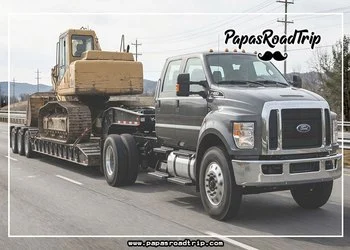
The ford f650 towing capacity depends on how the truck is built. The figure isn’t fixed for every F-650, though — rear axle ratio, body style, wheelbase and the upfitter’s rear frame all move it. Here’s how the rating is set, and how to read the one for the truck in front of you.
What an F-650 actually is
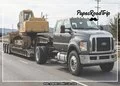
The F-650 is a medium-duty commercial truck, not a heavy pickup. Ford builds it as a bare chassis and cab — engine, frame, axles and brakes — and an upfitter adds the flatbed, dump body, box or tow body on top. That’s the first thing to hold in your head, because the truck you see on a dealer lot is rarely the truck Ford rated.
Ford sells it in Regular Cab, SuperCab and Crew Cab, with two engine choices: the 6.7L Power Stroke diesel and the 6.8L gas V10. Buyers are fleet operators, landscapers, tow companies, contractors and anyone who needs more truck than an F-350 but doesn’t want a full Class 8 tractor. It sits between the F-450/F-550 and the bigger F-750.
The misconception to drop now: people treat the F-650 like a pickup and assume one number covers every truck. It doesn’t. Ford publishes a range of ratings for the F-650 line, and the exact rating for your truck lives on a label on the driver’s door jamb and in the Ford chassis owner’s manual — not on a spec sheet online.
How the towing rating gets set
- Start with the engine. The 6.7L Power Stroke diesel is the towing engine. The 6.8L gas V10 is cheaper but pulls less, and it’s the one to avoid if heavy trailer work is the whole point of the truck.
- Check the rear axle ratio. A taller (numerically higher) ratio like 4.88 or 5.57 pulls harder and is what Ford pairs with the top tow ratings. A highway-friendly ratio trades pulling power for fuel economy.
- Confirm the cab and wheelbase. A Regular Cab with a short wheelbase is the lightest configuration and carries the highest rating. Crew Cab and long-wheelbase trucks add weight and lose some capacity.
- Read the door-jamb label. This is the GVWR (gross vehicle weight rating) and GAWR (axle ratings) for your truck. Every later calculation depends on these numbers, not on a brochure.
- Subtract the body and cargo. The upfitter’s flatbed or dump body, the fuel, the driver and the crew all eat into what’s left for the trailer. This is where most real-world ratings fall short of the headline.
- Match the hitch and the trailer. A gooseneck or fifth-wheel setup, a receiver hitch, and the trailer’s own GVWR all have to line up. A hitch rated below the truck’s capacity caps the whole job.
- Confirm with the trailer brake controller and wiring. A trailer this heavy needs working electric brakes on every axle. If the controller isn’t installed and tested, the truck isn’t ready.
The judgement call that separates a good result from a bad one is step 5. Two F-650s with the same engine and axle can have very different real towing numbers once one carries a 3,000 lb dump body and the other a bare flatbed. Weigh the truck loaded, then subtract.
If your setup crosses into Class 7/8 territory or you’re unsure about CDL rules for your state, that’s a conversation for your state DMV and a commercial truck insurer — not a do-it-yourself guess.
Ford F-650 towing capacity at a glance
These are the figures Ford publishes for the F-650 line, and they assume a stock chassis with no upfitter body, a driver only, and a properly rated hitch and trailer brakes. Add the body and cargo and your real number drops.
| Your situation | What to use or do | Figure that matters | What to watch for |
|---|---|---|---|
| Truck with a flatbed, dump or box body | Weigh it loaded, then subtract | GVWR minus actual curb weight = real trailer allowance | The body can eat thousands of pounds of capacity |
| Any F-650 with a receiver hitch | Match hitch rating to trailer | Hitch rating caps the truck, not the other way round | A Class IV hitch on a 32,500 lb truck is a mismatch |
| Trailer with no working brakes | Don’t tow it | Every axle needs working electric brakes | Test the controller before you load |
What separates a good tow setup from a bad one
Experienced operators weigh the truck before they ever hook up a trailer. They load it the way it’ll run — fuel full, body on, tools and crew aboard — and put it on a scale. That number, subtracted from the GVWR on the door jamb, is the only trailer weight that’s actually safe. The brochure figure is a ceiling, not a promise.
They also check the order of the hookup. Hitch first, then safety chains crossed under the tongue, then the breakaway cable, then the electrical plug, then the lights and brake test. Skipping the brake test is the mistake that costs people a trailer — a controller that isn’t communicating means the trailer’s brakes aren’t working, and a 20,000 lb trailer with no brakes will push a loaded truck through an intersection.
What they leave alone matters too. They don’t chase the highest possible number by overloading the truck to “make it work.” They don’t run a gas V10 on a job that needs a diesel. And they don’t trust a dealer’s verbal rating — they read the label.
The rating for your specific F-650 depends on the exact model year, cab, axle ratio and upfitter body, and Ford publishes a separate towing guide for each model year. Read your own truck’s door-jamb label and the towing guide for its year — those two documents settle it.
Common F-650 towing problems and fixes

| What you notice | What it usually means | What to do first |
|---|---|---|
| Truck feels light in the front on the highway | Trailer tongue weight is too high or the load is behind the axles | Shift cargo forward, re-weigh the tongue |
| Trailer brakes won’t engage | Controller not wired, not set, or the plug is corroded | Test the controller, clean the plug, check the ground |
| Truck sags at the rear | Rear axle is overloaded | Weigh each axle against the GAWR on the label |
| Rating on the door jamb is lower than the brochure | Upfitter body weight is eating the capacity | Weigh the truck loaded, subtract from GVWR |
| Trailer wanders at speed | Hitch height wrong or load unbalanced | Level the trailer, check tongue weight |
| Overheating on long grades | Diesel working at its limit in summer heat | Slow down, check coolant, consider a lower gear |
The rules that apply
Before you tow anything heavy with an F-650, four things decide whether you’re legal and safe, and each has a place to check it. First, the Gross Vehicle Weight Rating on your door-jamb label — that’s the federal label Ford installs, and it’s the number every other calculation hangs on. Second, your state’s CDL threshold: many states require a commercial license above 26,001 lbs GVWR, and your state DMV publishes the exact rule for your truck and trailer combination.
Third, the Federal Motor Carrier Safety Administration sets the rules for commercial operation, including driver qualification and hours of service, if you’re running the truck for business. Check FMCSA’s own published guidance for your operation. Fourth, your insurance carrier’s requirements for a commercial truck — some require a specific endorsement or a driver record check.
If your combination crosses into CDL territory or you’re hauling for hire, that’s a conversation for your state DMV and a commercial truck insurer. Don’t guess at it.
Keeping the truck tow-ready
Once the setup is dialed in, the work shifts to maintenance. Check the trailer brake controller before every trip — a quick test in the driveway catches most failures. Inspect the hitch, the pin box or the receiver, and the safety chains for cracks or wear at each service interval your Ford chassis manual lists.
Tire pressure matters more on a loaded truck than most owners realize. Run the pressures on the door-jamb label, and check them cold. A soft tire on a loaded rear axle is where blowouts start.
On an F-650 the rear axle does the heavy lifting, so those inner duals deserve a gauge, not a kick. Reach in and check each one separately; a dual that looks fine from the outside can be the low one.
Keep a written log of the truck’s loaded weight — it doesn’t change unless the body or the crew changes, and having it on paper saves you re-weighing every time. Re-weigh after any upfit change, any new body, or any change to the trailer.
Write the date and the scale ticket number next to each figure. If a roadside inspector or a buyer ever questions your numbers, a dated ticket settles it faster than your memory does.
When an F-650 isn’t the right truck

An F-650 is the wrong choice if your trailer is under about 15,000 lbs and you tow a few times a month — an F-250 or F-350 handles that with less cost, less fuel and easier parking. It’s also wrong if you need a true Class 8 tractor for 80,000 lb loads; step up to the F-750 or a full tractor.
The line between them is the hitch, not the badge. If your loaded trailer stays under roughly 15,000 lbs, the pickup pulls it and you keep a bed, a warranty and a truck that fits a normal parking space. Above that, the F-650’s chassis and brakes are what let you stop the load.
And it’s wrong if you’re not prepared for the upfit and the paperwork. A bare chassis needs a body, and a commercial truck needs commercial insurance and possibly a CDL. If that’s more than you want to manage, a heavy-duty pickup is the honest answer.
Price the body before you commit to the chassis. A flatbed, dump bed or box adds real money on top of the cab, and the truck sits unusable until it’s mounted. Buyers who skip that step get a chassis they can’t plate or drive for weeks.
Related guides
- Ford Bronco Towing Package: Ultimate Guide for Heavy Hauling
- Ford Ranger Tow Package: Ultimate Guide to Maximize Towing Power
- Ford Maverick Towing Package: Ultimate Guide for Maximum Hauling
Frequently asked questions
What is the max towing capacity of a Ford F-650?
Crew Cab and upfitted trucks rate lower. Check the door-jamb label on your specific truck, and the Ford towing guide for its model year.
Can a Ford F-650 tow a 40,000 lb trailer?
No, not on a stock rating. The F-650’s published ceiling is below that, and a 40,000 lb trailer needs a bigger truck — an F-750 or a Class 8 tractor. Trying to tow above the rating risks brake failure, axle damage and legal liability if you’re in an accident.
What’s the difference between F-650 and F-750 towing?
The F-750 is the heavier truck in the same cab family, with higher GVWR and heavier axles, so it carries a higher towing ceiling. If your trailer is near or above the F-650’s top rating, the F-750 is the next step up. Ford publishes separate towing guides for each.
Does the gas V10 tow as much as the diesel?
No. The 6.8L gas V10 is rated well below the 6.7L Power Stroke diesel for towing. The diesel is the engine for heavy trailer work; the gas engine suits lighter-duty chassis work where the truck rarely pulls a loaded trailer.
How do I find the towing capacity of my specific F-650?
Read the door-jamb label for the GVWR and axle ratings, then subtract the truck’s actual loaded weight. The remainder is your real trailer allowance. Ford’s towing guide for your model year gives the factory rating for your cab, engine and axle combination.
Is it safe to tow at the max rating?
Only with the right hitch, working trailer brakes on every axle, correct tire pressures and a load balanced over the axles. The max rating assumes all of that. Towing at the ceiling with a weak hitch or dead trailer brakes is where accidents happen — stay under the rating if any part of the setup is uncertain.
Do I need a CDL to tow with an F-650?
It depends on your combined weight and your state. Many states require a CDL above 26,001 lbs GVWR, and the rule changes with the trailer’s weight. Your state DMV publishes the exact threshold, and FMCSA sets the rules for commercial operation. Check both before you tow for business.
Conclusion
Before you hook up a trailer, pull the truck’s door-jamb sticker and build sheet and compare them against Ford’s body-builder guide for your exact model year. If anything looks unclear, call a Ford commercial dealer with your VIN—they’ll confirm what your setup can handle.