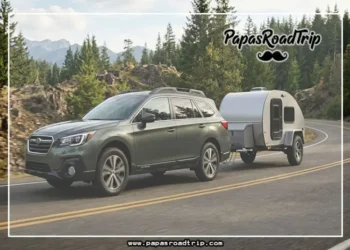
The 2019 Subaru Outback is a midsize wagon that doubles as a light-duty tow vehicle, and its rating depends entirely on how it’s equipped. If you searched for the 2019 Subaru Outback towing capacity, the short answer is that most models are rated to pull 2,700 pounds, while four-cylinder models with the optional trailer package are rated at 1,000 pounds. That gap matters: the same vehicle can be legally rated for very different loads depending on engine and package, so you need to confirm your specific trim before you hitch anything up.
Key Takeaways
- 2,700 lbs is the maximum towing capacity for 2019 Outback models equipped with the 3.6-liter six-cylinder engine or the four-cylinder with the factory-installed trailer package.
- 1,000 lbs is the limit for four-cylinder Outbacks without the trailer package — roughly a small utility trailer or a pair of jet skis.
- Tongue weight should stay at about 10 percent of your trailer’s loaded weight, so plan for roughly 270 lbs at the 2,700-lb maximum.
- The Outback’s payload and gross vehicle weight rating limit you before the tow rating does once you add passengers and cargo.
- Subaru recommends trailer brakes for loads above 1,000 lbs and requires them on many configurations — check your owner’s manual.
- Adding a hitch after purchase does not automatically raise a 1,000-lb rating to 2,700 lbs; the trailer package includes cooling and wiring changes.
What the 2019 Subaru Outback Is Rated to Tow
Subaru publishes two distinct tow ratings for the 2019 Outback, and the difference comes down to engine and equipment. The 2.5-liter four-cylinder boxer engine, which powers the base, Premium, and Limited trims, is rated at 1,000 pounds unless the vehicle was ordered with the optional trailer package. The 3.6-liter six-cylinder, offered in the Limited and Touring trims, is rated at 2,700 pounds as delivered.
The four-cylinder models fitted with the factory trailer package also reach 2,700 pounds. That package is the key variable — it isn’t simply a hitch bolted to the bumper. It bundles a higher-capacity radiator or cooling configuration, a transmission cooler where applicable, trailer wiring, and the hitch receiver itself. A base Outback with an aftermarket hitch doesn’t carry the higher rating.
| Configuration | Engine | Towing Capacity | Notes |
|---|---|---|---|
| Base / Premium / Limited (no trailer package) | 2.5L flat-four | 1,000 lbs | Light-duty only |
| Base / Premium / Limited with factory trailer package | 2.5L flat-four | 2,700 lbs | Package adds cooling and wiring |
| Limited / Touring | 3.6L flat-six | 2,700 lbs | Highest rating as delivered |
| Any trim, aftermarket hitch only | Either | 1,000 lbs | No rating increase without package |
Pro Tip: Check the driver’s door jamb label and the owner’s manual before you assume a rating. The label lists the gross vehicle weight rating and gross axle weight ratings, which are the numbers that actually govern how much you can load and tow safely.
Why the Engine Changes the Number
The 2.5-liter engine produces 175 horsepower and 174 lb-ft of torque, while the 3.6-liter six makes 256 horsepower and 247 lb-ft. Towing capacity isn’t just about pulling power, though — it’s about the whole system’s ability to dissipate heat. A continuously variable transmission under load generates heat, and the cooling system has to keep up. The trailer package exists precisely to manage that heat, which is why Subaru ties the higher rating to it.
The six-cylinder’s extra displacement and torque let it pull 2,700 pounds without the same cooling strain, so it carries the higher rating from the factory. This is a common pattern across the industry: the manufacturer’s rating reflects the weakest link in the chain, whether that’s cooling, brakes, or structure.
Matching a Trailer to Your Outback
Before you shop for a trailer, weigh what you actually plan to haul — loaded, not empty. A trailer’s dry weight is almost never its real weight once you add gear, water, fuel, or cargo. The following table shows typical real-world loads and where they land against the two ratings.
| Load Type | Typical Loaded Weight | Fits 1,000-lb Rating? | Fits 2,700-lb Rating? |
|---|---|---|---|
| Small utility trailer (5×8) with light cargo | 600–900 lbs | Yes | Yes |
| Two jet skis on a tandem trailer | 1,200–1,600 lbs | No | Yes |
| Small pop-up camper | 1,500–2,200 lbs | No | Yes |
| Single-axle aluminum boat trailer | 1,800–2,400 lbs | No | Yes |
| Lightweight travel trailer (teardrop) | 1,500–2,500 lbs | No | Yes, if loaded carefully |
Notice that the 1,000-lb rating is genuinely limited — it covers utility runs and small watercraft, not camping trailers. If your plans involve a camper, you want the 2,700-lb configuration.
Warning: Never exceed the trailer’s own gross vehicle weight rating or the Outback’s ratings, even briefly. Overloading stresses the CVT, the brakes, and the hitch, and it can void warranty coverage on drivetrain components.
Tongue Weight and Payload: The Real Limits
Tongue weight is the downward force the trailer coupler puts on the hitch ball, and it should sit at roughly 10 percent of the loaded trailer weight — up to 15 percent for some trailer designs. At the 2,700-lb maximum, that’s about 270 lbs pushing down on the rear of the car. At 1,000 lbs, it’s about 100 lbs.
That tongue weight counts against the Outback’s payload capacity, which is the difference between the gross vehicle weight rating and the curb weight. The 2019 Outback’s payload is roughly 1,000 to 1,100 lbs depending on trim and options. Subtract the driver, passengers, cargo, and tongue weight, and you can see how a family of four with luggage can run out of payload well before they run out of tow rating.
The practical rule: add up passengers, gear, and tongue weight, and keep the total under the payload figure on the door jamb label. If you’re close, move weight into the trailer behind the axle (within reason) or leave gear at home.
What the Trailer Package Actually Includes
If you’re shopping used, knowing what the factory trailer package contains helps you verify whether a car has it. The package generally includes:
- A Class I-style hitch receiver integrated with the rear bumper structure
- Trailer wiring harness with a flat-four connector
- Transmission fluid cooler (on CVT-equipped models)
- Upgraded engine cooling capacity
- A higher-output alternator on some configurations
Because these are factory-installed, they’re difficult and expensive to replicate after the fact. A dealer-installed hitch adds the physical receiver and wiring but doesn’t change the published rating. If a seller claims a four-cylinder Outback tows 2,700 lbs, ask for the window sticker or a VIN lookup to confirm the package was ordered.
Braking, Sway, and Safety Equipment
Subaru’s guidance for the 2019 Outback calls for trailer brakes on loads above 1,000 lbs, and many states require brakes on trailers above a certain weight — commonly 1,500 to 3,000 lbs, varying by state. The Outback’s own brakes are sized for the vehicle, not for a 2,700-lb trailer pushing it downhill, so trailer brakes aren’t optional equipment in practice.
A weight-distributing hitch is worth considering for heavier loads because it spreads tongue weight across both axles rather than loading the rear. Sway control is another add-on that helps in crosswinds and when passing trucks. For the 2019 Outback’s modest ratings, a simple weight-distributing setup is usually sufficient, and many owners tow without one at the lower end of the range.
Tire pressure matters too. Inflate the rear tires to the pressure listed on the door jamb for a loaded vehicle, and check the trailer tires before every trip. Underinflated trailer tires are a leading cause of blowouts.
Setting Up Your Outback for Towing
Getting the setup right takes an afternoon and pays off on every trip. Work through these steps in order:
- Confirm your rating. Check the owner’s manual and door jamb label for your specific trim and package.
- Weigh the loaded trailer at a public scale — many truck stops have certified scales for a small fee.
- Measure tongue weight with a tongue-weight scale, and adjust cargo position until it’s about 10 percent of trailer weight.
- Install the correct hitch ball for your coupler size (commonly 2 inches for this class of trailer) and torque it to spec.
- Wire the trailer lights and test running lights, brake lights, and turn signals with a helper.
- Check tire pressures on the Outback and the trailer, cold.
- Practice braking and turning in an empty lot before you hit traffic.
Pro Tip: Load the trailer slightly nose-heavy rather than tail-heavy. A tail-heavy trailer is far more prone to sway, and sway is the failure mode that causes most towing accidents.
Common Towing Mistakes to Avoid
The most frequent error is assuming the hitch is the whole story. A receiver and ball cost a few hundred dollars, but they don’t add cooling capacity, and they don’t change the rating. The second most common mistake is overloading the trailer because the dry weight looked fine online — always weigh loaded.
Other mistakes worth flagging:
- Ignoring payload. A 2,700-lb trailer plus four adults plus camping gear can exceed the gross vehicle weight rating.
- Skipping trailer brakes on a load that clearly needs them.
- Towing in overdrive or with the CVT in the wrong mode. Use the manual shift mode or the appropriate gear to keep the transmission from hunting.
- Forgetting the spare. Check that the trailer spare is inflated and the lug wrench fits.
- Not checking state law. Brake requirements, speed limits while towing, and mirror rules vary by state.
How the Outback Compares to Rivals
The 2019 Outback’s 2,700-lb maximum is modest for the class. A quick comparison shows where it sits:
| Vehicle | Max Towing Capacity (typical) | Notes |
|---|---|---|
| 2019 Subaru Outback | 2,700 lbs | Requires six-cylinder or trailer package |
| 2019 Toyota RAV4 | 1,500–3,500 lbs | Varies by trim and package |
| 2019 Honda CR-V | 1,500 lbs | Lower across the board |
| 2019 Ford Edge | 3,500 lbs | Higher with the tow package |
| 2019 Subaru Ascent | 5,000 lbs | Three-row, purpose-built for heavier towing |
If your towing plans regularly exceed 2,700 lbs, the Outback is the wrong tool — a mid-size SUV or a properly equipped pickup is the safer choice. The Outback shines for light utility work, small boats, and pop-up campers, not for travel trailers.
Frequently Asked Questions
Can a 2019 Outback tow 3,500 pounds?
No. The maximum published rating for any 2019 Outback configuration is 2,700 pounds, achieved with the 3.6-liter six-cylinder or the four-cylinder with the factory trailer package. Exceeding that figure puts the CVT, brakes, and cooling system outside their design limits and can void warranty coverage.
Does the 2.5-liter Outback have a 2,700-lb rating?
Only if it was ordered with the factory trailer package, which adds cooling capacity, a transmission cooler, wiring, and the hitch receiver. A four-cylinder Outback with an aftermarket hitch alone remains rated at 1,000 pounds, because the package’s cooling changes are what support the higher figure.
How much tongue weight can the 2019 Outback handle?
Plan for about 10 percent of your loaded trailer weight, so roughly 270 pounds at the 2,700-lb maximum and about 100 pounds at the 1,000-lb rating. That tongue weight counts against the vehicle’s payload capacity, so subtract it along with passengers and cargo when you check the door jamb label.
Do I need trailer brakes on a 2019 Outback?
Subaru recommends trailer brakes for loads above 1,000 pounds, and many states legally require them above thresholds that commonly fall between 1,500 and 3,000 pounds. For any load near the 2,700-lb maximum, treat trailer brakes as required equipment rather than an optional upgrade.
Can I add the trailer package to a used Outback?
It’s difficult and expensive to replicate the factory package after the fact, since it involves cooling system and transmission cooler changes in addition to the hitch and wiring. A dealer-installed hitch adds the receiver and wiring but doesn’t change the published rating, so verify the package with a VIN lookup before buying used.
What is the best trailer for a 2019 Outback?
For four-cylinder models without the package, stick to utility trailers and small watercraft under 1,000 pounds. For 2,700-lb configurations, a pop-up camper, a small aluminum boat, or a pair of jet skis on a tandem trailer are realistic fits — provided you weigh the loaded trailer and stay under the payload limit.
Conclusion
Before your first trip, weigh your loaded trailer at a public scale and confirm the numbers against your door jamb label — that single step catches most overloading mistakes before they become expensive ones.