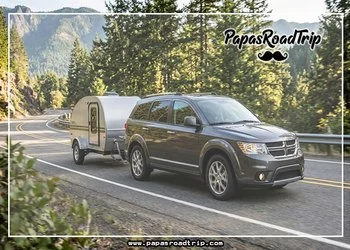
The Dodge Journey towing capacity is 1,000 pounds for four-cylinder models when properly equipped, while V6 models in some model years carry a higher rating — confirm your exact year and engine in the owner’s manual. The 2.4L four-cylinder carries the 1,000-pound rating; V6 models were rated higher in some years, so check your build. What changes is how you load the SUV, because the Journey’s own weight eats into that limit before the trailer does. This guide covers the trims that carry the rating, the tongue weight and passenger math behind it, and the cases where 1,000 pounds is the wrong answer for your trailer.
What the Journey’s rating actually means
The rating is the maximum weight of a loaded trailer — trailer plus cargo plus water — that Dodge says the vehicle can pull. It’s not the weight of an empty trailer. That difference catches people out, because a small camper’s dry weight tells you nothing about what it weighs once you fill the tank and pack the cupboards.
Dodge built the Journey as a front-wheel-drive family crossover, with all-wheel drive as an option on some trims. It seats up to seven with the third row up. Towing is a secondary job for this vehicle, and the rating reflects that. It’s meant for a small utility trailer, a pair of jet skis, or a light pop-up — not a travel trailer with a bathroom.
The misconception is that a bigger engine buys a bigger trailer. It doesn’t here. The 3.6L Pentastar V6 makes more power than the four-cylinder, and in some model years Dodge rated V6 models higher. The limit comes from the vehicle’s structure, brakes and cooling, not from engine output.
One rule you can count on: the rating applies to a vehicle with the proper equipment. Dodge publishes the towing figure in the owner’s manual for each model year, and that manual is the place to confirm your exact build. Check it before you buy a trailer, not after.
How to tow safely with a Journey
- Find your exact rating in the owner’s manual. Open the towing section for your model year. Confirm 1,000 pounds and check whether your trim needs the factory tow package. Don’t rely on a dealer’s memory or a forum post.
- Weigh the trailer loaded, not empty. Use a public scale — many truck stops have one. Fill the water tank and load your gear first, then weigh. If the number is over 1,000 pounds, you need a different vehicle.
- Add up everything inside the SUV. Passengers, luggage and pets all count toward the vehicle’s gross weight, not the trailer. A full car of adults leaves less margin for tongue weight.
- Keep tongue weight near 10% of the trailer’s loaded weight. For a 1,000-pound trailer, that’s about 100 pounds on the hitch. Too little and the trailer sways; too much and the rear sags.
- Fit a hitch rated for the load. A Class II hitch handles this range. Have it installed by a shop that follows the manufacturer’s torque specs — a loose hitch is a real hazard.
- Check the trailer lights before every trip. The Journey’s wiring harness needs to match your trailer’s plug. Test brakes, turn signals and running lights with a helper.
- Slow down and leave a longer gap. A short wheelbase and a light trailer behave badly in crosswinds and on downhill grades. Keep well under highway speed in poor weather.
The judgement call that matters most is the loaded-weight check at step 2. Skip it and you’re guessing. A trailer that feels fine on a flat road can push a light SUV around on a curve, and no amount of careful driving fixes an overloaded setup.
If your trailer needs electric brakes, a weight-distribution hitch or a brake controller, that’s beyond a basic install. Have a trailer shop set it up — wiring and brake work done wrong is a safety problem, not a convenience one.
Dodge Journey towing figures by setup
The numbers below assume a vehicle with the factory tow equipment and a driver only. Add passengers and cargo and your real margin shrinks.
| Your situation | What to use | Figure that matters | What to watch for |
|---|---|---|---|
| 2009–2020, four-cylinder | Factory tow package | 1,000 lb max trailer weight | Confirm in your owner’s manual |
| 2.4L four-cylinder | Class II hitch | 1,000 lb | Less power on hills; confirm rating in owner’s manual |
| 3.6L V6 | Class II hitch | Higher than four-cylinder in some years | Check your model year’s owner’s manual |
| Full car of 5 adults | Reduce trailer load | Tongue weight near 100 lb | Check gross vehicle weight rating |
| Small utility trailer | Standard setup | Well under 1,000 lb loaded | Weigh it loaded, not empty |
| Pop-up camper | Check loaded weight first | Often over 1,000 lb with gear | Water tank adds real weight |
| Jet skis on a double trailer | Single ski only | Two skis plus trailer often exceeds limit | Weigh the whole rig |
What careful Journey owners do differently
The people who tow happily with a Journey work backwards from the scale, not forwards from the brochure. They weigh the trailer loaded before they commit to a trip, and they weigh the SUV with the family inside. Two numbers, written down. That’s the whole habit, and it prevents most of the trouble.
They also read the door jamb sticker. Every vehicle carries a label listing its gross vehicle weight rating — the most the whole vehicle can weigh, passengers and cargo included. Subtracting the SUV’s actual weight from that figure tells you what’s left for tongue weight and gear. It’s a five-minute check that settles arguments.
A trailer that’s legal on paper can still be unsafe on the road. The sticker and the scale are what count.
Experienced towers leave the third row folded and the roof rack empty when a trailer is attached. Roof cargo raises the center of gravity, and a light SUV with a trailer behind it doesn’t need that. They also skip the temptation to “just add one more thing” to the trailer after it’s been weighed.
What they don’t do is chase more power. A cold-air intake or a louder exhaust doesn’t raise the rating, and it won’t help you stop. The limit is structural, and no bolt-on part changes it.
Dodge Journey towing problems and fixes

Most complaints trace back to loading, wiring or the hitch install — not the vehicle itself.
| What you notice | What it usually means | What to do first |
|---|---|---|
| Trailer sways at speed | Too little tongue weight | Move cargo forward, re-weigh the tongue |
| Rear of the SUV sags | Too much tongue weight or overloaded cargo area | Shift weight back, check the gross weight rating |
| Trailer lights don’t work | Wiring harness mismatch or a bad ground | Test the plug with a circuit tester |
| Overheating on long climbs | The load is near the limit on a hot day | Slow down, turn off the AC, take breaks |
| Brakes feel weak downhill | The trailer has no brakes and the SUV is doing all the work | Use a lower gear, keep speed down |
Sway that starts around 50 mph and builds is almost always tongue weight, not the Journey. Load the trailer so roughly 10 percent of its weight sits on the tongue, then re-weigh at a scale rather than guessing.
If the rear sags before you have even loaded the cargo area, the tongue is too heavy. Move the load back in small steps and check the rear axle rating, not just the total.
Lights that work on the tow vehicle but not the trailer point to the ground. Clean the connection at the frame, not the plug.
On a long climb in summer heat, the gauge climbing is your cue to drop a gear and slow to 45–50 mph. If it still climbs, pull over and let it idle.
Rules and paperwork to check first
No federal rule sets a towing limit for a passenger vehicle — the manufacturer does, and Dodge publishes the Journey’s figure in the owner’s manual. That manual is the document that counts if there’s ever a dispute about the rating.
Your state sets the rules that apply to the trailer. Many states require brakes on trailers above a certain weight, and that threshold varies. Your state’s DMV or motor vehicle agency publishes the current figure, so check its website for your trailer’s weight class. Registration and title rules for trailers also differ by state.
Your auto insurance policy may treat towing differently from normal driving. Call your insurer and ask whether your coverage extends to a trailer you’re pulling, and whether you need separate trailer coverage. Get the answer in writing.
Finally, check your driver’s license class. Some states require a different class for heavier combinations, though a 1,000-pound trailer usually stays within a standard license. Your state DMV confirms it.
Keeping the setup in good shape
After each trip, hose off the hitch and check the ball for wear. A dry ball wears faster, so a light coat of grease keeps it smooth. Look at the trailer tires for cracks and check the pressure cold, before you drive.
Grease the ball before every trip, not just when it looks dry. A ball that has sat through a rainy week will rust in the spots the coupler rubs hardest. Wipe it clean first, then apply a thin coat — too much grease collects grit that grinds the ball down faster than wear would.
Store the trailer with the tongue supported and the wheels chocked. Cover it if it sits outside for months. Before the next season, test the lights and spin the wheels by hand to feel for rough bearings.
If the trailer sits more than a few months, pull the wheels and repack the bearings before the first long trip. Short hops around town can wait, but a bearing that has dried out will seize on the highway, not in the driveway.
The sign that the setup needs attention again is simple: any change in how it feels. New vibration, a sag you didn’t have before, or lights that flicker mean stop and check. Don’t wait for a schedule — the vehicle tells you.
When 1,000 pounds isn’t enough

A travel trailer with a bathroom, a slide-out or a full water tank will almost always exceed the Journey’s limit once loaded. If that’s your plan, you need a vehicle rated for several thousand pounds — a mid-size or full-size SUV, or a pickup. Don’t try to stretch the Journey to fit.
A boat over about 16 feet with a fuel tank and gear usually lands past the limit too. Same answer: a different tow vehicle.
And if you tow every weekend with a loaded trailer, the Journey isn’t the right tool even within its rating. Repeated near-limit towing wears brakes and transmission fluid faster. A vehicle built for it will last longer and cost less in repairs.
The common mistake is adding up the trailer’s dry weight and stopping there. That number leaves out water, propane, batteries, dishes and anything else you load. A 3,500-pound trailer can pass 4,000 pounds before it ever leaves the driveway.
Weigh the loaded trailer at a public scale before you buy the Journey. If the scale ticket comes back under 1,000 pounds, the Journey works. If it doesn’t, no hitch or airbag kit will fix it.
One more case: flat, short hauls to a local ramp are easier on the vehicle than highway towing. If that’s all you do, the Journey can serve within its rating.
Related guides
- Dodge Journey All Wheel Drive Problems: Common Issues & Fixes
- Dodge Journey Window Switch Problems: Easy Fixes You Must Try
Frequently asked questions
Can a Dodge Journey tow 2,000 pounds?
No — a 2,000-pound trailer is double the four-cylinder’s 1,000-pound limit and unsafe to pull with this vehicle. If you need that capacity, look at a different SUV or a pickup. A 2,000-pound trailer is double the limit and unsafe to pull with this vehicle. If you need that capacity, look at a different SUV or a pickup.
Does the V6 Journey tow more than the four-cylinder?
No — the four-cylinder is rated at 1,000 pounds, and V6 models were rated higher in some model years. The V6 gives you more power for hills and passing, but check your owner’s manual for your exact figure. The V6 gives you more power for hills and passing, but Dodge didn’t raise the towing figure for it. The limit comes from the vehicle’s structure, not the engine.
How much tongue weight can a Journey handle?
About 100 pounds, which is roughly 10% of a fully loaded 1,000-pound trailer. That figure assumes the SUV isn’t already loaded to its gross weight limit with passengers and cargo. Check your door jamb sticker to see what margin you have left.
Is it safe to tow with a Dodge Journey?
Yes, within 1,000 pounds loaded, with a proper hitch and working lights. The risk comes from overloading, wrong tongue weight or bad wiring. Weigh your trailer loaded and check the lights before every trip, and the setup is safe for light loads.
What happens if I tow more than the rating?
You risk brake fade, transmission damage and loss of control, and you may void your warranty coverage for related repairs. Your insurance could also question a claim. The rating isn’t a suggestion — it’s the limit the vehicle was built and tested for.
How long does it take to install a tow hitch on a Journey?
About 1 to 2 hours at a shop for a bolt-on Class II hitch, assuming no drilling is needed. Doing it yourself saves labor but risks a loose hitch if you don’t follow the torque specs. A trailer shop gets it right the first time.
Do I need trailer brakes with a Journey?
It depends on your state and the trailer’s weight. Many states require brakes on trailers above a set weight, and that threshold varies. Check your state DMV’s rules, and if your trailer is near the limit, brakes make downhill driving much safer.
Conclusion
Before your next trip, load the trailer and the SUV the way you’d actually travel, then swing by a public scale to see where you stand. If the numbers come out tight, you’ll still have time to shift gear or pick a lighter trailer instead of finding out on the road.