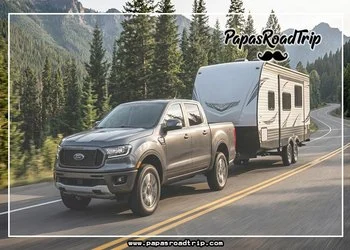
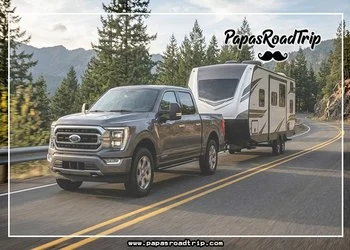
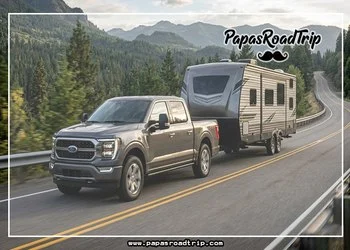
The 2026 Ford F-150 can tow up to 13,500 pounds, but only in the right configuration. That figure belongs to the Regular Cab, 8-foot bed, 4×2 truck with the 3.5L EcoBoost V6 and the Max Trailer Tow Package. Most F-150s on a dealer lot tow less. A crew cab 4×4 with the same engine lands lower, and the 2.7L EcoBoost sits far below that. This guide breaks down the 2026 ford f-150 towing capacity by cab, bed, drive and engine, so you can match a real truck to a real trailer.
What Ford’s towing capacity number measures
Towing capacity is the maximum weight a truck can pull, and Ford sets it per configuration, not per model. The same F-150 name covers dozens of builds, and each one gets its own rating. That’s why two F-150s parked side by side can differ by thousands of pounds.
The figure you need isn’t on the brochure. Your door jamb label gives the GVWR and axle ratings, and Ford’s towing guide gives the rating for your exact build. Ford also publishes a towing guide each model year that lists ratings by build. Check that guide, or ask a dealer to run your VIN.
People often think the engine decides everything. It doesn’t. Axle ratio, cab size, bed length, 4×2 or 4×4, and optional packages all move the number. A strong engine in a heavy truck can tow less than a smaller engine in a light one.
This matters most for people who buy a truck first and a trailer second. If you already own the trailer, you’re shopping for a truck that fits it. If you own the truck, you’re shopping for a trailer it can handle. Those are two different jobs.
How to match a trailer to your F-150
Start with the trailer, not the truck. The order below is the one that keeps you legal and safe.
- Find your trailer’s loaded weight. Use the trailer’s GVWR, not the dry weight. Dry weight leaves out water, propane, gear and food. A 7,000 lb dry trailer can easily run past 8,000 lb loaded.
- Read your door jamb label. It lists GVWR, front and rear GAWR, and the tire limits. These are the hard ceilings for your specific truck.
- Check the payload sticker. Payload is GVWR minus the truck’s own weight. Tongue weight, passengers and cargo all count against it. A 10% tongue weight on an 8,000 lb trailer is 800 lb, which eats most of a half-ton’s payload.
- Confirm the axle ratio. The 3.5L EcoBoost with the shorter (higher-numerical) axle ratio tows more than the same engine with a taller ratio. The ratio is on the window sticker or the axle code on the door label.
- Add the Max Trailer Tow Package if you’re ordering. It brings the upgraded cooling, hitch and wiring that unlock the top ratings. Without it, expect a lower number.
- Subtract for 4×4 and cab size. A 4×4 crew cab is heavier, so it tows less than a 4×2 Regular Cab with the same engine.
- Weigh the loaded rig at a public scale. A CAT scale costs a few dollars and tells you the truth. Compare the steer axle, drive axle and trailer axle to the ratings.
The judgement call that separates a good setup from a bad one is tongue weight. Too little and the trailer sways; too much and you overload the rear axle and lose steering grip. Aim for 10-15% of the loaded trailer weight on the tongue, then confirm on the scale. Getting this wrong is the mistake that costs people a truck, a trailer, or worse.
2026 F-150 towing figures by build
Here’s how the main builds compare. These are Ford’s published maximums for the 2026 model year, and each assumes the Max Trailer Tow Package where noted.
| Your build | Engine and setup | Max tow (lb) | What to watch |
|---|---|---|---|
| Regular Cab, 8-ft bed, 4×2 | 3.5L EcoBoost, Max Tow | 13,500 | Needs the right axle ratio and package |
| SuperCrew, 5.5-ft bed, 4×4 | 3.5L EcoBoost, Max Tow | ~13,000 | Heavier cab cuts the top figure |
| SuperCrew, 4×4 | 5.0L V8 | ~12,800 | Payload drops fast with passengers |
| SuperCrew, 4×4 | 2.7L EcoBoost | ~10,000 | Fine for mid-size trailers only |
| Any cab | 3.5L PowerBoost hybrid | ~12,700 | Strong torque, but check payload |
| Any cab | 3.3L V6 | ~8,000 | Light-duty towing only |
The hybrid’s electric torque makes it feel strong, but its battery adds weight, so payload is the limit, not pulling power. Confirm your exact build in Ford’s towing guide before you buy a trailer.
Getting the F-150 towing setup right
Experienced owners start with the scale ticket, not the brochure. They weigh the empty truck first, so they know the real payload before adding a single passenger. That one step stops most overloading before it starts.
Weigh the truck with the people and gear you actually travel with, full of fuel. The difference between that ticket and the truck’s GVWR is what you have left for tongue weight and all other cargo. A 500-pound tongue load eats 500 pounds of payload, not some smaller share.
They also load the trailer with the heavy items over the axles, not at the ends. A generator or water tank at the rear lightens the tongue and invites sway. Moving it forward fixes it. Check tongue weight again after loading, because gear shifts the balance.
Aim for 10 to 15 percent of the trailer’s loaded weight on the tongue. Below that, sway starts; well above it, the truck’s rear axle and steering feel light. If the trailer sways at highway speed, move cargo forward before you touch the hitch.
Partway through a trip, they stop and check the hitch, the safety chains and the tire pressures. Trailer tires run at higher pressure than truck tires, and a soft trailer tire overheats. They leave the truck’s suspension alone; lifting a truck changes its geometry and can lower its rating.
A truck that tows well isn’t the one with the biggest number. It’s the one whose payload, tongue weight and axle ratings all line up with the trailer behind it.
Common F-150 towing problems

| What you notice | What it usually means | What to do first |
|---|---|---|
| Trailer sways at highway speed | Too little tongue weight or a light rear end | Move cargo forward, recheck tongue weight |
| Truck squats hard when hitched | Tongue weight too high or payload overloaded | Weigh the rig, shift load, check rear GAWR |
| Brakes feel weak downhill | Trailer brakes not working or not set | Test the brake controller, check the wiring |
| Overheating on long climbs | Cooling package not matched to the load | Slow down, check for the Max Tow cooling |
| Rating lower than expected | Wrong axle ratio or missing tow package | Check the door label and window sticker |
If you can’t fix sway by moving weight, stop towing and get the setup checked by a qualified hitch shop. Sway at speed is a safety problem, not a comfort problem.
Squat and sway point in opposite directions, so don’t chase both with the same fix. A truck that sits level but wanders needs weight moved forward onto the ball. A truck that sits level and feels planted is done.
Weigh the truck and trailer at a public scale with the trailer loaded the way you actually travel. A half-ton of firewood behind the axle changes the numbers more than most owners expect.
Overheating on a climb in summer heat is the one to watch on an F-150. If the gauge climbs on a grade the truck handles in cooler weather, the load is at the edge of the cooling package, not broken.
A rating lower than the brochure figure usually traces to axle ratio or a missing tow package. The window sticker settles it faster than any build sheet lookup.
Rules and ratings you should confirm
Ford sets the ratings, and the door jamb label on your truck is the legal ceiling for that vehicle. Never tow above the GVWR, GAWR or the hitch’s own rating. The hitch receiver usually carries its own sticker with a weight-distributing limit.
That receiver sticker is the one people skip. A weight-distributing hitch raises how much tongue weight the receiver will take, but only when the bars are actually rigged and adjusted. Tow the same trailer on a plain ball and you’re back to the lower number. Read the sticker before you assume the higher figure applies.
Your state’s DMV sets the rules for trailer brakes, weight-distribution hitches and licence classes. Many states require trailer brakes above a certain weight, and some require a special endorsement for heavy trailers. Check your state DMV’s towing page before you buy.
Your insurer also matters. Tell them you tow, and confirm the trailer is covered. A claim denied for an unlisted trailer is a real cost.
If your trailer needs a commercial licence, air brakes or a gooseneck setup beyond a half-ton’s rating, that’s a job for a heavy-duty truck and a dealer who handles commercial sales. Don’t stretch an F-150 past its label.
Keeping your towing setup safe over time
Recheck your numbers once a year, and again whenever you change the trailer, add a heavy accessory or change tires. Tires age even when they look fine; check the date code on the sidewall and replace them when they reach the age limit the tire maker publishes.
Keep your scale ticket and door label photo in your phone. When you load for a new trip, compare against them. Store the hitch and chains clean and dry, and grease the hitch ball before each season.
After a long trip, look for cracked welds on the hitch, worn chain links and frayed wiring. Fix these before the next haul. A small repair now beats a failure on the road.
The tire date code is the four digits after the DOT letters on the sidewall. The first two are the week, the last two the year, so 2319 means the 23rd week of 2019. Most trailer tire makers put a six-year cap on the tire regardless of tread. If your trailer sits outside between trips, count from the build date, not the day you bought it.
Weigh the truck and trailer loaded at the start of every season, not just when the setup changes. Gear creeps in, and a full water tank or a loaded cooler can put you over rear axle rating without touching tongue weight.
If a chain link is worn thin enough to catch a fingernail, replace the pair, not just the one. Chains wear together and a mismatched set loads unevenly.
When an F-150 isn’t the right truck

An F-150 is the wrong choice if your loaded trailer runs past about 13,500 lb, the top rating any half-ton F-150 build carries. Step up to an F-250 or larger.
It’s also wrong if your payload is the real limit. A heavy tongue weight plus a family plus gear can exceed a half-ton’s payload even when the trailer is well under the tow rating. A three-quarter-ton truck solves that.
The payload case catches more people than the trailer weight case. Load your trailer for a real trip, fill the tank, put everyone aboard, then weigh the truck at a public scale. If the rear axle is over its rating, no amount of towing capacity helps you.
Finally, skip the F-150 if you tow heavy loads every week. A half-ton is built for occasional towing. Daily heavy hauling wears it faster, and a heavier truck is the better long-term buy.
Be honest about the season too. Two or three big trips a year is half-ton work. If the trailer rolls out most weekends from spring through fall, you’re past what the truck was built for.
Talk to a dealer about your real weights before you decide. Bring the scale ticket and the trailer’s loaded weight, not the dry weight from the brochure.
Related guides
- Ford Ranger Tow Package: Ultimate Guide to Maximize Towing Power
- Ford Bronco Towing Package: Ultimate Guide for Heavy Hauling
- Toyota Highlander Tow Package: Ultimate Guide to Towing Power
Frequently asked questions
What is the maximum towing capacity of a 2026 F-150?
It’s 13,500 lb, and only on the Regular Cab, 8-foot bed, 4×2 with the 3.5L EcoBoost and Max Trailer Tow Package. Any other cab, bed or drivetrain lowers it. Check your door jamb label or Ford’s towing guide for your exact build.
Can a 2026 F-150 tow a 10,000 lb trailer?
Yes, in configurations rated above 10,000 lb — the 3.5L EcoBoost, 5.0L V8 or PowerBoost hybrid with the right axle ratio and tow package. The 2.7L EcoBoost sits near that limit, and the 3.3L V6 can’t. Confirm payload too, since a 10,000 lb trailer puts about 1,000 lb on the tongue.
How much can a 2026 F-150 PowerBoost hybrid tow?
About 12,700 lb in its best build, which is close to the top EcoBoost figure. The hybrid’s battery adds weight, so payload is usually the tighter limit. Check the payload sticker before you load a heavy tongue.
Is it safe to tow at the maximum rating?
Yes, if you stay within every limit: GVWR, both axle ratings, payload and the hitch rating. The max tow figure assumes a properly loaded trailer with 10-15% tongue weight and working trailer brakes. Weigh your rig to confirm.
What happens if I tow more than my F-150’s rating?
You overload the axles, brakes and cooling system, and you may break your insurance coverage or state law. Handling gets worse and stopping distances grow. The door jamb label is the ceiling, so stay under it.
How often should I check my towing setup?
Before every trip, and once a year for a full review. Check tire pressure and date codes, hitch bolts, chains and wiring each time. Replace tires when they reach the age limit the maker publishes, not just when they look worn.
Conclusion
Before you sign anything, pull the door-jamb sticker on the exact truck you’re eyeing and check it against your trailer’s loaded weight. Dealers swap packages and buyers inherit surprises, so it’s worth a few minutes. If the numbers don’t line up, walk away and keep shopping.