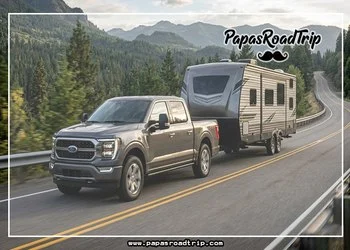
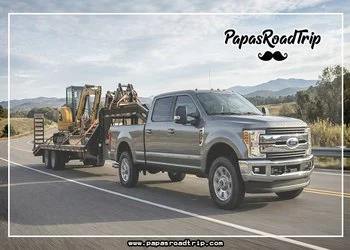
The 2017 F-250 towing capacity tops out at 18,500 pounds. That figure only applies to a properly equipped two-wheel-drive F-250 Super Duty with the 6.7L Power Stroke diesel, the right rear axle, and a weight-distributing hitch. Most gas trucks and four-wheel-drive models land well below it. This guide shows the numbers by cab, bed and engine, plus the payload, hitch and axle details that decide what your truck can really pull.
What towing capacity really measures
The number on the door jamb isn’t a promise about your truck. It’s the highest trailer weight Ford tested for one exact build — engine, cab, bed, drive type, axle ratio and tire package all fixed. Change any one of those and the rating moves.
Towing capacity is the trailer’s total loaded weight, including cargo, water and anything on the trailer itself. It isn’t the same as payload, which is what the truck carries: people, fuel, tools and the tongue weight pressing down on the hitch. Tongue weight counts against payload, not against towing capacity.
That distinction decides which number runs out first. Load a travel trailer with full fresh water and gear and you may stay under the tow rating while the tongue weight pushes you past payload. Weigh the truck loaded, subtract that from its GVWR, and the remainder is the real tongue weight budget.
Ford publishes these figures in its 2017 Super Duty towing guide, broken down by configuration. The door-jamb sticker on your own truck is the final word for your build.
The common misconception: people read the biggest number in an ad and assume it applies to their truck. It usually doesn’t. A crew cab 4×4 with the gas engine is a very different tow rig from the regular cab 4×2 diesel that set the record.
If your sticker lists a lower rating than the guide, trust the sticker. If the two disagree, the truck as built wins every time.
How to read your own truck’s rating
Work through these in order. Each one narrows the answer.
- Find your truck’s exact build. Check the VIN or the window sticker for engine, cab, bed length, drive type and axle ratio. The axle ratio matters more than most people expect — a 3.55 and a 4.30 behave very differently.
- Open the driver’s door jamb. The Safety Compliance Certification Label lists your truck’s GVWR and both axle weight ratings. These are specific to your truck, not the brochure.
- Read the trailer’s loaded weight, not its dry weight. Dry weight leaves out propane, water, batteries and gear. Weigh the loaded trailer at a public scale before you commit.
- Subtract tongue weight from payload. Take your payload figure, subtract passengers, fuel and cargo, then subtract the tongue weight (usually 10–15% of trailer weight). What’s left is your real margin.
- Match the hitch to the load. A weight-distributing hitch is required above certain trailer weights — check your owner’s manual for the exact threshold on your build.
- Check the combined rating. GCWR (gross combined weight rating) caps truck plus trailer together, and it can bind before the trailer rating does.
The judgement call that separates a safe setup from a white-knuckle one is the payload margin. A truck rated to pull 15,000 pounds can still be overloaded by a heavy tongue and a full bed. If payload runs out first, that’s your real limit.
2017 F-250 towing figures by build
These are the main configurations buyers ask about. Treat them as a starting range, not gospel for your truck — confirm against your door sticker and Ford’s published guide.
| Your setup | Engine and drive | Towing capacity (approx.) | What to watch |
|---|---|---|---|
| Regular cab, long bed, 4×2 | 6.7L diesel | Up to 18,500 lb | Needs the correct axle and hitch package to hit the top figure |
| Crew cab, short bed, 4×4 | 6.7L diesel | Around 15,000–17,000 lb | 4×4 and extra cab weight cut the rating |
| Crew cab, 4×2 | 6.2L gas V8 | Around 12,000–15,000 lb | Gas engine is the main limiter |
| Crew cab, 4×4 | 6.2L gas V8 | Around 12,000–14,000 lb | Payload often runs out before towing capacity |
| Any cab, gooseneck | 6.7L diesel | Higher than bumper-pull | Gooseneck ratings differ — check the guide |
| Any cab, bumper-pull | Either engine | Standard rating | Weight-distributing hitch required above set weights |
The gap between the top and bottom rows is roughly 6,000 pounds. That’s the difference between a stripped work truck and a loaded crew cab — same badge, very different job.
Details that decide a good tow
Experienced towers weigh the truck and trailer loaded before the first real trip. A CAT scale ticket costs little and settles every argument about whether you’re over. Guessing from brochure numbers is how people end up white-knuckling a downhill grade.
They also set the hitch height before loading. A trailer that sits nose-high or nose-low tows badly and wears tires. Get the ball height right with the trailer loaded, then adjust the weight-distribution bars until the truck sits level.
Partway through a trip, check tire pressures cold and look at the trailer tires for uneven wear. Under-inflated tires are a common cause of trailer blowouts, and the load rating on your tires assumes the pressure on the sidewall.
What they leave alone: the axle ratio and the truck’s factory ratings. You can’t tune your way past a payload sticker, and adding airbags or a helper spring doesn’t raise the legal rating — it just makes an overloaded truck sit level. That’s a common mistake, and it costs them in a roadside inspection or an insurance dispute after a crash.
Common towing problems and fixes

| What you notice | What it usually means | What to do first |
|---|---|---|
| Truck sags at the rear | Too much tongue weight or payload | Weigh the setup, redistribute cargo, check hitch setup |
| Trailer sway at speed | Tongue weight too low or load unbalanced | Move weight forward, slow down, check sway control |
| Brakes feel weak on hills | Trailer brakes not working or not set | Test the brake controller, check the trailer wiring |
| Overheating on long climbs | Load near the limit in hot weather | Slow down, check coolant, consider a lighter load |
| Poor steering feel | Front axle unloaded by too much tongue weight | Re-check weight distribution and hitch height |
Sag and poor steering often come from the same cause, so fix them together. If the rear drops and the front feels light, the tongue is carrying too much. Move cargo back over the trailer axles and re-weigh before you touch the hitch.
Sway is the opposite case. If the trailer wanders at highway speed but the truck sits level, tongue weight is too low. Shift weight forward, and don’t fix it by adding a sway bar alone.
Weigh the truck and trailer loaded, at a scale, before a long trip. Guessing at tongue weight is how most of these problems start.
If a problem shows up as a warning light or a brake fault, stop and have a qualified technician look at it. Trailer brake wiring and controller faults aren’t a roadside DIY job.
Rules and limits you should confirm
Ford’s own towing guide is the document that governs your truck’s rating, and it’s specific to the model year and build. The guide lists GCWR, maximum trailer weight and the hitch requirements for each configuration. Read the page for your exact cab, bed, engine and axle.
Don’t take the dealer’s word or a forum post for your number. The 2017 F-250 was built with several engine and axle combinations, and the rating changes with each one. The door jamb sticker gives you the axle code and payload; the guide turns those into a trailer limit.
Your state’s DMV sets the rules for registration, weight classes and whether you need a special license for a heavy trailer. Some states require an endorsement above certain combined weights. Check your state DMV’s website for the current threshold — it changes by state.
The trap is assuming your home state’s rules travel with you. They don’t. If you tow across state lines, look up the threshold in each state on your route before you leave, not at the scale house.
Your insurance policy may also have conditions about towing beyond a stated weight. A quick call to your insurer before a big trip settles it. Ask specifically whether your collision coverage applies while towing at the trailer’s loaded weight.
Anything involving trailer brake repair, axle work or welding a hitch mount needs a trained technician. Those jobs carry real risk if done wrong.
Keeping the setup safe over time
Re-check your weights whenever the load changes — a new trailer, added tools, a different water tank. The rating doesn’t change, but your margin does.
Inspect the hitch, ball mount and safety chains before every trip. Look for cracks, rust and loose bolts. Check trailer tire pressure cold and look at the tread for uneven wear, which points to an alignment or loading problem.
Re-torque lug nuts after the first 50 miles on a new trailer wheel, then check them periodically. Your trailer manufacturer’s manual gives the exact interval for your wheels — follow theirs, not a general rule.
Bring the setup back to spec by re-weighing after any change. If the truck sits different or the trailer tows differently, something moved.
The F-250’s receiver and ball mount take the most abuse of anything in the setup, so look at them hardest. Rust that has eaten into a weld is a replacement, not a wire-brush job. A ball with a worn flat spot or a loose mount will pop and clunk under braking.
Grease the ball and the coupler latch, and check that the latch pins fully closed over the ball every time you hook up. A coupler that latches loose can walk off on a rough road.
Keep a written log of your scale weights and your last inspection. When something feels off six months from now, the numbers tell you whether the truck changed or the trailer did.
If you tow the same trailer at the same weight on flat ground, an annual inspection and a re-torque at each tire rotation is enough. If you haul different loads or run rough roads, check before every trip.
When a different truck makes more sense

If your loaded trailer regularly comes within 1,000 pounds of your rating, you’re working a truck at its edge. A dually F-350 or a bigger chassis adds stability and payload margin for the same trailer. That’s the honest answer for anyone towing heavy every week.
Watch the pin weight, not just the trailer total. A fifth-wheel that sits under the tow rating can still push the rear axle past its rating once the truck is loaded with fuel, passengers and gear. Weigh the truck and trailer at a scale loaded, and compare each axle to its rating.
If you tow a light trailer a few times a year, a half-ton truck does the job with better fuel economy and a softer ride. The F-250 is more truck than that job needs. You pay for the extra capacity at the pump on every empty run.
If your trailer is over 18,500 pounds loaded, no 2017 F-250 is rated for it. You’re into F-350 dually or commercial truck territory, and the rules change with it. That can mean a different license class and stricter inspection rules, depending on your state.
The mistake is buying for the one heavy trip a year. Rent or borrow a bigger truck for that trip and keep the truck that fits the other 51 weekends.
Related guides
- Toyota Highlander Tow Package: Ultimate Guide to Towing Power
- Honda Passport Tow Package: Ultimate Guide for Powerful Towing
- Jeep Gladiator Max Tow Package: Ultimate Towing Power Unleashed
Frequently asked questions
What is the max towing capacity of a 2017 F-250?
18,500 pounds, and only on a properly equipped 4×2 regular cab with the 6.7L diesel and the correct axle and hitch package. Most crew cab and 4×4 builds are rated lower. Check your door-jamb sticker and Ford’s towing guide for your exact configuration.
Can a 2017 F-250 with the 6.2L gas engine tow 15,000 pounds?
Usually no. Gas F-250 ratings generally sit lower than the diesel, often in the 12,000–15,000 pound range depending on cab, bed and drive type. A crew cab 4×4 gas truck is typically at the lower end. Confirm against your own truck’s sticker before planning a load.
How much can a 2017 F-250 crew cab 4×4 tow?
Roughly 12,000–17,000 pounds, depending on engine and axle. The diesel version sits near the top of that range; the gas version sits lower. The exact figure for your truck is on the door-jamb label and in Ford’s published towing guide for that year.
What happens if I tow more than my rating?
You overload the truck’s axles, brakes and frame beyond what they were designed for. That can mean poor braking, unstable handling and legal exposure if you’re stopped or in a crash. Insurance may also decline a claim. Stay within the sticker, not the brochure.
Do I need a special license to tow with a 2017 F-250?
It depends on your state and the combined weight. Some states require an endorsement or non-commercial class for heavy trailers. Check your state DMV’s website for the current threshold, since rules differ and change over time.
Is it safe to tow at the maximum rating?
Yes, if the truck is properly equipped and every weight — payload, tongue, axle and combined — is within its limit. Towing at the max leaves no margin for error, so weigh your loaded setup and confirm each rating before you go.
Conclusion
Before you hook up a trailer, pull the door-jamb sticker on your own truck and compare its ratings against the load you plan to haul. That sticker reflects how yours was built, and it’s the final word. If the numbers feel tight, weigh your setup at a scale before trusting any brochure.