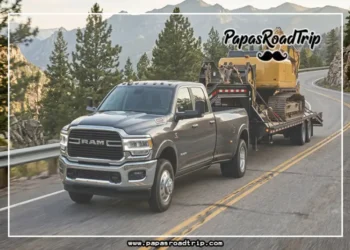
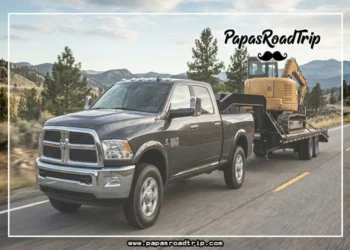
The 2014 Ram 2500 can tow up to 17,970 pounds when properly equipped. That top figure belongs to a Ram 2500 Regular Cab, two-wheel drive, with the 6.4L HEMI V8 and the 4.10 axle ratio. Most 2014 Ram 2500 trucks tow far less, because cab size, bed length, drive type and axle ratio all pull the number down. This guide gives the figures by configuration, the numbers on your door sticker, and the setup that keeps you inside them.
What that towing capacity number means
The 2014 Ram 2500 is a heavy-duty pickup truck. Ram built it for hauling trailers, equipment and heavy loads, not for daily commuting. Buyers choose it when a half-ton truck isn’t enough. The towing capacity is the maximum weight of a loaded trailer the truck can pull safely, and Ram publishes a separate figure for every build.
The one misconception people bring to this number is that it applies to their truck. It doesn’t. Towing capacity is set per configuration, and Ram’s own charts list dozens of combinations. A Crew Cab 4×4 diesel and a Regular Cab 4×2 gas truck share a badge, not a limit.
It sets test conditions for acceleration, braking and hill starts with a trailer attached. A truck rated under it has been checked against a fixed set of tests, not a marketing estimate.
The figure you must follow is on your truck, not in a brochure. The driver’s door jamb carries a Tire and Loading Information placard. It lists the maximum cargo and occupants your specific truck can carry. Towing capacity means nothing if you exceed that payload number first.
How to find your truck’s real towing number
- Open the driver’s door and read the placard. It gives your truck’s payload limit in pounds. Write it down. This is the number that limits most real-world towing.
- Check the certification label on the door jamb. It lists the front and rear gross axle weight ratings (GAWR) and the gross vehicle weight rating (GVWR). These are your hard ceilings.
- Identify your axle ratio. Look for the sales code on the build sheet or ask a Ram dealer to run your VIN.
- Match your build to Ram’s towing chart. Use the Ram Body Builder’s Guide for your model year. It lists every cab, bed, drive and engine combination with its rating.
- Estimate your trailer’s loaded weight. Use the trailer’s gross vehicle weight rating, not its empty weight. Water, gear and propane add up fast.
- Subtract tongue weight from payload. Tongue weight typically runs 10–15% of trailer weight. That weight sits on your truck and counts against payload.
- Compare both numbers. If either payload or trailer weight goes over its limit, the setup is wrong, even if the other number looks fine.
The judgement call that decides good from bad is which limit you hit first. On a 2500 with a diesel engine and a crew cab, payload usually runs out before towing capacity does. The diesel engine is heavy, and that weight comes straight off your available payload.
If your setup needs a commercial licence, air brake endorsement or a weigh station check, that’s a matter for your state DMV, not this guide.
2014 Ram 2500 towing figures by setup
These figures come from Ram’s published towing charts for the 2014 model year. They assume a properly equipped truck with the correct hitch and a driver only. Add passengers and cargo, and your usable trailer weight drops.
| Your setup | Engine and axle | Max tow rating (lb) | What to watch |
|---|---|---|---|
| Regular Cab 4×2, long bed | 6.4L HEMI, 4.10 | 17,970 | Highest rating; rare build |
| Regular Cab 4×2, long bed | 6.4L HEMI, 3.73 | About 16,500 | Payload still limits you |
| Crew Cab 4×2 | 6.4L HEMI, 4.10 | About 16,300 | Check payload before trailer weight |
| Crew Cab 4×4 | 6.4L HEMI, 4.10 | About 15,600 | 4×4 hardware adds weight |
| Mega Cab 4×4 | 6.7L Cummins diesel, 3.42 | About 16,800 | Heaviest cab, lowest payload |
| Any 2500 | 5.7L HEMI | Lower than 6.4L | Confirm on Ram’s chart for your build |
Treat every “about” figure as a starting point. Ram’s Body Builder’s Guide for 2014 lists the exact rating for each combination, and that page is the one to trust.
What separates a safe 2014 Ram 2500 setup from a risky one
Experienced towers start with the trailer, not the truck. They weigh the trailer loaded, on a public scale, before they buy a hitch. A trailer that weighs 12,000 pounds loaded needs a different setup than the same trailer empty at 9,000. Guessing here is how people end up over their rating without knowing it.
They also read the door placard first, every time. The payload number on that sticker is the one that decides whether a fifth-wheel trailer or a heavy tongue-weight bumper pull works. A 2500 with a diesel and a Mega Cab can run out of payload with a trailer well under its tow rating. The truck pulls fine; the axles and tires are the problem.
Hitch and weight distribution choices
A weight-distributing hitch moves tongue weight back to the trailer’s axles and the truck’s front axle. It’s the right choice for most travel trailers above roughly 5,000 pounds. A fifth-wheel or gooseneck hitch puts weight directly over the rear axle, which suits heavy trailers but eats payload fast. Match the hitch class to the trailer’s gross weight, not its empty weight.
What experienced towers leave alone
They don’t chase the top rating. A truck built for 17,970 pounds is a Regular Cab 4×2 with a gas engine, and most buyers want a crew cab. Buying the highest-rated build to tow a 10,000-pound trailer means paying for capability you’ll never use. They also don’t add lift kits or oversized tires without checking how those changes affect the rating. Ram’s figures assume the stock setup.
Common towing problems and quick fixes

| What you notice | What it usually means | What to do first |
|---|---|---|
| Truck sags at the rear when hitched | Too much tongue weight on the rear axle | Weigh the tongue; add a weight-distributing hitch |
| Trailer sway at highway speed | Tongue weight too low or load badly placed | Move cargo forward; aim for 10–15% tongue weight |
| Brakes feel weak on a downhill | Trailer brakes not working or not adjusted | Test the trailer brake controller before you drive |
| Rear tires near their limit | Payload exceeded, not towing capacity | Unload gear; recheck the door placard |
| Truck struggles on long grades | Trailer weight above what the engine and axle handle | Confirm your rating on Ram’s chart |
The pattern behind most of these is the same: the truck’s tow rating was fine, but the load on the truck itself wasn’t. Check payload and tongue weight before you blame the truck.
Rules and ratings that set your limit
Ram publishes the towing and payload figures, and those are the numbers that apply to your truck. The ratings follow SAE J2807, the towing test standard from SAE International. That standard sets how a manufacturer measures towing capacity, including the test trailer, the ambient conditions and the performance checks.
Your state sets the rules for the road. Many states require trailer brakes above a certain trailer weight, and the figure varies by state. Your state DMV or highway patrol publishes it. Some states also require a special licence or endorsement for heavy trailers, and a few require annual safety inspections.
Check these four things before you tow: your door placard payload, your axle ratings, your state’s trailer brake rule, and your hitch’s weight rating. Each has an official source, and each can overrule the brochure number.
If your combined weight crosses into commercial territory, or your trailer needs air brakes, that’s a licensing and inspection matter. Your state DMV handles it, not a towing chart.
Keeping your setup right over time
Recheck your numbers whenever something changes. A new set of heavier tires, an added toolbox, a different trailer — each one shifts what you can safely tow. Weigh your loaded trailer once a season if you tow often, and keep the scale ticket in the glovebox.
Tire pressure matters more than most owners think. Run the pressure Ram lists on the door placard for a loaded truck, not the pressure on the tire sidewall. Low rear tires under a heavy tongue weight are where blowouts start.
Check your hitch hardware before every long trip. Look for loose bolts, cracked welds and worn pins. A weight-distributing hitch needs its spring bars set to the trailer’s loaded weight, and that setting changes when you change trailers.
Keep your registration, your weight tickets and your hitch paperwork together. If an officer or an inspector asks, you’ll have the numbers to show your setup is inside its rating.
The 2500 makes this easy to skip, because it tows so calmly that nothing feels overloaded. Watch the rear axle instead. On a coil-spring 2500, the pin weight of a heavy fifth-wheel or gooseneck lands almost entirely there, and that’s the number that runs out first.
Weigh your truck once loaded for a trip, full of fuel and passengers, then subtract that from the rear axle rating on the door jamb. What is left is your real pin or tongue budget.
If you tow the same trailer all season on the same tires, one weigh-in and a pressure check each month is enough. If you swap trailers or add weight, reweigh before the next trip.
When a 2014 Ram 2500 isn’t the right truck

A 2500 is the wrong choice when your loaded trailer sits close to the top of its rating. Running at the limit leaves no room for passengers, gear or a heavier trailer later. A 3500 with dual rear wheels handles that margin better.
It’s also wrong when payload is your real limit. A diesel Mega Cab 4×4 runs out of payload before it runs out of towing capacity. If you plan a heavy fifth-wheel trailer, check the payload number first, and consider a 3500 if it’s tight.
And it’s wrong for occasional light towing. A 1500 handles a small utility trailer or a light boat with better fuel economy and a lower price. Buying a 2500 for a 5,000-pound trailer means paying for capability you won’t use.
The common mistake is shopping by towing capacity alone. That number assumes a base truck with a driver and little else. Every option you add comes out of payload, not off the trailer rating.
Weigh the truck at a scale with a full tank and everything you carry, then subtract that from the gross vehicle weight rating. What’s left is what your pin or tongue weight has to fit inside.
If that figure clears your trailer’s pin weight with a few hundred pounds to spare, the 2500 is fine. If it doesn’t, move up to a 3500 rather than lightening the load.
Related guides
- Toyota Highlander Tow Package: Ultimate Guide to Towing Power
- Honda Passport Tow Package: Ultimate Guide for Powerful Towing
- Jeep Gladiator Max Tow Package: Ultimate Towing Power Unleashed
Frequently asked questions
What is the max towing capacity of a 2014 Ram 2500?
17,970 pounds, on a Regular Cab 4×2 with the 6.4L HEMI V8 and 4.10 axle ratio. That’s the highest figure Ram published for the 2014 model year. Most crew cab and 4×4 builds tow less, so check your own build against Ram’s towing chart.
How much can a 2014 Ram 2500 Cummins diesel tow?
About 17,000 pounds in a Crew Cab 4×4 with the 3.42 axle ratio. The exact figure depends on cab, bed and drive type. The diesel engine is heavy, so payload drops even when the tow rating stays high. Confirm your build on Ram’s chart.
Can a 2014 Ram 2500 tow a 15,000 lb fifth wheel?
It can, if your specific truck’s rating and payload allow it. A 15,000-pound fifth wheel puts roughly 2,250–3,000 pounds of pin weight on the truck at 15–20%. Check that against your door placard payload before you commit. Many diesel crew cab builds run tight here.
Why is my 2014 Ram 2500 towing capacity lower than the brochure?
Because the brochure shows the best-case build, not yours. Cab size, bed length, 4×4, engine weight and axle ratio all change the rating. Your truck’s actual limits are on the door jamb placard and in Ram’s Body Builder’s Guide for 2014.
Is it safe to tow at the maximum rating?
Yes, if every other limit holds too. The rating assumes a driver only, a proper hitch and correct tire pressure. Stay under payload and axle ratings, and the setup is within Ram’s tested limits.
How often should I check my towing setup?
Before every long trip, and once a season if you tow often. Weigh the loaded trailer, check tire pressure against the door placard, and inspect hitch hardware for loose bolts or wear. Any change to the truck or trailer means rechecking the numbers.
What happens if I tow more than my rating?
You overload the axles, tires and brakes beyond what Ram tested. Braking distance grows, the truck sags, and trailer sway gets worse. Weigh your setup and stay inside the door placard numbers.
Conclusion
Before you hook up a trailer, load your truck as you’d actually travel and weigh it at a public scale. That real-world weight tells you what you’ve got left to work with. It’s a quick stop, and you’ll head out knowing you’re set up right.