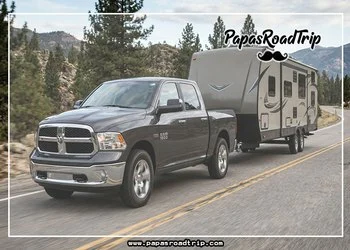
The 2004 Ford F-150’s tow rating depends on which of the six trims you own, whether it’s a Regular Cab, SuperCab, or SuperCrew, and which of the three engines sits under the hood. In short: you’re looking at roughly 5,000 to 9,900 pounds of maximum towing capacity, with payload ratings of about 1,300 to 3,000 pounds, depending on configuration. This guide breaks down the 2004 F-150 towing capacity by cab, bed, engine, and axle so you can match your truck to your trailer.
Key Takeaways
- The 2004 F-150’s maximum tow rating is 9,900 lbs, achieved only with the 5.4L Triton V8, the heavy-duty payload package, and the right axle ratio — most trucks on the road are rated well below that.
- There are three engines: the 4.2L V6 (manual only, base trucks), the 4.6L V8, and the 5.4L 3-valve V8. The engine and axle ratio drive the rating more than anything else.
- The GCWR (Gross Combined Weight Rating) is the number that actually governs safe towing — not the marketing tow number.
- Payload is often the real bottleneck: tongue weight, passengers, and cargo all count against GVWR before trailer weight matters.
- Your truck’s specific rating is printed on the Safety Compliance Certification Label on the driver’s door jamb — always check it before hooking up.
- A weight-distributing hitch is required above 5,000 lbs trailer weight per Ford’s own guidance for this generation.
How the 2004 F-150 Was Configured
The 2004 model year was the first of the eleventh-generation F-150, a clean-sheet redesign that Ford marketed heavily. It came in three cab styles — Regular Cab, SuperCab (extended cab with rear-hinged half doors), and SuperCrew (full four-door) — paired with three bed lengths: 5.5 ft (SuperCrew only), 6.5 ft, and 8 ft (Regular Cab and SuperCab long-bed).
Trims ran from the work-truck XL through STX, XLT, FX4, Lariat, and the luxury King Ranch. Importantly, trim level itself doesn’t change the mechanical tow rating much — what changes it’s the engine, axle ratio, cab/bed combination, and whether the truck has the heavy-duty payload package. A loaded Lariat can actually tow less than a bare XL if its own weight eats into the ratings.
Ford published towing guides for each model year, and the 2004 F-150 figures below reflect those published configurations. Because ratings vary by build, the door-jamb label is the final authority for your specific truck.
2004 F-150 Towing Capacity by Engine
The engine is the single biggest variable. Here’s how the three powertrains compare on maximum trailer weight when properly equipped:
| Engine | Displacement | Power (approx.) | Max Tow Rating | Notes |
|---|---|---|---|---|
| 4.2L V6 | 256 cu in | ~202 hp | ~5,000–5,700 lbs | Manual transmission, base Regular Cab/SuperCab only |
| 4.6L V8 | 281 cu in | ~231 hp | ~6,500–7,100 lbs | Automatic, most common mid-range engine |
| 5.4L Triton V8 (3-valve) | 330 cu in | ~300 hp | ~8,200–9,900 lbs | Automatic, required for max tow |
The 5.4L’s 9,900-lb figure is the headline number Ford advertised, but it required a specific build: usually a Regular Cab or SuperCab with the heavy-duty payload package, a 3.73 axle ratio, and the tow package. A SuperCrew Lariat 4×4 with the same 5.4L engine but a 3.55 axle and no HD payload package will be rated noticeably lower — often in the 8,000–8,700 lb range.
Pro Tip: Don’t assume “5.4 V8” means 9,900 lbs. The engine is necessary but not sufficient — the axle ratio and payload package are what unlock the top rating.
Towing Capacity by Cab and Bed Configuration
Cab and bed choice affects curb weight, which directly reduces how much trailer you can pull. Heavier trucks (SuperCrew 4×4) tow less than lighter ones (Regular Cab 4×2) with identical powertrains.
| Configuration | Typical Max Tow (5.4L V8) | Typical Max Tow (4.6L V8) |
|---|---|---|
| Regular Cab, 8-ft bed, 4×2 | ~9,500–9,900 lbs | ~7,000–7,100 lbs |
| Regular Cab, 6.5-ft bed, 4×2 | ~9,200–9,600 lbs | ~6,800–7,000 lbs |
| SuperCab, 6.5-ft bed, 4×2 | ~8,800–9,300 lbs | ~6,600–6,900 lbs |
| SuperCab, 8-ft bed, 4×4 | ~8,400–8,900 lbs | ~6,400–6,700 lbs |
| SuperCrew, 5.5-ft bed, 4×4 | ~8,200–8,700 lbs | ~6,300–6,600 lbs |
These are typical ranges across trims and axle ratios — your exact figure lives on the certification label. The pattern to remember: every option that adds weight subtracts towing capacity. Four-wheel drive, a bigger cab, a heavier trim, and dealer-added accessories all eat into the number.
Understanding GCWR, GVWR, and Payload
New tow-vehicle owners often fixate on the trailer weight and ignore the two numbers that actually keep them legal and safe. Here’s the hierarchy:
- GVWR (Gross Vehicle Weight Rating): the maximum your truck itself can weigh, including fuel, passengers, cargo, and tongue weight.
- GCWR (Gross Combined Weight Rating): the maximum combined weight of the loaded truck plus the loaded trailer.
- Payload: GVWR minus the truck’s curb weight — the people, gear, and tongue weight you can add.
- GAWR (Gross Axle Weight Rating): the limit for each axle, front and rear, separately.
The tow rating is essentially GCWR minus the truck’s weight in a specific configuration. That’s why two identical-looking trucks can carry different ratings. Tongue weight — typically 10–15% of trailer weight — counts against payload and rear GAWR, and on a half-ton truck with a family of four and gear in the bed, payload is frequently the limiting factor before trailer weight is.
Warning: Exceeding GVWR or GAWR is a safety and liability issue even if you’re under the “tow rating.” Load your truck and trailer at a CAT scale before a long trip to confirm both axle loads and the combined weight.
What the Tow Package Adds
Ford’s trailer tow package for the 2004 F-150 wasn’t just a hitch. Depending on the build it included a receiver hitch, 7-pin wiring harness, transmission oil cooler, upgraded cooling, and a heavier battery/alternator combo. Trucks without the package may have a lower rating or require aftermarket additions before towing near the limit.
If you’re buying a used 2004 F-150 specifically to tow, verify the package is present rather than assuming. Check for the factory receiver, the 7-pin connector at the rear bumper, and the auxiliary transmission cooler in front of the radiator. A truck rated for 9,900 lbs new but missing its coolers isn’t a 9,900-lb truck today.
Also confirm the axle ratio — it’s coded on the door label and in the VIN. Common 2004 F-150 ratios were 3.31, 3.55, and 3.73, with 3.73 generally paired with the max-tow builds.
Matching a Trailer to Your Truck
Use this quick decision framework before you shop for a trailer:
- Read your door-jamb label for GVWR, GAWR, and payload. Write the payload number down.
- Subtract the weight of passengers, fuel (roughly 6 lbs per gallon — a 26-gallon tank is ~156 lbs), and cargo from payload.
- Divide the remainder by 0.13 (a 13% tongue weight) to estimate the heaviest trailer your payload allows.
- Compare that figure to your GCWR-based tow rating and take the lower of the two.
- Confirm with a weight-distributing hitch if the trailer exceeds 5,000 lbs, per Ford’s towing guidance for this generation.
For a typical SuperCrew 4×4 with a 5.4L and a family aboard, that math often lands a travel trailer in the 6,000–7,500 lb range even though the truck’s sticker says 8,500+. That gap is normal and is exactly why payload math matters.
Towing Safely With a 20-Year-Old Truck
A 2004 F-150 is now two decades old, and its original ratings assumed new brakes, new springs, and new tires. Before trusting the sticker on a long haul:
- Inspect the frame and hitch mounting points for rust, especially in salt-belt states.
- Replace the transmission fluid and verify the cooler lines aren’t leaking.
- Check brake condition and fluid — trailer brakes and a brake controller are essential above roughly 3,000–5,000 lbs.
- Confirm tire load rating and age; trailer tires and truck tires older than about six years should be replaced regardless of tread.
- Verify the rear axle and springs haven’t sagged, which reduces effective payload.
The National Highway Traffic Safety Administration publishes tire load and safety guidance that’s worth reviewing if you’re unsure how to read the load index on your sidewalls.
Pro Tip: Weigh the truck empty at a CAT scale, then weigh it loaded with your trailer attached. The difference tells you your real tongue weight and whether you’re inside GVWR — no guessing required.
Common Towing Mistakes to Avoid

- Trusting the brochure number. The 9,900-lb figure applied to one specific build; your truck’s label is the truth.
- Ignoring tongue weight. Too little causes sway; too much overloads the rear axle and lifts the steering axle.
- Skipping the weight-distributing hitch. Above 5,000 lbs, Ford’s guidance calls for weight distribution — it’s not optional equipment.
- Overlooking the trailer’s own GVWR. A trailer rated higher than your truck’s capacity is a mismatch no hitch can fix.
- Assuming 4×4 helps towing. It adds weight and usually reduces the rating slightly.
- Forgetting the truck’s own cargo. Firewood, coolers, and passengers all come out of payload before the trailer does.
Related guides
- Do Airbags Increase Payload Capacity
- Will Car Pass Inspection With Engine Light ON?
- Why Replaced MAF Sensor? Check Engine Still On!
Frequently Asked Questions
What is the maximum towing capacity of a 2004 F-150?
The maximum is 9,900 lbs, available only on specific builds with the 5.4L Triton V8, the heavy-duty payload package, and a 3.73 axle — typically Regular Cab or SuperCab 4×2 models. Most 2004 F-150s on the road are rated between roughly 5,000 and 9,000 lbs depending on engine, cab, drivetrain, and axle ratio.
Can a 2004 F-150 with the 4.6L V8 tow a travel trailer?
Yes, within limits. The 4.6L V8 is typically rated around 6,500–7,100 lbs maximum, and after subtracting payload for passengers and gear, a realistic travel trailer target is often 4,500–6,000 lbs. Lightweight trailers under 5,000 lbs are the comfortable sweet spot for this engine.
What is the difference between the 4.6L and 5.4L for towing?
The 5.4L 3-valve V8 makes roughly 300 hp versus about 231 hp for the 4.6L, and it’s rated to pull up to about 2,500–2,800 lbs more in comparable configurations. The 5.4L also handles grades and headwinds with less strain, which matters on longer trips.
Do I need a weight-distributing hitch on a 2004 F-150?
Ford’s towing guidance for this generation calls for a weight-distributing hitch when trailer weight exceeds 5,000 lbs. Below that, a standard ball mount is generally acceptable, but always confirm against your owner’s manual and the hitch manufacturer’s rating.
Where do I find my truck’s exact tow rating?
Check the Safety Compliance Certification Label on the driver’s door jamb. It lists GVWR, GAWR for each axle, and often the original tire size. Combine that with the axle code and your owner’s manual’s towing chart to derive the rating for your exact build.
Can I increase my 2004 F-150’s towing capacity?
You can improve how comfortably and safely it tows — with a transmission cooler, weight-distributing hitch, trailer brakes, and fresh suspension — but you can’t legally or safely raise the published rating. The rating is set by the vehicle’s engineering limits, and no aftermarket part changes the door-jamb figures.
Conclusion
Before your next trip, walk out to the truck, photograph the door-jamb label, and write down the GVWR, GAWR, and payload figures. That five-minute step — combined with a CAT-scale weigh-in — tells you more about what your specific 2004 F-150 can safely tow than any brochure ever will.