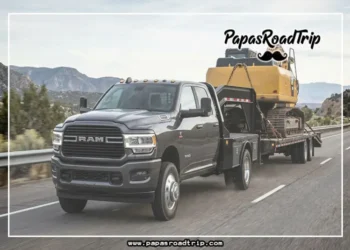
A regular cab with a 60-inch cab-to-axle and the max tow package gets you the highest ram 5500 towing capacity. A crew cab with a long bed and four-wheel drive lands much lower. The real numbers by configuration, the ratings that limit you first, and the checks that keep you legal all matter here.
What a 5500 chassis cab really is

A Ram 5500 is a chassis cab truck. Ram builds it as a bare frame with a cab in front, and a second company adds the bed, the flatbed, the dump body or the service box. That’s the key difference from a Ram 3500 pickup, which arrives finished. The 5500 is a Class 5 truck, built for work: landscaping, hotshot hauling, utility service and ambulance builds.
It’s for people who carry tools, tow equipment or move loads every week. The one misconception people bring is that the 5500 is just a heavier 3500. It isn’t. The frame, axles, brakes and cooling are different, and so is the way the truck gets rated.
Ram publishes a “Body Builder’s Guide” for each model year. It lists the frame dimensions, the mounting points and the weight limits for each wheelbase. The body company uses that guide to build a bed that doesn’t overload the rear axle. That’s also why two 5500 trucks with the same engine can carry very different legal ratings.
The number on the door jamb is the one that counts. It’s set by Ram for that exact truck as built, and no chart on the internet overrides it. Check yours before you hook up anything heavy.
How Ram rates a 5500 for towing
Ram starts with the truck’s gross combined weight rating, or GCWR. That’s the total legal weight of the truck, the trailer and everything in both. Then it subtracts the truck’s own weight to get the trailer number. So the same 5500 can tow more or less depending on what’s bolted to the frame.
- Pick the cab and wheelbase. A regular cab 4×2 with a 60-inch cab-to-axle is the lightest and tows the most. A crew cab 4×4 with a 84-inch cab-to-axle adds hundreds of pounds and cuts the trailer rating.
- Choose the engine. The 6.7L Cummins diesel is the tow engine. The 6.4L Hemi V8 is cheaper but rated lower for heavy trailers. Check Ram’s chart for your model year, because ratings change.
- Check the rear axle ratio. A numerically higher ratio (like 4.44) pulls better and lets you use more of the GCWR. A lower ratio saves fuel but lowers the trailer limit.
- Add the body weight. The bed, the toolbox, the welder and the fuel all count against the GCWR. Weigh the finished truck at a public scale before you trust any chart.
- Subtract from the GCWR. Take the GCWR from Ram’s chart for your exact build, subtract your scaled truck weight, and that’s your real trailer limit.
- Check the rear axle rating. This is often the first limit you hit, not the trailer number. A heavy tongue weight plus a loaded bed can exceed it.
- Check the hitch and receiver. The hitch has its own rating, and it may be lower than the truck’s. Read the sticker on the hitch itself.
The judgement call that separates a good setup from a bad one is weighing the truck loaded, not empty. A 5500 with a steel flatbed, a fuel tank and tools can weigh far more than the brochure suggests, and that weight comes straight off your trailer allowance.
Ram 5500 towing figures by setup
These are the main variations owners ask about. Always confirm against the chart for your model year and your exact build, since Ram updates ratings and the body adds weight.
| Your setup | What to do | Figure that matters | What to watch for |
|---|---|---|---|
| Regular cab, 4×2, 60″ CA, diesel, max tow | Best case for trailer weight | Highest rating in Ram’s chart for that year | Needs the right axle ratio and hitch |
| Crew cab, 4×4, 84″ CA, diesel | Common work truck | Lower than the regular cab by several hundred lb | Heavier cab and 4×4 cut the allowance |
| Gas 6.4L Hemi | Lighter duty towing | Lower trailer rating than diesel | Check the chart for your year |
| Steel flatbed or dump body added | Weigh it first | Body weight comes off the GCWR | A heavy body can cut towing a lot |
| Gooseneck or fifth-wheel trailer | Use the frame-mounted hitch | Hitch rating may be the limit | Confirm the hitch sticker, not the ad |
| Loaded bed plus trailer | Add both weights | Rear axle rating often limits first | Scale the truck loaded, not empty |
| Trailer with heavy tongue weight | Watch payload | Tongue weight counts against payload | Too much tongue weight overloads the axle |
Most real 5500 trucks with a body and tools tow less. That’s not a fault; it’s how the math works.
What separates a safe 5500 setup from an overloaded one
The people who get this right do one thing first: they weigh the truck. They fill the fuel tank, load the tools they actually carry, and drive to a public scale. They write down the front axle, rear axle and total weight. Then they compare those numbers to the ratings on the door jamb. Only after that do they look at trailer charts.
They also read the door jamb sticker before the brochure. The sticker lists the front gross axle weight rating, the rear gross axle weight rating and the gross vehicle weight rating for that exact truck. A dealer’s chart covers many builds; the sticker covers yours. When the two disagree, the sticker wins every time.
Order matters too. They set the tongue weight or pin weight first, then check the rear axle, then check the total. A trailer can be under its own limit and still overload the truck’s rear axle. That’s the mistake that costs people: they buy a trailer that matches the advertised tow rating, load the bed, and find the rear axle is over its limit at the scale. The fix is a lighter body, less cargo or a different trailer.
What they leave alone is the truck’s suspension and brakes. Lifting a 5500 or adding air bags doesn’t raise any legal rating. Air bags help the truck sit level, but the axle rating stays the same on the sticker.
Common 5500 towing problems and fixes

| What you notice | What it usually means | What to do first |
|---|---|---|
| Truck sags at the rear when hitched | Too much tongue or pin weight | Weigh the rig and move cargo forward on the trailer |
| Trailer feels light or wanders | Not enough tongue weight | Reload so about 10-15% of trailer weight sits on the tongue |
| Rear axle over its rating at the scale | Body and cargo weight too high | Remove weight from the bed or choose a lighter body |
| Brakes feel weak on long descents | Trailer brakes not set up right | Check the trailer brake controller and the trailer’s own brakes |
| Truck overheats on long climbs | Cooling working at its limit | Slow down, check coolant, confirm the tow package is fitted |
| Hitch creaks or moves | Loose or worn hitch hardware | Stop and check the hitch bolts and the receiver |
The tongue weight range above is a general guide, not a rule for every trailer. Check your trailer maker’s own manual for the figure they specify.
Rules and ratings you must confirm
Ram sets the ratings, and the door jamb sticker is the legal figure for your truck. The GCWR, the gross vehicle weight rating and the axle ratings all come from Ram for that build. If you change the body or add weight, the ratings don’t change, but your margin does.
The Federal Motor Carrier Safety Administration (FMCSA) sets the rules for commercial operation. If you tow for business and your combined weight crosses certain thresholds, you may need a US DOT number and a commercial driver’s license. The thresholds depend on your state and your weight, so check the FMCSA website and your state’s DMV before you start hauling for pay.
Your state also sets registration and weight fees for a truck this size. Check with your state motor vehicle office for the fee that applies to your registered weight.
If your setup crosses into commercial territory, talk to your state DMV or a transport compliance specialist. Getting the paperwork wrong can cost you a fine or keep the truck off the road.
Keeping the truck and trailer right
Once the rig is set up, write down the scaled weights and keep them with the truck. Recheck them any time you add a body, a toolbox, a fuel tank or a different trailer. A small change in truck weight changes your trailer allowance directly.
Check the hitch hardware and the trailer brakes before every heavy trip. Look for loose bolts, worn pins and frayed wiring on the brake controller. These are the parts that fail quietly.
Watch the tires for uneven wear, which can point to an axle or alignment problem. Check the tire pressure against the placard on the driver’s door jamb, and check it cold.
The sign that it’s time to re-weigh is simple: any change to the truck or the load. There’s no fixed interval that fits every build, so use the change itself as your trigger.
When a Ram 5500 is the wrong truck

A 5500 is the wrong choice if you tow occasionally and mostly drive empty. The stiff chassis and heavy axles ride harshly with no load, and you pay for capability you don’t use. A Ram 3500 pickup tows plenty for most owners and drives better day to day.
It’s also wrong if your trailer is light but your cargo is heavy. In that case a truck with more payload and less tow rating may fit better. Check the payload number on the sticker, not the tow number.
And it’s wrong if you need a finished bed from the factory. The 5500 comes as a chassis cab, so you’ll pay a body company to finish it. If you want a truck you can drive home and use, a pickup is the simpler path.
The tell is your annual mileage split. If most of your miles are solo commuting and a handful of weekends pull a trailer, the 5500’s extra capacity sits idle all year. If the truck earns its keep loaded or hitched most days, the harsh empty ride stops mattering.
Budget the upfit before you sign. A flatbed, a service body or a hauler bed adds real money on top of the chassis cab price, and lead times at body companies can run weeks. Get that quote first.
One more cost people miss: insurance and registration often class a 5500 as commercial, even when you only tow a horse trailer on weekends. Ask your insurer before you buy.
Related guides
- Do Airbags Increase Payload Capacity
- Does Ford Use Real Leather? Truth Revealed!
- Does Honda Use Real Leather? Truth Revealed!
Frequently asked questions
What is the max towing capacity of a Ram 5500?
Any crew cab, four-wheel drive or heavy body lowers it. Check Ram’s trailering chart for your model year and your door jamb sticker for your exact truck.
Can a Ram 5500 tow a 20,000 lb trailer?
Yes, in most configurations. A diesel 5500 with a standard body has enough GCWR for a 20,000 lb trailer, but you must confirm your scaled truck weight leaves that much room. Weigh the loaded truck first, then subtract from the GCWR on Ram’s chart.
Why is my Ram 5500 towing less than the chart says?
Because the chart assumes a bare truck. Your body, tools, fuel and cargo all count against the GCWR, and they come straight off the trailer allowance. Weigh the finished truck at a public scale and use that number instead of the brochure weight.
Is it safe to tow at the maximum rating?
Yes, if every rating is met at the same time: GCWR, gross vehicle weight rating, both axle ratings and the hitch rating. Towing at the max while the rear axle is over its limit isn’t safe. Scale the rig loaded and confirm each number separately.
How much tongue weight can a Ram 5500 take?
It depends on your hitch and your payload, not a single truck number. The hitch sticker gives the hitch limit, and the tongue weight counts against payload and the rear axle. A common guide is 10-15% of trailer weight, but check your trailer maker’s manual for their figure.
Do I need a special license to tow with a Ram 5500?
Not always. It depends on your combined weight and whether you tow for business. FMCSA rules and your state DMV set the thresholds, and a heavy combined weight used commercially can require a US DOT number and a commercial license. Check both before you haul for pay.
What happens if I tow over the Ram 5500 rating?
You’re overloaded, and that affects braking, handling and your legal position. An overloaded truck can fail an inspection, and in a crash your insurance may question the load. The ratings on the door jamb are the limit, so scale the rig and stay under them.
Conclusion
Before you hook up, load your exact truck’s door-jamb sticker and owner’s manual into a folder and keep it in the glovebox. That way you’ll have the real limits on hand at the scale or the trailhead, and you won’t be guessing when it matters most.