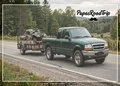
The 2000 ford ranger towing capacity tops out at 6,000 lbs. That figure belongs to the 4.0L V6 with the automatic transmission, 4.10 axle ratio and the factory tow package. A 2.5L four-cylinder 2WD Ranger is rated far lower — around 2,000 lbs with a manual gearbox. The exact number for your truck depends on its cab, bed, drivetrain and axle, and it’s printed on the door-jamb label and in the owner’s manual. This guide covers those variations, the gear that makes towing safe, and when the truck isn’t the right tool.
What the tow rating really means
The tow rating is the most weight Ford says the truck can pull, and it’s set by the whole package, not the engine alone. Axle ratio, transmission, cab style, bed length and whether the truck is 2WD or 4WD all move the number. That’s why two 2000 Rangers sitting in the same driveway can have ratings thousands of pounds apart.
Ford published these ratings in the 2000 Ranger owner’s manual and a separate towing guide for that model year. The door-jamb safety label and the manual are the two places your own truck’s number lives. Don’t trust a number from a forum or a friend’s truck — check your own.
The truck is built for light work: a small boat, a utility trailer, a pair of jet skis, a few yards of mulch. It’s a compact pickup with a short wheelbase, and that shape has real limits once a trailer gets heavy or long. The rating tells you what the truck can pull. It doesn’t tell you what feels safe on a highway at speed.
The misconception people bring is that the biggest engine number applies to every Ranger. It doesn’t. A four-cylinder truck with a manual and a tall axle is a different machine from a 4.0L automatic with the tow package, and it should be treated as one.
How to find your Ranger’s real tow number
- Open the driver’s door and read the safety label. It lists the gross vehicle weight rating (GVWR) and the axle codes. Write them down. This takes two minutes and settles most of the argument.
- Check the axle code against the chart in the owner’s manual. The code tells you the ratio — 3.08, 3.45, 3.73 or 4.10 are the common ones. A lower number pulls less. A 4.10 with the 4.0L is the top of the range.
- Confirm the engine and transmission. The 4.0L V6 with the automatic carries the highest rating. The 2.5L four-cylinder sits at the bottom, and the manual gearbox lowers it further because of clutch load.
- See whether the truck has the factory tow package. That means the hitch, the trailer wiring and, on some builds, an auxiliary transmission cooler. If it’s missing, the rating may not apply until you add the right parts.
- Weigh your loaded trailer, not the empty one. A trailer’s dry weight means little once fuel, water, gear and passengers are aboard. A public scale gives you the real figure for a small fee.
- Subtract the tongue weight from your payload. Tongue weight counts against the truck’s cargo limit, along with people and gear in the cab. If payload runs out first, the tow rating is already used up.
The judgement call that matters most is matching the trailer to the truck’s weakest link, not its strongest. A 4.0L truck with a 3.08 axle and no cooler isn’t a 5,600-lb tow rig. Read the axle code before you read the engine badge, and let the lower number win.
If your trailer needs brakes, a weight-distribution hitch or a commercial licence in your state, that’s beyond a driveway job — talk to a licensed hitch shop or your state’s motor vehicle office.
2000 Ford Ranger towing capacity by setup
These are the ratings Ford published for the 2000 model year. Treat them as a starting range and confirm your own truck against its door label and manual, because Ford listed variations by cab, bed and drivetrain that this table folds together.
| Your setup | What to use or do | Figure that matters | What to watch for |
|---|---|---|---|
| 4.0L V6, automatic, 4.10 axle, tow package | The top-rated build — best for a loaded trailer | Up to 5,600 lbs | Still limited by payload and tongue weight |
| 4.0L V6, automatic, 3.73 axle | Good all-round setup for a boat or utility trailer | Around 5,000 lbs | Confirm the axle code on the door label |
| 4.0L V6, manual gearbox | Fine for light loads, harder on the clutch | Lower than the automatic | Slipping clutch on hills is the warning sign |
| 3.0L V6, automatic | Mid-range work, small trailers only | Roughly 3,000–4,000 lbs | Check the exact figure in your manual |
| 2.5L four-cylinder, manual, 2WD | Light utility trailer, jet skis, garden waste | Around 2,000 lbs | Don’t add a heavy load “just this once” |
| 4WD models | Extra weight cuts payload, not tow rating | Same tow figure, less cargo | Weigh the truck loaded before you hitch |
| Any Ranger without the tow package | Add the hitch and wiring first | Rating may not apply as built | A dealer or hitch shop can confirm the parts |
What separates a safe tow from a scary one
The people who tow well with a small truck do the boring things first. They weigh the trailer loaded, before the trip, on a public scale. They check tongue weight — roughly 10% to 15% of the trailer’s total weight is the usual target, and too little tongue weight is what makes a trailer sway. They read the door label, not the brochure.
They also load the truck, not just the trailer. Every pound of tongue weight comes out of the payload, and so does every passenger and every tool in the bed. A Ranger with two adults, a full tank and a cooler has less room for tongue weight than the empty truck on the spec sheet. That’s the trade-off: more gear in the truck means less trailer you can safely pull.
Where beginners go wrong
The common mistake is hooking up a trailer that’s too heavy for the truck’s real rating and finding out on a downhill curve. The cost isn’t just a ticket — it’s brake fade, sway and a crash that insurance may not fully cover if the rig was over its rated limit. Another is skipping the trailer brakes on a load near the top of the range.
The experienced move is to leave margin. If your trailer weighs close to the rating, slow down, add trailer brakes if you don’t have them, and avoid steep grades. And leave the engine mods alone — a cold-air intake or a chip doesn’t raise the rating, and it can void a warranty or fail an emissions check.
Common towing problems and quick fixes

| What you notice | What it usually means | What to do first |
|---|---|---|
| Trailer sways at speed | Too little tongue weight, or load sitting too far back | Move weight forward, re-check tongue weight |
| Truck squats at the rear | Tongue weight is over the payload limit | Weigh the setup, lighten the load |
| Brakes feel weak on a downhill | Trailer has no brakes, or they aren’t working | Have trailer brakes checked before towing again |
| Transmission runs hot on hills | No auxiliary cooler, or too much load | Add a cooler, drop a gear, slow down |
| Clutch slips pulling away | Manual gearbox under a heavy load | Lighten the trailer, or switch to an automatic truck |
Sway that starts only above 55 mph and settles when you ease off is usually a loading problem. Sway that starts early and builds is a hitch or tire problem, and no amount of weight shifting will fix it. Pull over and check both before the next stretch of highway.
On a Ranger with the 3.0L V6, the manual gearbox is the weak point, not the engine. If your clutch slips on a grade you have already towed before, the disc is worn, and a new clutch will slip again under the same trailer. Either lighten the load or move to an automatic truck.
A hot transmission on a long climb is the one item on this table that turns into a rebuild. If the gauge climbs and stays up after you drop a gear, stop and let it idle in neutral to cool.
What Ford and the labels require
Ford’s own towing guide for the 2000 Ranger is the document that sets these ratings, and it lists them by engine, axle and drivetrain. The door-jamb safety label, required on every vehicle sold in the US, carries the GVWR and axle codes that let you match your truck to that guide. Read both before you trust any number.
The other rule that changes what you may do is your state’s. Trailer brake requirements, weight limits for a standard driver’s licence and hitch rules vary by state — check your state’s motor vehicle department website for the current figures. A trailer over a certain weight often needs its own brakes and a breakaway system.
Before you start, confirm four things: your truck’s axle code, its payload figure, your loaded trailer weight, and your state’s rules. If the trailer needs brakes, a weight-distribution hitch or a commercial licence, that’s a job for a licensed hitch shop or your state motor vehicle office, not a driveway fix.
Keeping the truck tow-ready
Once the hitch is on and the wiring works, the job isn’t finished — it’s maintenance. Check the hitch bolts and the trailer wiring before every trip; a loose bolt or a corroded plug is the most common cause of trailer lights failing. Grease the ball, and look at the tires on both truck and trailer for cracks or low pressure.
Change the transmission fluid more often if you tow regularly, and watch for the sign it’s due: dark fluid or a burnt smell on the dipstick. Ford’s own maintenance schedule in the owner’s manual gives the interval for your driving conditions — check it there rather than guessing. The same goes for brake fluid and coolant.
After each tow, wash the hitch and the rear of the truck to clear road salt, and store the trailer with the tongue supported so the tires don’t flat-spot. A truck kept this way holds its rating for years. One left to rust at the hitch doesn’t.
When a Ranger isn’t the right truck

A 2000 Ranger is the wrong choice when the trailer is heavy and the trips are long. A travel trailer near the top of the rating, towed through mountains, asks more of a compact pickup than it can safely give — a half-ton truck is the honest answer there. The Ranger’s short wheelbase and light weight are working against you at that size.
It’s also the wrong truck if you need to tow often with a full bed and a full cab. Payload runs out before tow rating does, and you’ll be leaving gear behind or overloading the truck. A larger truck solves both at once.
And it’s the wrong choice if you can’t confirm the rating. A truck with no door label, a swapped axle or a mystery history isn’t one to trust with a trailer. Have a shop check it, or use a different vehicle.
Related guides
- Ford Ranger Tow Package: Ultimate Guide to Maximize Towing Power
- Ford Ranger Years to Avoid: Buyer Beware Guide
- Ford Ranger Transmission Problems: Troubleshoot & Fix
Frequently asked questions
What is the max towing capacity of a 2000 Ford Ranger?
Up to 5,600 lbs, and only on the 4.0L V6 with the automatic, the 4.10 axle and the factory tow package. Any other combo is lower — a four-cylinder 2WD manual is around 2,000 lbs. Check your door label and owner’s manual for your exact truck.
Can a 2000 Ranger tow a 5,000 lb trailer?
Yes, if it’s a 4.0L V6 automatic with a tall enough axle and the tow package — but you’ll be near the limit, so trailer brakes and careful loading matter. A four-cylinder or a low-ratio axle can’t do it safely. Weigh the loaded trailer first.
How much can a 4-cylinder 2000 Ranger tow?
Around 2,000 lbs with the manual gearbox and 2WD, which suits a small utility trailer or a pair of jet skis. It’s not a boat or camper tow rig. Confirm the figure in your owner’s manual, since cab and drivetrain change it.
Does the 2000 Ranger need a special package to tow?
The factory tow package adds the hitch, the trailer wiring and sometimes a transmission cooler, and the top ratings assume it. Without it, the rating may not apply as built. A dealer or hitch shop can confirm which parts your truck needs.
Is it safe to tow at the maximum rating?
It’s legal if the truck is built to that rating and loaded correctly, but it leaves no margin. Keep tongue weight around 10%–15% of trailer weight, add trailer brakes, and slow down. For long mountain trips, a larger truck is safer.
How much tongue weight can a 2000 Ranger handle?
It’s set by payload, not a single number — tongue weight counts against the truck’s cargo limit along with passengers and gear. Aim for 10%–15% of trailer weight and keep the total under your payload figure from the door label.
What happens if I tow more than the rating?
You risk brake fade, trailer sway and a crash, and insurance may not fully cover a rig that was over its rated limit. The truck also wears faster — clutch, transmission and brakes take the strain. Stay under the rating and leave margin.
Conclusion
Before your next haul, check the door-jamb label against your owner’s manual and weigh your loaded trailer at a public scale. If the numbers leave little margin, you’ll want to lighten the load or step up to a bigger truck.