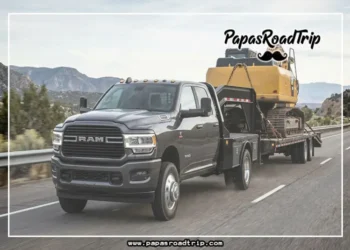
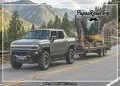
The hummer ev towing capacity is up to 7,500 pounds across the EV2X, 3X and Edition 1 trims, which GMC lists as the maximum. The 12,000-pound figure you may have seen isn’t a towing rating. This guide covers the real numbers by trim, what cuts them, and the checks that keep you inside them.
What the rating actually means
The rating is a maximum, not a promise. GMC publishes it for a truck in a set condition: the right equipment, a driver and passenger, and no extra cargo. Load the bed or fill every seat and the trailer weight you can pull drops. That’s the part people miss.
Towing capacity is the weight of a trailer the truck is built to pull. It isn’t the same as the weight the truck can carry. Payload is what goes in the cab and bed. The two share one limit, so weight in the truck comes out of the trailer’s share.
The Hummer EV is a big, heavy electric pickup. It’s built for buyers who want power and presence, and who tow now and then. It isn’t a work truck for daily heavy hauling. If you pull a loaded trailer every day, a diesel 2500-series truck fits that job better.
One thing to get straight: electric trucks pull well, but they pay for it in range. The motor has strong low-speed torque, so moving a trailer from a stop feels easy. The battery drains faster under that load. Plan charging stops around the trailer, not around the truck alone.
The 12,000-pound number floating around online isn’t a towing figure. Check GMC’s own Hummer EV specifications page for your model year, because ratings can change between years.
How to work out your own safe trailer weight
You can’t just hitch up and go by the brochure number. Work through these decisions in order. Each one settles the weight you can actually pull.
- Find your exact trim and model year. The EV2X, 3X and Edition 1 are all rated to 7,500 pounds. Check the sticker on your driver’s door jamb, not a review site.
- Add up everything in the truck. That’s you, your passengers, and any cargo in the bed or cab. Subtract that total from the payload figure on the same sticker.
- Compare payload left with your trailer’s tongue weight. Tongue weight is the downward load the trailer puts on the hitch. A common guide is 10% to 15% of the trailer’s loaded weight. A 7,000-pound trailer puts roughly 700 to 1,050 pounds on the hitch.
- Weigh the trailer loaded, not empty. Water tanks, gear and fuel add up fast. A trailer that’s fine empty can be over the limit with a full tank.
- Check your hitch and ball setup. The hitch, ball mount and ball each carry their own weight rating. The weakest part sets the limit for the whole setup.
- Read the door sticker for axle and combined limits. The gross axle weight rating (GAWR) and gross combined weight rating (GCWR) tell you the real ceiling. Stay under all of them, not just the towing number.
- Test the setup on a short, quiet route first. Load it, drive 10 to 15 minutes at low speed, then check the hitch, lights and tire temperatures before a longer trip.
The judgement call that matters most is tongue weight. Too little and the trailer sways at speed. Too much and you overload the rear axle and steering feels light. Aim for the middle of the 10% to 15% range and adjust by moving cargo inside the trailer.
Weighing your setup at a public scale is the only way to know your real numbers. Most truck stops have one, and it costs little. If you’re not sure how to read the scale ticket, ask the staff — they do it every day.
Hummer EV towing figures at a glance
These are the figures to keep on your phone. Every one assumes a stock truck with a driver and one passenger, no bed cargo, and a properly rated hitch.
| Your situation | What to use or do | Figure that matters | What to watch for |
|---|---|---|---|
| EV2X or 3X, light load | Standard hitch setup | 7,500 lb max trailer | Payload still comes off this number |
| Edition 1, light load | Standard hitch setup | 7,500 lb max trailer | Confirm your year on the door sticker |
| Full cab of passengers | Recount payload first | Payload minus people | Trailer limit drops by the same amount |
| Trailer with water tanks | Weigh it loaded | 10–15% tongue weight | Empty weight hides the real load |
| Long highway trip | Plan charge stops | Range drops under load | Charge before you need it, not after |
| Steep downhill grades | Use low regen and low gear | Brake fade risk | Let the motor slow you, not the brakes |
| Unknown trailer weight | Public scale | Actual loaded weight | Never trust the seller’s figure |
The range figure under load isn’t published as a single towing number by GMC, because it changes with speed, grade, temperature and trailer shape. Watch your own truck’s estimate and build in a buffer.
Details that separate a safe setup from a risky one
The people who tow well do the boring things first. They weigh the trailer before the first trip, not after a problem. They read the door sticker instead of a forum post. And they leave a margin — they don’t run at the exact maximum on a long trip.
Preparation is where most of the safety lives. Check tire pressures on both truck and trailer when the tires are cold. Cold means before you’ve driven more than a mile or two. Under-inflated trailer tires heat up and fail, and that’s one of the most common causes of a roadside breakdown with a trailer.
The order of work matters too. Hitch up, then connect the safety chains in a cross pattern, then the breakaway cable, then the lights. Test the lights with a helper before you move. Do a walk-around at the first stop, roughly 10 to 15 minutes in, and check the hitch, the chains and the tire temperatures by hand.
What experienced towers leave alone is just as telling. They don’t add heavy accessories to the bed “for balance.” They don’t tow at the maximum on mountain roads in bad weather. And they don’t trust a weight-distributing hitch to fix an overloaded truck — it moves weight around, it doesn’t remove it.
One more detail: trailer brakes. A trailer near the top of the range needs its own brakes, working and adjusted. Without them, the truck’s brakes do all the work, and stopping distances grow fast on a downhill grade.
Common towing problems and quick fixes
Most towing trouble shows up as something you feel or see, not something a computer tells you. Match what you notice to the likely cause, then fix the simplest thing first.
| What you notice | What it usually means | What to do first |
|---|---|---|
| Trailer sways at speed | Too little tongue weight | Move cargo forward inside the trailer |
| Steering feels light | Too much weight on the rear axle | Shift cargo back or remove bed load |
| Range drops fast | Normal under trailer load | Slow down and plan the next charger |
| Brakes feel weak downhill | Trailer brakes not working | Check the brake controller and trailer wiring |
| Trailer lights don’t work | Wiring or connector fault | Check the plug and test each light |
If sway starts, ease off the accelerator gently and don’t brake hard. Hard braking or sharp steering makes sway worse. Pull over at the first safe spot and adjust the load.
Sway that returns after you move the load forward usually means the trailer is loaded too light on the tongue overall, not just badly placed. Shift weight forward until the trailer tracks straight, then stop adjusting.
Weak trailer brakes on a downhill grade are worth diagnosing before the next trip, not during it. Test them at low speed on flat ground first. If the trailer still won’t hold, the controller or the wiring is the likely culprit.
Range loss is the one item on that table you can’t fix, only manage. Plan chargers around the loaded range, not the empty-truck range, and expect the gap to widen in cold weather or a headwind.
What GMC and the law require
GMC sets the ratings, and the door jamb sticker is the version that applies to your truck. The owner’s manual covers hitch requirements, break-in rules for towing, and the trailer brake setup. Read the towing section before your first trip — it’s short and specific to your truck.
The law is separate from the rating. Every US state sets its own trailer brake and lighting rules, and some require trailer brakes above a certain trailer weight. Your state’s DMV or motor vehicle department publishes those rules, and they can differ from the truck’s rating.
Check four things before you start. Your state’s trailer brake rule, your trailer’s own weight rating plate, your insurance cover for towing, and whether your driver’s licence covers the combined weight. For heavy combinations, some states require a different licence class — ask your DMV, not a forum.
If your setup needs a brake controller fitted or wiring repaired, that’s a job for a qualified trailer shop. Getting it wrong affects your brakes, and that’s a safety system, not a DIY project.
Keeping the setup right over time
Once you’re set up, a few habits keep it safe. Store the weight ticket and your hitch ratings together, so you can check them before each season. Recheck tire pressures before every trip with a trailer — they lose pressure slowly and you won’t feel it until it matters.
Re-weigh the trailer whenever you change what you carry. Adding a generator, a water tank or a second bike changes the tongue weight, and the old figure no longer applies. Do it before the trip, not after.
Check the hitch, chains and wiring at the start of each towing season, and look for rust, frayed wires or a worn ball. Replace worn parts rather than tightening them. The sign that something’s due is simple: any part that looks worn, loose or rusted gets fixed before the next trip.
Battery health also deserves a look each year. Towing works the battery harder, and a health check at your dealer shows whether it’s holding up. Ask them for the reading and compare it with the previous year.
When a different truck makes more sense

If you tow a heavy trailer most days, a diesel or gas heavy-duty truck will do it with less planning and more range. The electric truck is built for occasional towing, not daily hauling at the limit.
If your regular route has long gaps between chargers, plan carefully or pick a different vehicle. Towing cuts range, and a route with no charger near the end is a risk you don’t need. Check charger spacing on your actual route before you commit.
And if your trailer is over 7,500 pounds loaded, this truck isn’t rated for it at all. No hitch or accessory changes that. You need a truck with a higher rating, full stop.
The split usually comes down to how often, not how far. A few big pulls a season is Hummer EV territory. A heavy trailer hooked up every week is not, even if each trip is short.
Weigh the trailer loaded, with water and gear aboard, before you sign anything. The 8,500-pound figure is a ceiling, not a target, and a trailer that scales at 8,200 leaves you almost no margin for passengers and cargo in the truck.
One more cost people miss: charging while hitched. Many stations aren’t laid out for a trailer, so you may have to unhook to charge. On a long tow that turns one stop into two.
Related guides
- Do Airbags Increase Payload Capacity
- Does Ford Use Real Leather? Truth Revealed!
- Does Honda Use Real Leather? Truth Revealed!
Frequently asked questions
What is the towing capacity of the Hummer EV?
It’s 7,500 pounds across the EV2X, 3X and Edition 1 trims, per GMC’s figures. These assume a stock truck with a driver and passenger and no extra cargo. Check your door jamb sticker, because the rating can change by model year.
Can the Hummer EV really tow 12,000 pounds?
No. The 12,000-pound figure isn’t a towing rating for this truck. The published maximum is 7,500 pounds. If you’ve seen 12,000 quoted, check the source — it’s likely mixing up a different number or a different vehicle.
How much does towing drop the range?
There’s no single published figure, because it depends on trailer weight, speed, grade and temperature. Expect a significant drop under load. Watch your truck’s own range estimate and charge earlier than you would without a trailer.
Is it safe to tow at the maximum rating?
Yes, if you stay within every limit — towing capacity, payload, axle ratings and combined weight — and your hitch and trailer brakes are rated for the load. Running at the maximum leaves no margin, so check your weights at a scale first.
Do I need trailer brakes?
Usually yes, for a trailer near the top of the range. Many states require trailer brakes above a certain trailer weight, and your state DMV publishes the rule. Without working trailer brakes, stopping distances grow quickly on downhill grades.
How often should I check the hitch and wiring?
Before every trip, and again at your first stop about 10 to 15 minutes in. Do a full check at the start of each towing season. Replace any part that’s worn, loose or rusted rather than tightening it and hoping.
What happens if I go over the towing limit?
You overload the truck’s axles, brakes and tires beyond what they’re built for. Handling gets worse, stopping distances grow, and you may break state weight rules. It can also affect your insurance cover. Weigh your setup and stay under every limit.
Conclusion
Before you hook up, weigh your loaded trailer at a public scale and compare it against your trim’s door-jamb sticker. That’s the only figure that matters for your truck. It’ll take ten minutes, and you’ll know exactly where you stand before your first mile.