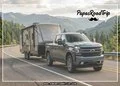
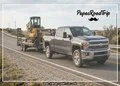
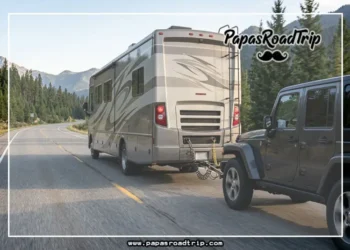
Motorhome towing means pulling a trailer, a car, or another vehicle behind your RV — and in the US the setup has to stay within your RV’s gross combined weight rating (GCWR), its hitch rating, and your state’s towing rules. A typical Class C motorhome handles a 3,500–5,000 lb trailer only if the hitch and GCWR allow it. This guide covers the weights, the hitch and brake setup, the state rules, and the fixes when something goes wrong.
What towing behind a motorhome really involves

Towing behind a motorhome is the practice of attaching a trailer, a boat, or a car to your RV’s hitch and pulling it on public roads. People use it to bring a second vehicle, a boat, or extra cargo without driving a second car. It’s most common with Class A and Class C motorhomes, which have the frame and the hitch receiver for it. Smaller Class B vans often can’t tow much at all.
The one misconception people bring is that the hitch rating is all that matters. It isn’t. Three numbers decide what you can pull safely:
- The hitch’s own rating (printed on the hitch label)
- The RV’s GCWR (gross combined weight rating) minus the loaded RV weight
- The trailer’s gross vehicle weight rating (GVWR) when fully loaded
The lowest of those three is your real limit. A 5,000 lb hitch on an RV that’s already near its GCWR can legally tow almost nothing.
One rule that’s always true: the trailer’s weight plus everything in the RV can’t exceed the GCWR. That’s a manufacturer’s figure, not a legal one — but it’s the one that keeps your brakes and frame within design limits.
If you’re not sure of your RV’s GCWR, check the sticker inside the driver’s door frame or the owner’s manual. Don’t guess it.
How to set up motorhome towing
- Weigh the loaded RV first. Fill the fuel tank and water, load your gear, then weigh at a public scale (CAT scales are common at truck stops). Write down the front axle, rear axle, and total.
- Find the GCWR and subtract. GCWR minus your loaded RV weight = your towing headroom. If that number is smaller than the trailer’s loaded weight, stop here.
- Check the hitch label. It lists a maximum trailer weight and a maximum tongue weight. Both must be met — not just one.
- Pick your towing method. Flat tow (dinghy), dolly, or full trailer. Each has different weight and brake needs.
- Add a brake system on the towed vehicle. Most states require brakes above a certain trailer weight. The exact threshold varies by state — check your state DMV’s towing page.
- Set the hitch height. The trailer should sit level. A drop hitch or rise hitch corrects the height mismatch so the trailer sits level.
- Test the lights and brakes before every trip. Turn signals, brake lights, and the breakaway cable. A 5-minute check catches most problems.
The single judgement call that separates a good setup from a bad one is this: weigh the loaded trailer, not the empty one, and compare it against the lowest of your three limits. Trailers gain weight with water, gear, and propane. A setup that’s legal on paper at the driveway can be over the limit at the first weigh station.
If a step needs a certified hitch installer, a brake controller wired into your RV’s electrical system, or a scale ticket you can’t read, that’s a job for a shop — not a driveway fix.
Towing numbers at a glance
The figures below are typical ranges, not rules for your RV. Always confirm against your own hitch label and owner’s manual.
| Your situation | What to use | Figure that matters | What to watch for |
|---|---|---|---|
| Class C RV, light trailer | Standard 2-inch receiver | 3,500–5,000 lb trailer limit (check label) | Tongue weight over the hitch max |
| Class A diesel, heavy trailer | Weight-distributing hitch | 5,000–10,000 lb (varies widely) | GCWR already used by cargo and water |
| Flat-towing a small car | Tow bar + supplemental brake | Towed weight under state brake threshold | State brake rules differ |
| Towing a boat | Trailer with surge brakes | Trailer GVWR vs. hitch rating | Ramp launch weight shifts |
| Long downhill grades | Engine braking + trailer brakes | Posted grade speed limit, well under it | Brake fade on long descents |
| Crossing state lines | Check each state’s rules | Brake and width limits vary | Some states require a special permit |
Where experienced setups get it right
Experienced towers weigh the rig loaded, not empty. They fill the water tank, add the gear, and get a real number before they buy a hitch or a tow bar. That one habit prevents most overload problems before they start.
They also work in a fixed order: hitch first, then brakes, then lights, then a test pull at low speed. Nothing gets skipped because “it worked last time.” A breakaway cable that’s frayed or a brake controller that’s set too low won’t show up until you need it.
The test pull happens in an empty lot, not on the road out of town. They pull forward, stop hard from about 20 mph, and walk back to look. If the trailer nose dipped or the rear of the motorhome squatted, the hitch height or the weight distribution is wrong, and they fix it there.
What they check partway through
Halfway into a long trip, they stop and touch the trailer hubs and tires. A hub that’s hot to the touch means a bearing or brake problem. They also re-check the hitch pin and the safety chains — vibration loosens things over hundreds of miles.
What they leave alone
They don’t add cargo to the trailer tongue to “balance” it. Tongue weight should be about 10–15% of trailer weight for a stable pull. More than that overloads the hitch; less makes the trailer sway.
If the rig sways at highway speed, the fix is usually more tongue weight or a slower lane, not a heavier load in the motorhome’s rear. Adding weight behind the rear axle lifts the front tires and makes the sway worse.
Common towing problems and fixes

| What you notice | What it usually means | What to do first |
|---|---|---|
| Trailer sways at highway speed | Too little tongue weight, or load too far back | Move weight forward, re-weigh |
| RV feels sluggish on hills | Setup near or over GCWR | Weigh loaded rig, remove cargo |
| Brake controller light stays on | Wiring fault or wrong gain setting | Check the manual’s gain chart |
| Trailer lights don’t work | Bad ground or blown fuse | Test the 7-pin plug with a tester |
| Tires wearing on one edge | Axle misalignment or wrong tire pressure | Check pressure against the tire sidewall |
Sway that starts only when a truck passes you is usually tongue weight. Sway that starts on its own, at a steady speed, points to the hitch setup itself.
Before you move any weight forward, put the loaded trailer on a scale. Guessing at tongue weight is how people overload the hitch and the rear axle at the same time.
A brake controller light that stays on after you release the manual lever is a wiring fault, not a gain problem. Adjusting gain won’t clear it.
If one trailer tire wears on an edge and the others look even, check that tire’s pressure cold before you suspect the axle. Uneven wear on both tires of one axle is the alignment case.
The rules that apply to towing
Towing law in the US is set by each state, not by one federal body. That means the brake requirement, the maximum width, and the speed limit for a towing rig can change when you cross a state line.
The Federal Motor Carrier Safety Administration (FMCSA) sets rules for commercial vehicles, not for private RVs. For your own rig, the state DMV is the source. Check these before you start:
- Your state’s trailer brake law — most states require brakes above a set trailer weight, but the number differs. Look it up on your state DMV website.
- Maximum width and length — most states allow 8.5 ft width and a combined length around 65 ft, but confirm yours.
- Your RV’s GCWR and hitch rating — on the door sticker and hitch label.
- Your insurance policy — some policies exclude towed trailers unless listed. Call your insurer.
- Special permits — needed for oversize loads in most states. Your state DOT handles these.
If your rig is over a state’s width or length limit, that’s a permit job for the state DOT, not something to sort out at the roadside.
Keeping your towing setup in shape
Once the rig is set up, keep a simple log. Write down the date, the loaded trailer weight, the hitch and brake settings, and any changes. That record tells you when something has drifted.
After each trip, check the safety chains, the breakaway cable, and the hitch pin. Look for wear on the tow bar or the coupler. Replace frayed chains and worn pins before the next trip — they’re cheap, and a failure at speed isn’t.
Check the hitch bolts too, not just the pin. A receiver that has worked loose shows as rust streaks around the bolt heads or a hitch that rocks when you push the ball by hand. Torque them to the figure in your hitch maker’s instructions, and re-check after the first few hundred miles of a new install.
Your trailer tires age out even when the tread looks fine. Most tire makers publish an age limit on their website; check yours there rather than guessing. Read the DOT date code on the sidewall — four digits, week and year — and count from that, not from when you bought the tire.
Re-weigh the rig whenever you add a big item — a full water tank, a generator, a second battery. A 40-gallon water tank adds about 330 lb, and that can push a tight setup over the limit. Weigh with the tank full if that’s how you travel, since a part-full tank gives you a number you can’t use.
If the rig sits for months, plan a short local run before a long trip. It shakes out a seized brake and lets you feel the hitch under load while you’re still close to home.
When towing isn’t the right choice

Towing isn’t always worth it. Here are three cases where a different approach works better.
Your RV is already near its GCWR. If the loaded RV leaves little headroom under its GCWR, a towed car may push you over. Rent a car at each stop instead, or drive the second vehicle separately. Weigh the RV loaded — full water, fuel, everyone aboard, gear in the bays — before you trust the brochure number. The sticker figure assumes an empty coach, and most owners run heavier than they expect.
You only need a car for short trips. A tow dolly or a rental at the destination costs less than a full flat-tow setup, and you skip the brake controller install. Flat towing pays off on long trips with frequent moves. If you stay put for a week at a time, the rental desk wins.
You’re crossing many states with tight rules. Some states have lower width or brake thresholds than your home state. If your route crosses several, check each one on its DMV site — or plan a route that stays in states that match your setup. A single low-bridge state on the route can undo a setup that’s legal at home.
Related guides
- What is Z82 Trailering Package?: Unveil Towing Prowess
- How to Get Free Car Wash
- Zips Car Wash Complaints
Frequently asked questions
Can you flat tow a car behind a motorhome?
Yes, if the car is approved for flat towing by its maker. Not every car is — some automatic transmissions can’t be towed with all four wheels down without a lube pump or a driveshaft disconnect. Check your car’s owner manual under “recreational towing” before you buy a tow bar.
How much weight can a motorhome tow?
It depends on three numbers: the hitch rating, the RV’s GCWR minus its loaded weight, and the trailer’s loaded weight. A Class C often handles 3,500–5,000 lb; a Class A diesel can handle more. The lowest of the three numbers is your real limit.
Do I need a special license to tow a trailer with a motorhome?
In most US states, no — a standard driver’s license covers a private RV and its trailer. A few states require a non-commercial Class A or B for heavier RVs. Check your state DMV’s RV license rules before you buy.
How fast can you drive while towing?
Most states set a lower speed limit for towing vehicles, often 55–65 mph, and tire makers cap sustained speed on trailer tires. Check your state’s limit and the speed rating on your trailer tire sidewall. On steep grades, keep it well under the posted limit.
What happens if the trailer starts to sway?
Ease off the gas and hold the wheel straight. Don’t brake hard and don’t steer against the sway — that makes it worse. Once it settles, pull over and move weight forward on the trailer. If it happens again, the load or the hitch setup needs fixing.
Is it safe to tow with a motorhome at night?
Yes, if your lights and brake controller work and you can see the trailer in your mirrors. Test the 7-pin plug and all lights before dark. Night towing is harder on long descents, so plan your route and keep speed down on grades.
How often should I check the towing setup?
Before every trip and again at each fuel stop on a long day. Check the hitch pin, safety chains, breakaway cable, and tire pressure. Re-weigh the rig whenever you add a heavy item like a full water tank or a generator.