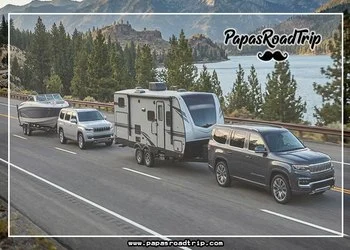
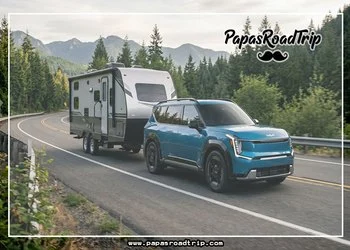
The 2024 kia ev9 towing capacity is 5,000 lbs when the vehicle is fitted with the factory tow hitch. That figure applies to every EV9 trim sold in the US, from the Light RWD to the GT-Line. Without the hitch package, the rating doesn’t apply at all. Kia lists the number in the owner’s manual and on its US spec pages, so check your own window sticker to confirm your car has the package.
What the towing capacity actually means
The EV9 is Kia’s three-row electric SUV, and the 5,000 lb figure is its maximum braked trailer weight. “Braked” is the key word. The trailer needs its own brakes working, and the load needs to sit on a proper hitch. Kia publishes this rating for the US market on the EV9’s spec sheet, and it doesn’t change with trim or battery size.
That last point catches people out. A base Light and a loaded GT-Line carry the same 5,000 lb rating, so paying more buys comfort and features, not towing headroom. Don’t let a dealer’s trim pitch convince you otherwise.
People often assume an electric SUV tows less than a gas one. That’s the misconception. Electric motors make strong torque from a standstill, which actually suits pulling a trailer. The real limits are heat and range, not muscle.
Range is where the EV9 asks for planning. A loaded trailer cuts driving distance noticeably, so map charging stops around the trailer, not the solo range figure. Many charging sites are awkward to enter with a trailer attached.
Towing is for drivers who want to pull a small boat, a camper, or a utility trailer now and then. It isn’t for someone who needs to haul heavy equipment every week. The rating is a ceiling, not a target, and staying under it keeps you inside Kia’s warranty terms.
How to tow with the EV9, step by step
- Confirm your hitch. Check that the car has the factory tow hitch installed. If it doesn’t, the 5,000 lb rating doesn’t apply. Have a Kia dealer or a qualified hitch shop fit one rated for the load.
- Weigh your loaded trailer. Put the trailer on a public scale with everything in it. Stay at or under 5,000 lbs total, including water, fuel and gear. A half-full water tank adds real weight fast.
- Keep the tongue weight in range. Aim for about 10% of the trailer weight on the hitch — roughly 500 lbs at the full 5,000 lbs. Too little makes the trailer sway; too much pushes the rear down.
- Check your payload. Look at the tire placard on the driver’s door jamb. It lists the maximum cargo and passengers for your exact car. Tongue weight counts against that number, not against the 5,000 lbs.
- Set the drive mode. Use the EV9’s towing or eco setting and switch on trailer sway control if your trim has it. Check your manual for the exact menu path, since it differs by trim.
- Plan charging stops. Towing cuts range, and the drop grows with trailer size, speed and hills. Kia doesn’t publish a towing range figure, so test your own route on a short trip first.
- Do a walk-around before you drive. Check the coupler latch, the safety chains crossed under the tongue, the lights and the tire pressures on both car and trailer.
The single judgement call is tongue weight. Get it right and the trailer tracks straight behind you. Get it wrong and you’ll feel sway at highway speed, which is where most towing trouble starts.
2024 Kia EV9 towing capacity at a glance
The numbers below cover the situations most owners run into. Every figure assumes the factory hitch is fitted and the trailer has working brakes.
| Your situation | What to do | Figure that matters | What to watch for |
|---|---|---|---|
| Small utility trailer, empty | Hook up and go | Well under 5,000 lbs | Light trailers bounce; secure the load |
| Single-axle camper | Use sway control | Up to 5,000 lbs loaded | Tongue weight near 500 lbs |
| Boat on a tandem trailer | Check ramp traction | Up to 5,000 lbs with brakes | Wet ramps and regen braking feel odd |
| Trailer over 5,000 lbs | Don’t tow it with the EV9 | Over the rating | Warranty and insurance may not cover you |
| Long highway trip | Plan charger stops | Range drops with load and speed | Headwind and hills cost the most |
| Steep mountain descent | Use low regen carefully | Speed, not weight, is the risk | Trailer brakes must work on their own |
| No factory hitch fitted | Fit one first | Rating doesn’t apply yet | Aftermarket hitches vary in rating |
What experienced towers get right
The detail that separates a calm trip from a white-knuckle one is preparation before the trailer is even attached. Load the heavy items over the trailer’s axle, not at the back. A trailer loaded tail-heavy will sway no matter how good the car is. Keep the weight low and centered.
Then check the car’s own limits, not just the trailer’s. The door-jamb placard is the number people skip. Passengers, dogs, coolers and tongue weight all come out of that payload figure. A family of five plus a full cooler can eat a big chunk of it before the trailer is counted.
If the tongue weight plus your passengers and cargo goes over the door-jamb number, lighten the load; if it fits with room to spare, you’re set.
On the road, experienced towers watch speed more than weight. Wind drag rises quickly as you go faster, and that’s what drains the battery. Sitting at a steady 55 to 60 mph on a highway costs far less range than pushing 70. It’s also calmer behind the wheel.
Finally, know what to leave alone. Don’t tamper with the hitch wiring or add a homemade extension to the receiver. That’s where warranty problems and safety failures come from. Use Kia’s own harness and a hitch rated for the load.
Common EV9 towing problems and fixes
| What you notice | What it usually means | What to do first |
|---|---|---|
| Trailer sways at speed | Too little tongue weight or load too far back | Move weight forward over the axle and re-check |
| Car feels sluggish pulling away | Trailer brakes stuck on or not wired | Test the trailer brakes and check the plug |
| Range drops much faster than expected | Headwind, hills or high speed | Slow to 55–60 mph and plan a closer charger |
| Rear of the car sits low | Too much tongue weight or overloaded cargo area | Weigh the tongue and move gear into the trailer |
| Warning light after hooking up | Trailer light wiring fault | Check every bulb and the ground connection |
Sway that starts only above 60 mph and settles when you slow down is usually loading, not the hitch. Sway that begins at 45 mph means stop and reload before you go further.
A sluggish launch with the trailer brakes cool points to wiring. If a hub is hot to the touch after a short tow, the brake is dragging and the trailer needs service before the next trip.
The EV9’s warning light is often a ground fault, not a dead bulb. Check the ground wire on the trailer frame before you replace anything.
Rear squat with an empty cargo area is tongue weight. Squat that appears only when the third row is full and the trunk is loaded is cargo. Move the gear into the trailer and re-weigh.
Rules and limits to check first
Kia’s rating is the number that governs what you may tow, and it’s printed in your owner’s manual and on Kia’s US EV9 pages. Read the towing section of your own manual before your first trip, because it lists the hitch requirements and the break-in advice for a new car. Kia’s guidance on towing during the first miles matters for the drivetrain.
Your state also sets rules. Many US states require trailer brakes above a certain weight and set speed limits for vehicles towing. Check your state’s department of motor vehicles or transportation website for the exact figures where you live, since they differ from state to state.
The weight that triggers trailer brakes varies a lot by state, so don’t assume the figure from your last state carries over. Look up the rule for the state where the trailer is registered, not just where you drive.
Your insurance is the third check. Call your insurer and confirm the trailer is covered and that towing doesn’t change your policy terms. If a trailer needs a registration or title in your state, sort that out before you drive.
Ask the insurer one direct question: if the trailer damages the car or someone else’s property, is it paid under the EV9’s policy or the trailer’s own? Get the answer in writing before you hitch up.
Keeping your setup working
After each trip, rinse the hitch receiver and the trailer coupler, especially if you drove on salted roads. Salt and grit wear the moving parts and make the coupler stiff. Dry it and put a light coat of grease on the ball.
Check the hitch bolts for tightness before every season, and look at the trailer tires for cracks. Trailer tires age faster than car tires because they often sit in the sun. Replace them when the sidewalls show cracking, not just when the tread looks low.
Store the trailer with the tongue supported and the wheels chocked. Keep your towing paperwork — hitch receipt, trailer registration and insurance — in the glovebox so it’s there when you need it.
Before each new season, re-weigh your typical load, since gear tends to creep up over time. A cooler, a second battery and a few tools are enough to push a light trailer past its rating without anyone noticing.
If the trailer sits outside through winter, pull the wheels once a year and repack the bearings. Grease that never gets warm can dry out and let water in.
Torque the hitch bolts to the figure in the hitch maker’s instructions rather than guessing by feel. Loose bolts wear the holes oval, and then no amount of tightening fixes it.
When the EV9 isn’t the right tow vehicle
If your trailer weighs more than 5,000 lbs loaded, the EV9 is the wrong car — full stop. A larger travel trailer, a car hauler or a horse trailer with two animals will be over the rating. You need a truck or a full-size SUV with a higher rating.
Weigh the trailer loaded, not empty, before you decide. A 4,500-lb dry trailer with water, gear and propane can push past 5,000 lbs, and the EV9’s rating doesn’t care what the brochure said. A public scale at a truck stop settles it for a few dollars.
If you tow long distances every week, the charging stops will wear you down. A diesel or gas tow vehicle refuels in minutes and doesn’t lose range the same way. For daily heavy work, that’s the practical choice.
The exception is the owner who tows a 3,000-lb camper six or eight weekends a season on familiar routes. There the EV9 works, because you charge at the campground or at home between trips.
And if you only tow a tiny trailer a few times a year, paying for the full hitch package may not be worth it. A roof rack or a small rental trailer for those rare trips can cost less overall.
Related guides
Frequently asked questions
How much can a 2024 Kia EV9 tow?
5,000 lbs of braked trailer weight, with the factory hitch fitted. That figure is the same across all US trims. It assumes the trailer has working brakes and the tongue weight stays within the car’s payload limit. Without the hitch package, the rating doesn’t apply.
Can the Kia EV9 tow a camper?
Yes, if the loaded camper stays at or under 5,000 lbs. Many small and mid-size campers fit that range. Weigh the camper fully loaded, with water and gear, before you commit. Larger campers with slide-outs usually go over the limit.
Does towing void the Kia EV9 warranty?
No, towing within Kia’s published limits doesn’t void the warranty. Towing over the rating, or using a hitch not rated for the load, can affect a related warranty claim. Keep your hitch receipt and follow the manual’s towing section.
How far can the EV9 go while towing?
Kia doesn’t publish a towing range figure, so there’s no official number. Expect a clear drop from the normal range, and more drop with a taller, heavier trailer, hills and highway speed. Test a short route first and note your own consumption.
Is it safe to tow with an electric SUV?
Yes, when you stay within the rating and set up the hitch correctly. Electric motors pull smoothly from a stop, which helps on ramps and hills. The risks are the same as any tow vehicle: too much weight, bad tongue weight or faulty trailer brakes.
What happens if I tow more than 5,000 lbs?
You go past Kia’s rating, which can overload the hitch, the brakes and the rear suspension. Handling gets worse and stopping distances grow. It can also affect your insurance cover and related warranty claims. Use a vehicle rated for the load instead.
Do I need trailer brakes on a 2024 EV9 tow setup?
For a trailer near the 5,000 lb limit, yes — the rating itself assumes working trailer brakes. Many US states also require brakes above a set trailer weight. Check your state DMV or transportation website for the exact rule where you live.
Conclusion
Before you head to the dealer, jot down the trailer or boat you plan to pull and its loaded weight, then ask the salesperson to show you the hitch package on the window sticker. That way you’ll leave knowing your EV9 is set up right from day one.