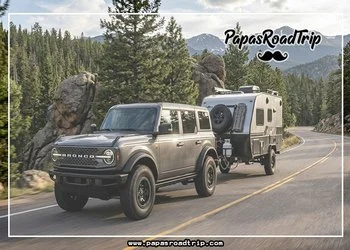
The 2023 Ford Bronco towing capacity tops out at 3,500 pounds. That figure applies to the two-door and four-door Bronco when the truck is built with the 2.7L EcoBoost V6, the trailer tow package, and the right axle ratio. Most other builds are rated lower. This guide breaks down which Bronco gets 3,500 pounds, which ones don’t, and what you need to add before you hook up a trailer.
What the Bronco’s tow rating really means
The Bronco is a body-on-frame off-roader with a removable roof and doors, built for trails first and hauling second. Its tow rating is the maximum weight Ford says the truck can pull safely when it’s built a certain way. That number isn’t fixed for every Bronco. It changes with the engine, the axle, and the package fitted at the factory.
People often assume a big off-roader like this can pull a heavy camper. It can’t. The Bronco is a mid-size SUV, and its rating is closer to a small crossover than a full-size pickup. If you’re planning to tow a large travel trailer, this isn’t the truck for it.
The rating covers the trailer’s loaded weight, not its empty weight. Ford publishes the figure for each build in its 2023 Bronco owner’s manual towing guide. Check your own door-jamb sticker and manual, because the rating depends on how your specific Bronco left the factory.
Two Broncos in the same trim can carry different ratings, so the door-jamb sticker is the only figure that applies to yours. Read it before you shop for a trailer, not after.
The common mistake is buying the camper first and checking the rating second. That order leaves you with a trailer the Bronco can’t pull, and trading either one costs far more than a five-minute check would have.
If your loaded trailer comes in under your sticker’s rating, the Bronco will tow it. If it doesn’t, no weight-distribution hitch or airbag kit raises the number. Those change how the truck feels, not what Ford rated it for.
Weigh the trailer loaded, with water and gear aboard, at a public scale. The brochure weight is a dry figure and will read low.
How to match your Bronco to a trailer
- Find your Bronco’s exact rating. Look at the window sticker or the door-jamb label for engine, axle ratio, and tow package. If those don’t match the 3,500-pound build, your rating is lower.
- Weigh the trailer loaded, not empty. Fill the water tank, load your gear, and weigh it at a public scale. A trailer that’s 3,200 pounds empty can pass 3,500 once it’s packed.
- Add the tongue weight. Tongue weight counts against the Bronco’s payload, not just the tow rating. Keep it around 10% of the trailer weight, so about 350 pounds for a 3,500-pound trailer.
- Check payload on the door sticker. Subtract passengers, cargo, and tongue weight. If the total passes your payload limit, the trailer is too heavy even if it’s under 3,500 pounds.
- Confirm the hitch and wiring. You need a proper hitch receiver and a 4-pin or 7-pin connector. The tow package includes these; a base Bronco may not.
- Add trailer brakes above 1,500 pounds. Many states require brakes on trailers over a certain weight, and Ford recommends them for heavier loads. Check your state’s DMV rules.
- Test the setup on flat ground first. Load the trailer, check the lights, and drive a short loop before any highway trip.
The judgement call that matters most is honest trailer weight. The number on the trailer’s title is empty weight, and it’s almost always lower than what you actually pull. Weigh it loaded, or you’ll be over the limit without knowing it.
2023 Ford Bronco towing capacity by build
The table below shows how the rating changes with the build. The 3,500-pound figure only applies to the top row.
| Your Bronco build | What to use or do | Figure that matters | What to watch for |
|---|---|---|---|
| 2.7L V6, tow package, correct axle | Full 3,500 lb rating | 3,500 lb trailer weight | Confirm the tow package is on the window sticker |
| 2.3L EcoBoost four-cylinder | Lower rating, check your manual | Below 3,500 lb | Don’t assume the V6 figure applies |
| Bronco Raptor | Different rating, check Ford’s spec | Varies by build | Wider body, different suspension |
| Trailer with no brakes | Keep it light | Around 1,500 lb | State law may require brakes above this |
| Tongue weight | Counts against payload | About 10% of trailer weight | Payload limit is on the door sticker |
| Two-door vs four-door | Same top rating on V6 builds | 3,500 lb | Shorter wheelbase feels less stable |
| Bronco Sport (different model) | Not the same truck | Check the Sport’s own manual | Often confused with the full Bronco |
Getting the details right before you tow
The build sheet decides everything. Two Broncos that look identical on the lot can have different ratings, because one has the tow package and the other doesn’t. Before you buy or rent a trailer, read the window sticker and the door-jamb label. Those two labels tell you the engine, the axle ratio, and the payload — the three numbers that set your real limit.
Weight distribution matters more than people expect. Load heavy gear over the trailer’s axle, not at the back. Too much weight at the rear makes the trailer sway, and a short-wheelbase two-door Bronco feels that sway sooner than a longer truck would. Keep the tongue weight near 10% of the trailer weight and the setup stays stable.
Check the lights and the hitch every time. A loose coupler or a dead brake light is a small thing that turns into a big problem on the highway. Walk around the trailer, push down on the coupler latch, and test every light before you pull away.
Leave the engine and drivetrain alone. Towing doesn’t need a tune or a modification. What it needs is the right hitch, working lights, and a trailer that’s honestly under your limit.
Common towing problems and fixes

Here’s what people notice when something’s off, and what to check first.
| What you notice | What it usually means | What to do first |
|---|---|---|
| Trailer sways at speed | Too little tongue weight, or load too far back | Move cargo forward over the axle |
| Bronco feels slow to stop | Trailer has no brakes, or brakes not wired | Check the brake controller and wiring |
| Sagging rear end | Tongue weight too high for the suspension | Weigh the tongue, lighten the front load |
| Lights don’t work | Bad ground or wrong connector | Check the 4-pin or 7-pin plug and ground |
| Overheating on long climbs | Load near the limit on a hot day | Slow down, drop a gear, check coolant |
Sway is the one to take seriously. If moving cargo forward doesn’t settle it, stop and re-weigh the tongue rather than driving slower and hoping.
A Bronco that feels slow to stop usually has a trailer with no brakes, or brakes that aren’t wired to the controller. Test them in a lot before a trip, not on the road.
Lights that flicker or quit are almost always a ground problem, not a bad bulb. Clean the ground on the trailer frame and check the plug pins for corrosion.
On a hot climb with a load near the limit, watch the temperature gauge instead of the speedometer. If it starts climbing, drop a gear and let the engine spin.
Rules and limits you should check
Ford sets the rating, and your state sets the road rules. The Bronco’s 3,500-pound figure comes from Ford’s own towing guide, and it assumes the correct build with the tow package. Your state DMV decides when trailer brakes and extra mirrors are required, and those rules change from state to state. Check your state’s DMV website before you tow anything heavy.
Your insurance company also matters. Some policies ask you to declare towing, and a claim after an overloaded crash can be refused.
If your trailer needs electric brakes, a brake controller install is a wiring job. Get it done by a shop that fits trailer wiring, not by trial and error.
The 3,500 pounds is a ceiling, not a target. Two Broncos with the same engine can carry different ratings depending on how they left the factory. Look at the sticker on the driver’s door jamb, not the brochure.
That sticker also lists your payload. Four adults and gear can eat several hundred pounds before a trailer is hitched. Weigh the truck loaded at a public scale if you plan to tow near the limit.
Tongue weight is the other number people skip. Aim for roughly 10 percent of the trailer’s loaded weight on the hitch. Too little and the trailer sways at highway speed. Too much and the rear axle squats.
If your trailer comes in under about 1,500 pounds loaded, most states won’t ask for brakes. Above that, assume they will.
Keeping your setup safe over time
Recheck your numbers whenever something changes. A new set of passengers, a full water tank, or a different trailer all shift the weight. Weigh the loaded trailer again if you’re close to 3,500 pounds.
Inspect the hitch, the coupler, and the wiring before every trip. Look for cracks, rust, and loose bolts. Test the lights with a helper standing behind the trailer.
Check tire pressure on both the Bronco and the trailer when the tires are cold. Low trailer tires heat up and fail. The pressure figure is on the trailer tire’s sidewall, and it assumes the load the tire is rated for.
Store the trailer with the coupler locked and the tongue supported. A trailer that sits on its jack for months can bend the jack or sink into soft ground.
The Bronco’s own door-jamb sticker gives the tire pressure for the truck, not the trailer, so don’t use it as a shortcut. Set the trailer tires to the sidewall figure and the Bronco’s to the sticker.
Torque the lug nuts on the trailer wheels before the season starts, then again after the first few miles of a loaded trip. Loose trailer wheels are the failure that gives no warning.
If the trailer sits outside, cover the tires. Sun and rain age rubber faster than mileage does, and a cracked sidewall can fail under load even when the tread looks fine.
Keep the weight-distributing setup matched to the trailer you’re pulling that day. Swap trailers and the bars, ball mount, and drop may all need to change with it.
When the Bronco isn’t the right tow truck
The Bronco is the wrong choice if you plan to pull a large travel trailer or a heavy boat. A trailer over 3,500 pounds loaded needs a full-size pickup like an F-150, which is rated much higher. Don’t try to stretch the Bronco’s limit with a weight-distributing hitch; the rating is the rating.
That limit also shrinks once the Bronco is loaded. Every pound of people and cargo inside counts against the gross vehicle weight rating, and tongue weight counts against payload. Four adults and a cooler can put you over on payload before the trailer is anywhere near 3,500 pounds.
Weigh the setup at a public scale loaded the way you actually travel. If the tongue weight plus gear pushes past the door-jamb sticker, you need the truck.
It’s also the wrong choice if you tow every week for work. A truck built for hauling will last longer under constant load and give you more payload for tools and gear.
And it’s the wrong choice if you want a simple setup with no brake controller or wiring work. A lighter trailer under 1,500 pounds keeps things simple, but anything heavier needs the extra equipment.
The two-door Bronco makes this sharper. Its shorter wheelbase and lower rating leave less margin, so a trailer that tows fine behind a four-door may be too much here. Check the sticker on your own door jamb rather than a brochure number.
Related guides
Frequently asked questions
What is the 2023 Ford Bronco towing capacity?
It’s 3,500 pounds, but only on builds with the 2.7L EcoBoost V6, the trailer tow package, and the correct axle ratio. Other builds are rated lower. Check your own window sticker and owner’s manual for the exact figure, because the rating depends on how your Bronco was built.
Can a 2023 Bronco tow a camper?
Yes, if the loaded camper stays under 3,500 pounds and your Bronco has the right build. Most small teardrop and pop-up campers fit. Full-size travel trailers usually don’t. Weigh the camper loaded, with water and gear, before you decide.
How much tongue weight can a Bronco handle?
About 350 pounds on a 3,500-pound trailer, which is roughly 10% of the trailer weight. That tongue weight counts against the Bronco’s payload, not just its tow rating. Check the payload figure on your door-jamb sticker and subtract passengers and cargo first.
Does the Bronco Raptor tow the same as a regular Bronco?
No. The Raptor is a different build with a wider body and different suspension, and its rating is set separately by Ford. Check the Raptor’s own owner’s manual and window sticker. Don’t assume the 3,500-pound figure carries over.
Do I need trailer brakes on a Bronco?
Many states require trailer brakes above a certain trailer weight, often around 1,500 pounds, and Ford recommends them for heavier loads. Check your state DMV rules. If your trailer has electric brakes, you’ll need a brake controller fitted properly.
Is it safe to tow at the full 3,500 pounds?
Yes, if the trailer is loaded correctly, the tongue weight is right, and the brakes work. The rating assumes a properly equipped Bronco and a trailer under the limit. Towing at the limit on steep grades or in heat puts more strain on the truck, so slow down and watch the temperature gauge.
Conclusion
Before you shop, check the Ford trailer tow guide for your exact trim and build, then confirm the rating on the door-jamb label of the specific Bronco you’re considering. Options and axle ratios vary by year and package, so it’s worth verifying rather than assuming.