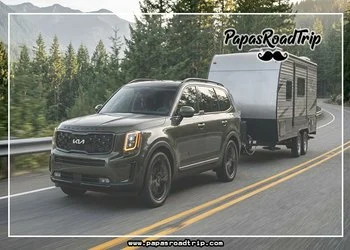
The 2022 Kia Telluride towing capacity is 5,000 pounds when properly equipped with the factory tow hitch and trailer wiring. That figure holds across all four trims — LX, S, EX and SX — and with front- or all-wheel drive. This guide covers the engine and cooling details behind that number, the weight limits to calculate before hitching up, and where the Telluride falls short.
What the 5,000-pound rating really means
The Telluride is a three-row midsize SUV that Kia builds for families. Every 2022 model uses the same 3.8-liter V6 engine, which produces 291 horsepower and 262 lb-ft of torque. Because there’s only one engine and one transmission (an 8-speed automatic), Kia publishes a single tow rating for the whole lineup.
Kia states that rating in the owner’s manual and on the vehicle’s specification page. The rating applies to a trailer with brakes. Kia’s towing section notes that trailers above a certain weight need their own braking system, and the manual gives that threshold.
The misconception people bring here is simple: they think all-wheel drive adds towing power. It doesn’t. AWD helps you launch on a slippery ramp and keeps the vehicle stable on wet roads, but the 5,000 lb ceiling stays the same.
A second misconception is that the rating covers everything you load. It doesn’t. Towing capacity is the trailer’s weight. Everything you put inside the Telluride — passengers, cargo, pets — comes out of a separate number called payload. Mixing those two up is where people get into trouble.
How to check your setup before you tow
- Find your payload sticker. Open the driver’s door and look at the yellow-and-white label on the door jamb. It lists the maximum cargo and occupants your specific Telluride can carry. That number changes with trim and options, so read your own sticker — not a brochure.
- Weigh your passengers and gear. Add up everyone riding in the vehicle plus anything in the cargo area behind the third row. Subtract that total from the payload figure on the sticker. What’s left is the tongue weight you can afford.
- Keep tongue weight near 10% of the trailer’s loaded weight. For a 5,000 lb trailer, that’s about 500 lb on the hitch. Below 10% the trailer can sway; well above it you overload the rear axle.
- Confirm the trailer has brakes. Kia’s manual requires trailer brakes above a certain trailer weight, so check the manual for your model year before you buy or rent. Surge brakes or electric brakes both work; the point is that the trailer stops itself.
- Add a weight-distribution hitch for heavy loads. For heavy loads, a weight-distributing hitch spreads the tongue load across both axles and keeps the rear from squatting.
- Check your mirror and lighting setup. A hitch receiver and 7-pin wiring are available as dealer-installed accessories. Confirm your trailer’s plug matches, and add extended mirrors if the trailer is wider than the Telluride.
- Do a short test pull. Load the trailer, drive 10-15 minutes on a quiet road at moderate speed, then stop and check the hitch, the chains and the tire pressures.
The one judgement call that separates a good tow from a white-knuckle one is tongue weight. Get that close to 10% and the Telluride tracks straight. Get it wrong and no amount of driving skill fixes the sway.
2022 Kia Telluride towing capacity at a glance
These are the numbers you’ll come back to. Each row assumes the factory tow package is fitted and the trailer has working brakes.
| Your situation | What to use | The figure that matters | What to watch for |
|---|---|---|---|
| Standard trailer, brakes fitted | Factory hitch + 7-pin wiring | 5,000 lb max trailer weight | Stay at or under 500 lb tongue weight |
| Trailer without brakes | Not recommended above Kia’s manual limit | Check your owner’s manual for the exact cutoff | Unbraked trailers push you on downhills |
| Two adults, two kids, luggage | Subtract from door-jamb payload | Payload minus people and cargo = tongue allowance | Full cargo area eats your hitch margin |
| Boat on a ramp | AWD helps traction only | Same 5,000 lb ceiling | Ramp grade, not drivetrain, is the real limit |
| Long highway trip, mountains | Weight-distribution hitch | ~10% tongue weight | Engine and transmission heat on long climbs |
| Small utility trailer | Standard ball mount | Well under the 5,000 lb cap | Check ball size matches the coupler |
What experienced towers get right
The detail that catches people is the door-jamb payload sticker. Two Tellurides with the same trim can carry different amounts because of sunroofs, roof rails and optional seats. Reading your own sticker takes ten seconds and settles the question for your vehicle. Brochure numbers are a starting point, not an answer.
Experienced towers load the trailer before they load the SUV. They put heavy items over the trailer’s axles, not at the tail, because weight at the back of a trailer amplifies sway. Then they check tongue weight with a bathroom scale and a lever, or a cheap tongue-weight gauge. That’s a five-minute job that prevents most bad tows.
A trailer that feels light and stable at 40 mph can start swaying at 65 mph. Speed is the variable most people underestimate.
The order of work matters too. Hitch and wiring first, then trailer loading, then tongue weight, then a test pull. Skipping the test pull is the mistake that costs people — a loose coupler latch or a crossed safety chain shows up in the first mile, not on the highway.
What experienced towers leave alone is the drivetrain. They don’t add “towing mode” gadgets or aftermarket chips to raise the rating. The 5,000 lb figure comes from Kia’s engineering, and no bolt-on part changes it legally or safely.
Common towing problems and fixes

| What you notice | What it usually means | What to do first |
|---|---|---|
| Trailer sways at highway speed | Tongue weight too low or load too far back | Move cargo forward over the axles, recheck tongue weight |
| Rear of the Telluride squats low | Tongue weight too high for the rear springs | Add a weight-distribution hitch, shift cargo back slightly |
| Brakes feel weak on a downhill | Trailer brakes not working or not adjusted | Check the 7-pin connection and the trailer brake controller |
| Transmission runs hot on long climbs | Heavy load plus sustained grade | Slow down, use a lower gear, pull over to let it cool |
| Lights on the trailer don’t work | Wiring connection or a blown fuse | Check the 7-pin plug, then the vehicle’s tow fuses |
Sway that starts only above 55 mph and stops when you slow down is usually loading, not the hitch. Sway that appears at 45 mph with a light trailer points to the hitch setup itself.
If moving cargo forward fixes it, keep it there. If it returns with the same load in the same spot, have the weight-distribution hitch re-set before your next trip.
A Telluride that squats with an empty trailer has too much tongue weight for the springs. One that squats only when loaded needs the distribution hitch adjusted, not more cargo moved back.
Weak trailer brakes on a downhill are almost always the controller gain set too low. Test them in a empty lot at low speed before you trust them on a grade.
Hot transmission fluid on a long climb is the one item on this table you shouldn’t push through. Pull over at the first sign of it.
Rules and limits worth checking first
Kia’s owner’s manual is the document that governs what your Telluride may tow, and it’s the one to read before you buy a trailer. It sets the 5,000 lb ceiling, the tongue weight limit, and the trailer weight above which brakes are required. Kia also states that exceeding these limits can lead to warranty claims being denied for damaged parts.
Beyond Kia, your state’s motor vehicle department sets the rules for trailer brakes, lighting and registration. Many states require brakes on trailers above a certain weight, and that threshold differs from state to state. Check your state DMV’s trailer page before you tow across a border.
Your insurance company also matters. Some policies exclude or limit coverage when you tow beyond the manufacturer’s rating. One phone call to your insurer settles that.
If your trailer needs electric brakes wired to a controller, or your setup is near the limit, have a trained hitch shop install and check it. Brake wiring done wrong is a safety problem, not a DIY project.
Keeping the tow setup in good shape
After each trip, rinse the hitch receiver and ball mount to clear road salt and grit, then dry them. A rusty ball wears the coupler faster and makes hitching harder next time. Store the ball mount and pins in a dry box, not loose in the cargo area where they roll around.
Check the trailer tires before every long trip, including the spare. Trailer tires age out even when the tread looks fine, so look at the date code on the sidewall. If the code shows the tire is past its safe service life, replace it regardless of tread depth — that’s the sign, and it’s more reliable than any mileage count.
Inspect the safety chains and the coupler latch each season. Replace any chain with a cracked link. Re-torque the hitch bolts once a year or after any hard knock, using the torque figure in the hitch maker’s instructions.
Keep the Telluride’s own tires in the picture too. The tow rating assumes the Telluride is sitting level and loaded within its limits. If the rear sags or the steering feels light with the trailer hooked up, stop and move weight forward before you drive another mile.
Check the receiver bolts again after the first few tows with a new hitch. They can settle once the load works them.
When the Telluride isn’t the right tow vehicle
The Telluride is the wrong choice if your trailer’s loaded weight creeps past 5,000 lb. Travel trailers with slide-outs, larger boats and car haulers often land there. In that case, step up to a body-on-frame truck or a full-size SUV with a higher rating.
Weigh the trailer loaded, with water and gear aboard, before you sign anything. A dry weight on the sales sheet tells you little about what the hitch actually carries on a Saturday morning.
It’s also the wrong choice for frequent long-distance towing through mountains. The V6 works hard on sustained grades, and a vehicle with a bigger engine and a dedicated tow package will feel calmer. If you tow a few times a year on flat ground, the Telluride is fine.
And it’s the wrong choice if you need to carry six people and tow at the same time. The payload math rarely works. A separate tow vehicle solves that better than any hitch accessory.
Count the people and the cargo you actually load, not the ones in the brochure. Coolers, firewood and a full tank eat into the same number the tongue weight comes out of.
Related guides
- Kia Telluride Fire Recall: Urgent Safety Alert for Owners
- Kia Telluride Years to Avoid: Expert Tips Before You Buy
Frequently asked questions
Can the 2022 Kia Telluride tow 6,000 pounds?
No. The rating is 5,000 lb for every 2022 trim, and no factory or aftermarket option raises it. Towing above that figure puts stress on the frame, brakes and transmission beyond what Kia designed for, and it can affect your warranty. If your trailer weighs more than 5,000 lb loaded, you need a different vehicle.
Does the Telluride need a special tow package?
The 5,000 lb rating is the vehicle’s limit; you do need a properly installed hitch receiver and 7-pin wiring so the trailer’s lights and brakes work. Some 2022 Tellurides came with this from the factory; others need it added. Without proper wiring, your trailer’s lights and brakes won’t work, and that’s a safety and legal problem.
How much tongue weight can a 2022 Telluride handle?
About 500 lb, following the common 10% rule of thumb for a 5,000 lb trailer. Your actual allowance is lower once you subtract passengers and cargo from the payload on your door-jamb sticker. Your actual allowance is lower once you subtract passengers and cargo from the payload on your door-jamb sticker. Weigh your setup rather than guessing, because going over loads the rear axle.
Is it safe to tow with the Telluride’s all-wheel drive?
Yes, and AWD helps on wet ramps and loose surfaces. It doesn’t increase the 5,000 lb rating, though. The rating is the same for front-wheel drive and all-wheel drive models. What keeps you safe is correct tongue weight, working trailer brakes and a speed you can control.
How long does a trailer last behind a Telluride?
The vehicle doesn’t limit trailer life — maintenance does. Trailer tires typically need replacing once they reach the age shown on their date code regardless of tread, and wheel bearings need repacking on the schedule in your trailer’s manual. Check the tire date code and your trailer paperwork before each season rather than counting miles.
What happens if I tow more than 5,000 pounds?
The brakes, transmission and frame carry loads beyond their design, stopping distances grow, and the rear suspension can bottom out. Kia can decline warranty claims on damaged parts. Your insurer may also limit coverage. If your trailer is heavier, use a vehicle rated for it — don’t try to compensate with driving style.
Conclusion
Before you book a trailer rental, check the driver’s door jamb sticker for your Telluride’s specific ratings and confirm the hitch is factory-installed. If you’re still shopping, compare the Telluride against a body-on-frame SUV—you’ll quickly see whether it fits your towing plans.