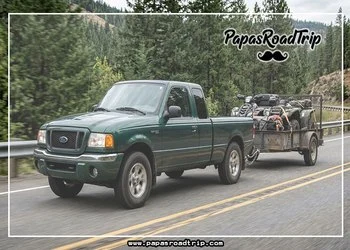
The 2004 Ford Ranger’s towing capacity depends on three things: cab style, engine, and drivetrain. The lowest figure is 2,260 lbs for a 2.3L four-cylinder with a manual gearbox. The top figure is 6,000 lbs, which needs the 4.0L V6, an automatic, 4×2 drive, and the factory tow package. Most trucks on the road today sit between those two ends. This guide shows you which setup you have, what each one pulls, and the limits that matter more than the brochure number.
What the Ranger’s tow rating actually measures
A tow rating isn’t a guess about how strong the frame feels. It’s the maximum weight Ford says the truck can pull when it’s loaded a certain way, with the right equipment fitted. Change one part of that setup — the engine, the gearbox, the axle ratio, or the hitch — and the number changes with it.
The 2004 Ranger was part of that long-running generation, sold as a Regular Cab, an extended “SuperCab,” and a four-door. Ford built it with three engines: a 2.3L four-cylinder, a 3.0L V6, and a 4.0L V6. Buyers picked rear-wheel drive or four-wheel drive, and a manual or automatic transmission. Each combination got its own rating.
The rating covers the trailer, plus everything loaded onto it. It doesn’t cover people or cargo inside the truck — those come out of a separate number called the payload.
The misconception people bring to this truck is simple: they assume every Ranger tows the same. It doesn’t. A four-cylinder work truck and a loaded 4.0L 4×2 can differ by more than 3,000 lbs. Ford printed the exact figure for each build in its own 2004 Ranger towing guide, so you can look up your own combination rather than trust a number from a forum.
How to find your Ranger’s real rating
Work through these in order. Each one narrows the answer, and the last step is the one most owners skip.
- Read the door jamb sticker. It’s on the driver’s side, between the front and rear door. It lists the truck’s original tire size and axle code. Write both down.
- Decode the axle code. The two-digit code on that sticker tells you the axle ratio. Ford’s own towing guide lists what each code means. A taller (numerically lower) ratio like 3.55 tows less than a shorter (numerically higher) 4.10.
- Confirm the engine and transmission. The V6 badge on the fender isn’t proof — check the eighth character of the VIN, or look at the engine cover. A 3.0L and a 4.0L look similar from outside and tow very differently.
- Check for the factory tow package. Look for the trailer wiring harness tucked behind the rear bumper and a transmission cooler in front of the radiator. If neither is there, the truck left the factory without the package.
- Match your build to Ford’s chart. Find your cab, engine, drive, and axle ratio in the guide. That’s your rating — not the highest number in the brochure.
- Subtract your payload. Weigh the truck loaded, with people and gear, at a public scale. Take that weight off the truck’s Gross Vehicle Weight Rating (GVWR) from the door sticker. What’s left is what you can put in the bed and on the hitch.
- Stay under the hitch limit too. The hitch and ball mount carry their own maximum tongue weight. The lower of the two numbers wins.
The judgement call that separates a safe setup from a scary one is tongue weight. Aim for 10% to 15% of the loaded trailer’s weight on the ball. Too little and the trailer wags at highway speed; too much and the rear axle and tires take a beating. Load the trailer, then weigh the tongue — don’t estimate it.
If your trailer needs electric brakes or a weight-distributing hitch, that’s a job for a shop that fits hitches. Wiring and brake controllers are simple, but a bad install can fail on the road.
2004 Ford Ranger towing capacity by setup
These are the ratings Ford published for the 2004 model year. Your truck’s door sticker and Ford’s guide are the final word for your exact build.
| Your setup | What it’s rated for | Figure that matters | What to watch for |
|---|---|---|---|
| 2.3L I4, manual, 4×2, no tow package | Light utility trailers only | 2,260 lbs | Smallest rating of the range; check tongue weight carefully |
| 2.3L I4, automatic, 4×2 | Small boats and utility trailers | Around 3,000 lbs | Automatic helps, but the four-cylinder still limits you |
| 3.0L V6, manual, 4×2 | Mid-size utility and pop-up campers | Around 3,400 lbs | Manual gearbox caps the rating below the automatic |
| 3.0L V6, automatic, 4×2 | Small travel trailers, boats | Around 4,000 lbs | Needs the factory tow package to reach its rating |
| 4.0L V6, automatic, 4×2, tow package | The strongest 2004 Ranger build | 6,000 lbs | Only with the right axle ratio and hitch; verify on the door sticker |
| 4.0L V6, 4×4 | Slightly lower than the 4×2 | Varies by axle and cab | Four-wheel drive adds weight, which cuts the rating |
| Any Ranger with the wrong axle ratio | Lower than the chart above | Check the axle code | The code on the door sticker overrides the badge |
Getting the most from a Ranger tow setup
The owners who tow well with this truck do the boring things first. They weigh the trailer empty, then loaded, and they write both numbers down. They check tire pressure cold, on all four tires plus the trailer’s, before every long trip. And they load the trailer with the heavy items over the axle, not at the tail.
They also work in a fixed order. Hitch and wiring first, then a short test tow on a quiet road at low speed, then a check of the hitch bolts and the trailer lights. Only after that do they load up and head out. Skipping the test tow is where people find out at 60 mph that a light isn’t working.
Partway through any trip, they stop and put a hand on the trailer tires and the truck’s rear tires. A tire that’s much hotter than the others is telling you something — usually pressure or an overloaded axle. They also re-check the hitch ball nut after the first 50 miles of a new install, since new hardware settles.
What they leave alone is the truck itself. Lifting a Ranger, fitting bigger tires, or adding a heavy bumper all change the numbers on the door sticker, and none of them raise the rating. A lifted truck with oversize tires usually tows less safely than a stock one, not more.
One mistake costs people real money: trusting the brochure number without checking the axle code. A buyer picks up a 4.0L Ranger expecting 6,000 lbs and finds a 3.55 axle and no tow package underneath. The real rating can be well under that, and the discovery comes after the trailer is bought.
Ranger towing problems and what to do first

| What you notice | What it usually means | What to do first |
|---|---|---|
| Trailer sways at highway speed | Too little tongue weight, or the load sits too far back | Move cargo forward over the axle and re-weigh the tongue |
| Rear of the truck squats hard | Too much tongue weight or overloaded rear axle | Weigh the setup at a scale; move weight or lighten the load |
| Trailer lights don’t work | Wiring harness not fitted, or a bad ground | Check the factory harness behind the bumper, then the ground wire |
| Transmission runs hot on hills | No auxiliary cooler, or the load is near the limit | Fit a transmission cooler; drop a gear and slow down on climbs |
| Brakes feel weak when stopping | Trailer has no brakes, or they aren’t adjusted | Check whether your trailer weight legally needs brakes in your state |
| Truck feels unstable in wind | Trailer too light on the tongue, or a mismatched hitch height | Set the ball height so the trailer sits level when loaded |
What to confirm before you hook up
No single federal rule sets your Ranger’s rating — Ford does that, and your state sets the rest. Before you tow, look up four things. First, your state’s trailer brake law: many states require brakes on trailers above a certain weight, and that weight differs by state. Check your state DMV or motor vehicle department website for the exact figure.
Second, your driver’s license class. Some states require a special endorsement for heavier trailers, so check your state’s licensing rules. Third, your insurance policy — call and confirm the trailer is covered while attached. Fourth, the hitch’s own sticker, which lists its maximum weight and tongue load.
On the hitch sticker, read the tongue weight limit as carefully as the trailer weight. A hitch rated for a heavy trailer can still be overloaded by too much weight pressing down on the ball. Load the trailer so the tongue carries its share, not more.
The brake law is where most people get caught. A trailer that tows fine in one state can be illegal a few hours down the road, because the weight threshold changes at the line. If you’re crossing state lines, check the law in every state you’ll pass through, not just your own.
If any of these needs a legal answer for your situation, ask your state DMV or a licensed insurance agent rather than a forum.
Keeping the setup sound over time
Once you’ve got the right hitch and a rating you trust, write it down. Keep a note in the glovebox with your truck’s rating, your trailer’s loaded weight, and your tongue weight. That page saves you from re-weighing every season, and it’s what an insurance claim or a buyer will ask for later.
Check the hitch bolts, the ball nut, and the safety chains before each towing season, and again before any long trip. Look for rust at the frame where the hitch mounts — that’s the failure point on an older truck. Replace safety chains that are frayed, and check the trailer’s tires for cracking even if the tread looks fine, since trailer tires age out faster than truck tires.
The sign that something needs attention is simple: any new noise, any change in how the truck sits when loaded, or any wobble that wasn’t there last time. Don’t wait for a schedule — investigate the change.
When a Ranger isn’t the right truck

The 2004 Ranger is a good light-duty tow vehicle, and it’s the wrong choice in a few clear cases. If your loaded trailer comes in above roughly 6,000 lbs, you’re at or past the limit of even the best 2004 build, and you should look at a half-ton truck instead. There’s no safe way to stretch a Ranger past its rating.
If you tow a tall travel trailer with a large frontal area, the Ranger’s lighter weight and shorter wheelbase make it less stable in wind and crosswinds than a full-size truck. A weight-distributing hitch helps, but it doesn’t change the physics.
And if you tow often on steep mountain grades, the 4.0L V6 will work hard and run hot. A truck with a larger engine and a factory transmission cooler is the better tool for that job.
Related guides
- Ford Ranger Tow Package: Ultimate Guide to Maximize Towing Power
- Ford Ranger Years to Avoid: Buyer Beware Guide
- Ford Ranger Transmission Problems: Troubleshoot & Fix
Frequently asked questions
What is the towing capacity of a 2004 Ford Ranger?
It ranges from 2,260 lbs to 6,000 lbs, depending on your build. The 2,260 lbs figure is the 2.3L four-cylinder with a manual. The 6,000 lbs figure needs the 4.0L V6, an automatic, 4×2 drive, and the factory tow package. Check your door sticker and Ford’s towing guide for your exact combination.
Can a 2004 Ranger tow 5,000 lbs?
Only some builds can. You need the 4.0L V6 with an automatic and the factory tow package to reach 5,000 lbs. A 3.0L V6 tops out lower, and a four-cylinder is far below. Confirm your axle code before you hook up a trailer that heavy.
How much can a 4.0L V6 Ranger tow?
Up to 6,000 lbs in its strongest form: automatic, 4×2, correct axle ratio, and the factory tow package. Four-wheel drive and a manual gearbox both lower that figure. The exact number for your truck is on the door jamb sticker and in Ford’s 2004 towing guide.
Does a 2004 Ranger need a special hitch to tow?
Yes — it needs a hitch rated for your trailer’s weight and tongue load, fitted to the frame. Many Rangers left the factory without one. Check the hitch’s own sticker for its maximum, and make sure the ball height keeps the loaded trailer level.
Is it safe to tow at the maximum rating?
It’s safe only when everything else is right: tongue weight at 10% to 15%, tires at the correct cold pressure, working trailer brakes if your state requires them, and a load that stays under the payload limit. The rating assumes a properly equipped truck, not just a strong engine.
What happens if I tow more than the rating?
You overload the frame, brakes, and transmission beyond what they were built for. Stopping distances grow, the truck can sway, and you may be legally liable if a crash follows. Insurance can also decline a claim for towing outside the manufacturer’s limit. Stay under the number on your door sticker.
How often should I check the hitch and trailer before towing?
Before every trip, and again after the first 50 miles of a new hitch install. Check the hitch bolts, ball nut, safety chains, and trailer lights each time. Before each towing season, inspect the frame mounts for rust and the trailer tires for cracking, since age matters as much as tread.
Conclusion
Before your next trip, load the truck the way you’ll actually drive it and swing by a scale to confirm you’re within limits. If the numbers feel tight, you’ll want to sort that out before hitching up, not on the highway.