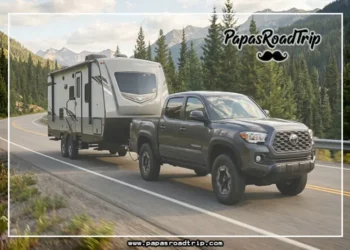
The f250 7.3 towing capacity tops out at 20,000 lbs when the truck is a properly equipped F-250 Super Duty with the 7.3L V8 gas engine and the right axle ratio. That’s the maximum, not the everyday number. Most 7.3L trucks you see on a lot tow somewhere between 12,000 and 18,000 lbs, because cab style, bed length, drivetrain and axle ratio all pull the figure down. The exact rating for your truck is on the Ford towing guide for its model year and on the door jamb sticker.
What that towing capacity number means
The 7.3L V8 is Ford’s gasoline engine for the Super Duty line, sold as the 7.3L Godzilla V8. It’s a big pushrod gas motor, and it sits below the diesel in the lineup. Ford rates each truck for a maximum loaded trailer weight, and that rating changes with the truck’s build.
Towing capacity means the most weight a trailer can add to the truck, including the trailer and everything on it. It isn’t the same as payload, which is the weight the truck itself carries — people, tools, fuel, and the tongue weight of the trailer. Both limits apply at the same time.
The misconception people bring is that every 7.3L truck tows the same. It doesn’t. Two F-250s with the same engine can carry very different ratings depending on how they were ordered. Ford publishes a towing guide for each model year, and that guide is where the real number lives.
The options that move the number most are axle ratio, cab and bed configuration, and whether the truck is two- or four-wheel drive. A regular cab two-wheel-drive truck with the tall highway axle will out-tow a loaded crew cab 4×4 with the same engine.
So the engine badge on the fender tells you almost nothing on its own. Read the door jamb sticker for the truck’s own weight ratings, then match your VIN to the Ford guide for that year.
If you’re shopping, pull the guide before you agree to a price. A truck ordered with the wrong axle can leave you a few thousand pounds short of the trailer you already own, and no tune fixes that.
How to find your F-250 7.3L towing capacity
- Find the model year and body style. Ratings are published per year, so a 2020 truck and a 2023 truck can differ. Check the VIN sticker in the driver’s door jamb for the year and the build details.
- Read the axle ratio code on the door jamb sticker. The ratio changes the rating a lot. A taller (numerically higher) ratio tows more. Ford’s towing guide lists each ratio separately.
- Note the cab and bed. A regular cab with a long bed usually carries a higher rating than a crew cab with a short bed, because the truck itself weighs less.
- Confirm 2WD or 4WD. Four-wheel drive adds weight to the truck, which lowers the trailer rating. The guide gives a separate line for each.
- Open Ford’s towing guide for that model year and match your exact build. That’s the only figure that applies to your truck.
- Check the door jamb sticker for GVWR and payload. The trailer rating assumes the truck isn’t overloaded. If your payload is used up by people and cargo, you can’t tow the full trailer figure.
- Weigh the loaded trailer at a public scale before a long trip. The rating is a limit, not a target, and a scale ticket tells you where you stand.
The judgement call that separates a safe setup from a risky one is matching the hitch and weight-distribution gear to the trailer you actually have, not the one the brochure imagined. A trailer near the top of the rating needs a weight-distributing hitch and sway control. If the trailer is over about half the truck’s rating, set the hitch up properly and check the load on a scale.
F-250 7.3L towing figures by build
The table below shows the pattern Ford’s guides follow. Treat every figure as a range, not a promise — your exact number comes from the guide for your model year and your door jamb sticker.
| Your situation | What to use | Figure that matters | What to watch for |
|---|---|---|---|
| Crew cab, 4WD, short bed, 3.55 axle | Standard hitch, check payload first | Lowest ratings in the 7.3L line | Payload runs out before trailer weight does |
| Regular cab, 2WD, long bed, 4.31 axle | Fifth-wheel or gooseneck hitch | Highest ratings, up to about 20,000 lbs | Needs the right bed clearance and hitch |
| Crew cab, 4WD, 3.73 axle | Weight-distributing hitch | Mid-range, roughly 15,000–18,000 lbs | Tongue weight eats payload fast |
| Any 7.3L with a full load of people and tools | Recheck payload on the door sticker | Payload limit, often the real cap | Trailer rating means nothing if payload is gone |
| Towing a travel trailer with a high profile | Weight-distributing hitch with sway control | Frontal area limit in the Ford guide | Wind load, not just weight, decides comfort |
| Towing near the top of the rating | Scale ticket before every big trip | Actual loaded trailer weight | Brochure figure vs. real weight |
What separates a good 7.3L towing setup from a bad one
The 7.3L gas engine makes its power higher in the rev range than a diesel. That changes how you drive, and it changes what a good setup looks like. A diesel pulls hard from low rpm; the 7.3L wants to rev, so it holds a lower gear on a grade and stays there. Plan for that on long climbs and let the transmission do its job.
Experienced owners set the truck up before they load the trailer. They check tire pressure cold, on all four truck tires and all trailer tires, against the placard in the door jamb. They load heavy items over the trailer axles, not at the ends, so the tongue weight stays in the range the hitch maker specifies. Then they check tongue weight on a scale or with a tongue-weight gauge.
Partway through a trip, the check is simple: look at the truck’s stance. If the rear squats and the front lifts, the weight distribution isn’t set right. Adjust the hitch bars, then recheck. Also watch transmission temperature on long grades — the 7.3L works hard when loaded, and heat is what shortens the life of the fluid.
What experienced towers leave alone is the truck’s software and the factory ratings. They don’t chase a higher number by adding parts. The rating on the door sticker is the legal and safe limit, and no bolt-on part changes it.
Common 7.3L towing problems and fixes

Most complaints about the 7.3L come down to setup, not the engine. The table below matches what you notice to the likely cause and the first thing to check.
| What you notice | What it usually means | What to do first |
|---|---|---|
| Truck squats at the rear when loaded | Weight distribution not set, or too much tongue weight | Recheck tongue weight and adjust the hitch bars |
| Trailer sways at highway speed | Too little tongue weight, or no sway control | Move cargo forward and fit a sway-control hitch |
| Engine revs high and holds a low gear on hills | Normal for a gas V8 — it makes power higher up | Let it rev; check transmission temperature instead |
| Transmission runs hot on long climbs | Load near the limit, or a grade in too high a gear | Slow down, use a lower gear, check fluid condition |
| Braking feels weak with the trailer loaded | Trailer brakes not set up or not working | Test the trailer brake controller before you drive |
Rules and limits you should confirm
Ford publishes the maximum loaded trailer weight for each build in its own towing guide, and that guide is the authority for your truck. The door jamb sticker carries the GVWR and the payload figure, and those are the limits the truck was built to. Your state’s driver licensing rules also matter: some states require a special endorsement or a non-commercial class for heavier trailers. Check your state DMV’s own page for the weight that triggers it.
The guide and the sticker answer different questions, so use both. The guide tells you what a truck like yours can pull; the sticker tells you what your specific truck can carry, and payload is usually what runs out first on a 7.3 truck with a heavy tongue weight.
Before you start, confirm four things:
- The exact towing guide for your model year, from Ford.
- The GVWR and payload on your door jamb sticker.
- The hitch rating stamped on your hitch receiver.
- Your state’s trailer-licensing and brake rules.
The hitch rating is the one people skip. A receiver rated below the truck’s tow rating caps the whole setup, whatever the guide says.
If your trailer or combined weight crosses into commercial territory, or you’re unsure about licensing, ask your state DMV or a licensed dealer — that’s not a do-it-yourself call.
Keeping the setup right over time
Once the hitch is dialed in, write the settings down. Note the hitch bar count, the tongue weight, and the tire pressures you used. That record saves you an hour the next time you hook up, and it tells the next owner what the truck was set up for.
Keep that record in the truck, not in the garage. A note on your phone works, but tape a card inside the trailer tongue or the driver’s door jamb and it’s there when you need it at a scale.
Check the hitch hardware and the trailer tires before every long trip. Look for cracks in the receiver, loose bolts, and tire sidewall damage. Recheck tire pressure cold, since heat from towing raises it and a hot reading misleads you.
Torque the hitch bolts to the manufacturer’s spec rather than by feel, and do it again after the first few hundred miles with a new hitch. Bolts that were snug in the driveway can work loose once the truck has pulled real weight.
Re-weigh the trailer whenever the load changes — a full water tank, a new toy, or a different trip changes the number. The sign that your setup needs attention again is a change in how the truck sits or how the trailer tracks, not a calendar date.
When the 7.3L isn’t the right choice

If you tow heavy every week, a diesel Super Duty is the better tool. The diesel makes its torque low in the rev range, holds speed on grades with less effort, and usually carries a higher rating in the same truck. The 7.3L is the right pick when you tow occasionally and want lower running costs.
The gap matters most on long grades at highway speed. A gas engine downshifts and climbs in the revs; a diesel pulls the same load at lower rpm and holds the gear. If your regular route is flat and short, that difference rarely shows up in your day.
If your trailer is well over the 7.3L’s rating for your build, no hitch or part fixes that. Step up to an F-350 or a dual-rear-wheel truck with the rating you need.
Check the rating for your exact cab, bed and axle before you buy, not the brochure’s best-case number. Two trucks with the same 7.3L can carry different ratings, and the door jamb sticker is what applies to yours.
And if you only tow a light utility trailer a few times a year, a smaller truck does the job for less money. The 7.3L Super Duty is built for real work, and you pay for that capability whether you use it or not.
Related guides
- Toyota Highlander Tow Package: Ultimate Guide to Towing Power
- Honda Passport Tow Package: Ultimate Guide for Powerful Towing
- Jeep Gladiator Max Tow Package: Ultimate Towing Power Unleashed
Frequently asked questions
What is the max towing capacity of a 7.3L F-250?
About 20,000 lbs, and only on a properly equipped truck — regular cab, 2WD, long bed, and the right axle ratio. Most crew cab 4WD 7.3L trucks rate lower, often in the 15,000–18,000 lb range. Check Ford’s towing guide for your model year.
Can a 7.3L gas F-250 tow a fifth-wheel trailer?
Yes, if the truck is rated for it and the pin weight fits your payload. Fifth-wheel and gooseneck ratings appear in Ford’s towing guide for each build. Check the pin weight against your door jamb payload before you commit.
How much can a 7.3L F-250 tow without a weight-distributing hitch?
It depends on the hitch rating and the trailer weight. Many hitches require weight distribution above a set trailer weight, often around 5,000 lbs — check the sticker on your receiver. Above that, fit weight distribution.
Is the 7.3L gas engine good for towing?
Yes, for occasional and moderate towing. It’s a strong, simple V8 with lower running costs than a diesel. It revs higher on grades and won’t match a diesel’s low-rpm pull, so plan for that on long climbs.
What happens if I tow more than my F-250’s rating?
You overload the truck’s brakes, tires, and frame beyond their design limits. Braking distances grow, the truck can sway, and you may be legally liable in a crash. The rating is a hard limit, not a suggestion.
How often should I check my towing setup?
Before every long trip, and any time the load changes. Check tire pressure cold, hitch hardware, and trailer brakes each time. Re-weigh the trailer when you add water, gear, or a different load.
Does 4WD lower the F-250 7.3L towing capacity?
Yes, usually. Four-wheel drive adds weight to the truck, and that lowers the trailer rating compared with the same build in 2WD. Ford’s guide lists a separate figure for each drivetrain.
Conclusion
Before you hook up a trailer, take five minutes to check your own truck’s door jamb sticker and owner’s manual—that’s the only rating that truly counts for your setup. If the numbers feel confusing, ask a Ford dealer or a seasoned towing shop to walk you through them.