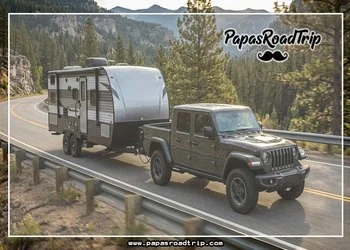
The 2021 Jeep Gladiator can tow between 4,000 and 7,650 pounds depending on how it’s configured, with payload ratings spanning roughly 1,105 to 1,700 pounds. Most buyers land in the 6,000–7,650 pound range with the Max Tow package, but the Sport S with the automatic and the right axle ratio is the configuration that unlocks the highest figure in the lineup.
Key Takeaways
- The maximum 2021 Gladiator tow rating is 7,650 pounds, and it requires the Max Tow Package on a Sport or Sport S with the 3.6L V6, automatic transmission, and 4.10 axle ratio.
- The base Sport with a manual transmission and 3.73 gears tows only 4,000 pounds — a spread of more than 3,600 pounds across the same model year.
- The Rubicon tops out at 7,000 pounds, not because it’s weaker but because its off-road suspension, 33-inch tires, and 4:1 transfer case are rated for less trailer weight.
- Payload is the number that actually limits most real-world setups: it ranges from about 1,105 to 1,700 pounds and includes passengers, cargo, and tongue weight.
- The diesel 3.0L EcoDiesel tows 6,500 pounds in most trims — less than the V6, despite its extra torque.
- Tongue weight should land at 10–15 percent of loaded trailer weight, and that figure counts against your payload, not your tow rating.
The 2021 Gladiator Towing Capacity by Trim
The Gladiator’s tow rating isn’t set by trim alone. It’s a product of four variables: engine, transmission, axle ratio, and package content. Two Gladiators that look identical on the lot can be 3,000 pounds apart in rating. Here is how the 2021 lineup breaks down.
| Trim / Configuration | Engine | Max Tow Rating | Typical Payload |
|---|---|---|---|
| Sport (manual, 3.73 axle) | 3.6L V6 | 4,000 lbs | ~1,600 lbs |
| Sport / Sport S (auto, 3.73 axle) | 3.6L V6 | 4,500 lbs | ~1,600 lbs |
| Sport S with Max Tow Package | 3.6L V6 | 7,650 lbs | ~1,535 lbs |
| Overland | 3.6L V6 | 6,000 lbs | ~1,140 lbs |
| Mojave | 3.6L V6 | 6,000 lbs | ~1,200 lbs |
| Rubicon | 3.6L V6 | 7,000 lbs | ~1,200 lbs |
| Sport / Overland / Rubicon | 3.0L EcoDiesel | 6,500 lbs | ~1,105–1,200 lbs |
A few things jump out from that table. The Max Tow Package is the single biggest lever — it nearly doubles the base Sport’s rating. It bundles a 4.10 axle ratio, a heavy-duty cooling system, a Class IV receiver hitch, a 240-amp alternator, and trailer sway control tuning. Without it, the automatic V6 Sport is stuck at 4,500 pounds.
The Overland and Mojave sit at 6,000 pounds because their comfort-oriented and desert-running suspensions aren’t rated for more. The Rubicon’s 7,000-pound figure reflects its rock-crawling hardware: the 4:1 transfer case and softer off-road springs limit how much trailer weight Jeep is willing to certify.
Pro Tip: Never trust the window sticker alone. The driver’s-side door jamb carries a yellow placard listing the exact payload and gross vehicle weight rating for that specific truck as built. That placard is the legal number, and it can differ from brochure figures by a few hundred pounds once options are added.
Why the Same Truck Has Four Different Ratings
Buyers often ask why a Gladiator Rubicon with the same engine as a Sport S can’t match its 7,650-pound figure. The answer is that tow ratings are limited by the weakest link in a chain of physical constraints, and each trim changes which link is weakest.
Cooling capacity
Towing generates heat — in the transmission, the engine coolant, and the oil. The Max Tow Package’s upgraded cooling stack is what allows the higher rating. A Gladiator without it’s thermally limited, not structurally limited.
Axle ratio and driveline stress
A 4.10 axle ratio multiplies torque to the wheels more than a 3.73, which means less strain on the transmission when pulling a load. It also changes the final drive stress calculations that engineers use to certify a rating.
Suspension and tire rating
The Rubicon’s softer springs and 33-inch Falken or BFGoodrich tires are optimized for articulation and off-road traction, not for resisting trailer-induced sway. Taller sidewalls flex more under tongue weight. Jeep certifies accordingly.
Gross Combined Weight Rating
Every configuration has a GCWR — the maximum combined weight of the truck, everything in it, and the trailer. The tow rating is simply GCWR minus the truck’s own curb weight. Heavier trims (Rubicon, Mojave) have more curb weight, so even with the same GCWR they can tow less.
How to Read Your Own Door Jamb Sticker
Before you hook up anything, do this five-minute exercise. It’s the only way to know what your specific truck can legally and safely pull.
- Find the yellow placard on the driver’s door jamb. It lists GVWR (gross vehicle weight rating) and “The combined weight of occupants and cargo should never exceed X.”
- Subtract your real payload. Weigh yourself, your passengers, and everything you’ll carry — gear, tools, a cooler, a bed rack. Subtract that total from the payload figure on the placard.
- Subtract the tongue weight of the trailer you intend to pull (typically 10–15 percent of loaded trailer weight). What remains is your margin.
- Check the receiver hitch label for the hitch’s own rating — a Class IV hitch is typically rated to 10,000 pounds gross trailer weight with weight distribution, but confirm on the label.
- Cross-check against the owner’s manual chart for your exact engine, transmission, and axle ratio.
If step 3 leaves you with a negative number, you’re over payload even if you’re under the advertised tow rating. This is the most common mistake Gladiator owners make.
Warning: A weight-distribution hitch is required above certain trailer weights (typically 5,000 pounds gross trailer weight on most Gladiator configurations) and is strongly recommended for anything over 3,500 pounds. Towing a 6,000-pound trailer on a bare ball mount will squat the rear suspension and unload the front tires, which degrades steering and braking.
Payload: The Number That Actually Bites

The Gladiator’s payload ratings range from about 1,105 pounds (diesel Overland) to roughly 1,700 pounds (base Sport with manual). That sounds generous until you do the math on a family camping trip.
Take a Rubicon with 1,200 pounds of payload. Add two adults (350 lbs), two kids (150 lbs), a bed full of camping gear and firewood (300 lbs), and a 6,000-pound trailer at 12 percent tongue weight (720 lbs). Total: 1,520 pounds. You are 320 pounds over payload before you’ve hooked up a single bike rack.
This is why payload matters more than tow rating for most Gladiator buyers. The truck can physically pull more than it can legally carry, and the carrying limit arrives first.
Where the weight hides
- Tongue weight — 10–15 percent of trailer weight, counted against payload
- Aftermarket bumpers and winches — a steel front bumper plus a winch can add 150–200 pounds
- Larger tires and lift kits — unsprung and sprung weight that eats into the margin
- Bed racks, rooftop tents, and drawers — 100–400 pounds depending on the build
- Passengers and pets — easy to underestimate
If you plan to modify the truck, weigh it at a CAT scale before you buy a trailer. A $15 scale ticket tells you more than any brochure.
Diesel vs. Gas: The Counterintuitive Answer
The 3.0L EcoDiesel makes 442 lb-ft of torque — substantially more than the V6’s 260 lb-ft — and yet it tows less in most configurations: 6,500 pounds versus up to 7,650.
The reason is weight and cooling. The diesel engine and its emissions hardware add roughly 400 pounds to the front end, which reduces payload and eats into GCWR margin. The diesel also has different cooling and transmission calibration limits. Torque helps with acceleration and grade-climbing feel, but it doesn’t raise the certified rating.
For a buyer who tows 4,000–5,500 pounds a few times a year and wants better fuel economy and low-end grunt, the diesel is a fine choice. For someone towing near the limit, the V6 with Max Tow is the higher-capacity option.
Matching a Trailer to Your Gladiator
Use this table to sanity-check common trailer types against the lineup. Loaded weights are typical ranges, not guarantees — always weigh your own setup.
| Trailer Type | Typical Loaded Weight | Minimum Gladiator Config |
|---|---|---|
| Small utility / kayak trailer | 1,000–2,000 lbs | Any trim, any transmission |
| Single-axle camper (teardrop, pop-up) | 2,000–3,500 lbs | Any V6 trim |
| Travel trailer, 16–19 ft | 3,500–5,000 lbs | Sport auto or better; WDH recommended |
| Travel trailer, 20–22 ft | 5,000–6,500 lbs | Max Tow, Rubicon, or diesel; WDH required |
| Car hauler with a compact car | 5,000–6,500 lbs | Max Tow or Rubicon; WDH required |
| Boat, 18–21 ft on trailer | 3,500–5,500 lbs | Sport auto or better |
| Large travel trailer (24 ft+) | 7,000+ lbs | At or beyond the lineup’s limit — reconsider |
The pattern is clear: the Gladiator is a capable mid-size tow rig up to about 6,000 pounds, and a marginal one above that. A 22-foot travel trailer at 6,500 pounds loaded is realistically at the edge of what most configurations can handle once payload is accounted for.
Pro Tip: When shopping for a travel trailer, ignore the “dry weight” in the brochure. Use the trailer’s GVWR (on its own placard) as your planning number, because that’s what it will weigh loaded with water, propane, batteries, and gear.
Real-World Towing Behavior
Owners consistently report that the Gladiator feels stable and planted with trailers in the 4,000–5,500 pound range, particularly with a weight-distribution and sway-control setup. The 3.6L V6 revs high and makes its power late, so expect the eight-speed automatic to hold gears and run 2,500–3,500 rpm on grades. Fuel economy while towing typically drops into the 10–13 mpg range, which matters on long trips given the truck’s 22-gallon tank.
Above 6,000 pounds, the experience becomes more demanding: longer braking distances, more sensitivity to crosswinds, and a noticeable drop in acceleration on inclines. The truck will do it, but it’s working.
The Gladiator’s 5-foot bed also limits what you can carry alongside a trailer — a fifth-wheel or gooseneck setup isn’t possible, and bed space for gear competes with the hitch and trailer wiring.
Common Mistakes and How to Avoid Them

Mistake 1: Trusting the brochure instead of the door jamb. Brochure figures assume a stripped base model. Your truck has options, and options add weight.
Mistake 2: Confusing tow rating with payload. The two limits are independent, and you must satisfy both. Payload usually runs out first.
Mistake 3: Skipping the weight-distribution hitch. Above 5,000 pounds, a WDH isn’t optional in practice. It transfers weight to the front axle and the trailer axle, restoring steering control and leveling the truck.
Mistake 4: Forgetting trailer brakes. Most states require trailer brakes above 3,000 pounds gross trailer weight; check your state’s motor vehicle code. The Gladiator’s integrated trailer brake controller (available on some trims, aftermarket on others) is worth the investment.
Mistake 5: Not weighing the setup. Load the truck and trailer as you would for a trip, then hit a CAT scale. You’ll get steer axle, drive axle, and trailer axle weights for about $15. Compare them to the ratings. This is the single most useful thing you can do.
Mistake 6: Oversized tires without regearing. Going to 35-inch tires without changing axle gears effectively lowers your final drive ratio, which increases driveline stress and can push you outside the certified configuration. If you lift and re-tire, understand that you may be towing outside the factory rating.
Related guides
- Jeep Gladiator Max Tow Package: Ultimate Towing Power Unleashed
- Jeep Gladiator Years to Avoid: Expert Tips for Buyers
- Jeep Gladiator 3Rd Brake Light Not Working: Quick Fix Guide
Frequently Asked Questions
What is the maximum towing capacity of a 2021 Jeep Gladiator?
The maximum is 7,650 pounds, achieved only on a Sport or Sport S with the 3.6L V6, automatic transmission, 4.10 axle ratio, and the Max Tow Package. Any other configuration is rated lower, sometimes by more than 3,000 pounds. Check your door jamb placard and owner’s manual for your specific build.
Can a Gladiator Rubicon tow 7,650 pounds?
No. The Rubicon is rated at 7,000 pounds with the V6, despite sharing the engine with higher-rated trims. Its off-road suspension, 33-inch tires, and 4:1 transfer case reduce the certified rating. It’s a capability trade-off, not a defect — the Rubicon is built to crawl, not to haul at the limit.
Does the diesel Gladiator tow more than the gas V6?
No. The 3.0L EcoDiesel is rated at 6,500 pounds in most trims, below the V6’s maximum of 7,650. The diesel’s extra torque improves the towing experience but its added weight and cooling limits reduce the certified figure. It’s the better choice for fuel economy and low-end pull, not for maximum trailer weight.
How much tongue weight can a Gladiator handle?
Tongue weight should be 10–15 percent of loaded trailer weight, and it counts against payload, not the tow rating. A 6,000-pound trailer needs 600–900 pounds of tongue weight, which consumes most of a Rubicon’s 1,200-pound payload before passengers and cargo. Weigh your setup to confirm.
Do I need a weight-distribution hitch?
Above roughly 5,000 pounds gross trailer weight, yes — most Gladiator configurations require or strongly recommend one. It restores front-axle weight, levels the truck, and reduces sway. Below that, a standard ball mount is usually fine, but check your owner’s manual for the specific threshold.
Can I tow with a manual-transmission Gladiator?
Yes, but the rating drops. The manual-transmission Sport is rated at 4,000 pounds with the 3.73 axle. The clutch and gearbox are the limiting factors. If towing is a priority, the eight-speed automatic is the better choice and unlocks the higher ratings.
Where to Verify Your Specific Numbers
The authoritative source for your truck’s rating is the owner’s manual towing chart for your model year, combined with the door jamb placard. Jeep publishes a towing guide each model year that lists every configuration; your dealer’s service department can print the chart for your VIN. For trailer and hitch specifications, the receiver label and the trailer manufacturer’s placard are the numbers that matter. For state-specific trailer brake and weight requirements, your state’s motor vehicle agency publishes the rules.
Before your next tow, load the truck and trailer as you would for the trip, spend fifteen minutes at a CAT scale, and compare every axle weight to its rating. That single habit prevents the most common — and most dangerous — towing mistakes, and it tells you more about your Gladiator’s real limits than any spec sheet ever will.